5 June 2026 · Twitter Ban Service · ~12 min read
Twitter mass report vs the right report tool, by violation
There is no single "Twitter mass report" button or magic report tool that bans an account on its own — X routes every violation to a different report path and weighs evidence, not volume. This guide matches each harm — scams, stolen art, doxxing, death threats, deepfakes, impersonation — to the right X report tool, the policy behind it, and the point where it leaves X for the law.
Is there one Twitter report tool, or a different route for each violation?
There isn't one tool — there's a set of them, and picking the wrong one is why most reports stall. People search for a "twitter mass report" service or a "twitter report tool for spam" hoping for a single lever, but X deliberately splits reporting across the in-app ••• menu and a handful of standalone web forms, each tied to a specific policy. Volume is a myth worth killing first: X logged more than 224 million user reports in the first half of 2024, per its Global Transparency Report, and triages them by rule-match rather than headcount — which is exactly why a coordinated bulk-reporting campaign doesn't speed anything up. The table below is the map; the sections after it go deeper, harm by harm. For the mechanics of report types and limits, our guide to reporting an X account covers the plumbing.
| The harm | X policy it breaks | Who can submit it | What X can realistically do |
|---|---|---|---|
| Scam / crypto fraud | Platform manipulation & spam | Anyone | Suspend; won't recover money |
| Stolen art / copyright | Copyright (DMCA) | Rights-holder or agent | Remove the post; repeat strikes |
| Harassment / pile-on | Abusive behaviour | Target or bystander | Warn, limit, or suspend |
| Death / violent threats | Violent speech | Anyone | Remove; suspend; police matter |
| Doxxing | Private information | Owner, or anyone if abusive | Force removal; lock; suspend |
| Deepfake (intimate) | Non-consensual nudity | Depicted person | Remove fast; permanent ban |
| Impersonation | Authenticity / impersonation | Impersonated party | Label or remove the account |
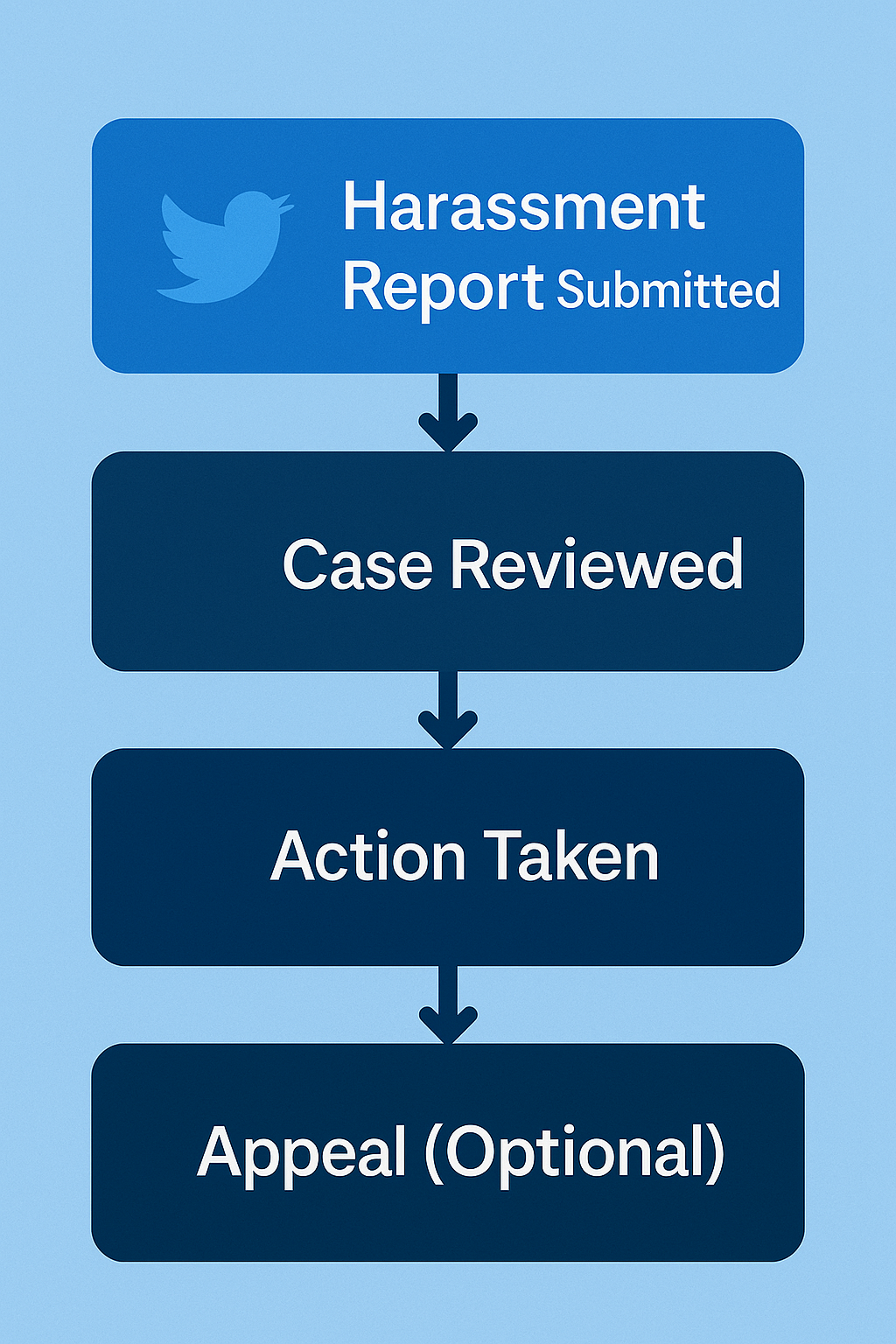
How do I report a scammer or report a Twitter scam?
To report a scammer on Twitter, open the offending profile or post, choose ••• → Report, and pick the scam or fraud option, which maps to X's platform manipulation and spam policy — the rule against deception aimed at taking money, property, or login data. The 2026 patterns are pig-butchering "investment mentors," fake airdrops and token presales, cloned support handles, and "recovery agents" who target people already scammed once. Give the reviewer the full shape: the handle, the thread or DMs, and any wallet or payment address. One rule overrides everything — X will never DM you to restore access or ask for a fee, so that message is the scam. Crucially, reporting a Twitter scam helps get the account actioned but never claws money back. If you've paid, treat it as fraud in parallel: tell your bank at once and file with a fraud body such as the FBI's IC3 or your national cyber-crime unit. For the exact form to use per case, see our map of every official X report form.
How do you report stolen art, art theft, or copyright infringement on Twitter?
If someone has reposted your work, the strongest move is rarely the in-app button — it's a copyright claim. To report art theft on Twitter, or how to report someone on Twitter for stealing art, you file a formal notice through X's copyright (DMCA) policy, which covers your art used as a profile or header image, uploaded into a post, or linked from one. Clear up the myth first: credit is not permission. A reposter tagging your handle has still copied your work without a licence, and "but I credited the artist" is not a legal defence — though genuine fair use or commentary sometimes is. To report copyright infringement on Twitter that sticks, attach proof you're the creator (the source files, earlier-dated posts, your portfolio) and links to both the original and the theft. Two honest cautions: a DMCA notice forwards your name and address to the infringer under 17 U.S.C. §512, and a knowingly false claim creates liability — so it's the wrong tool for an unflattering photo or a grudge. Why lead with copyright for stolen art? A 2024 academic audit of platform takedowns found copyright reports were honoured far faster and more consistently than several other report types. The full filing walkthrough lives in our DMCA and post-report guide.
How do you report harassment to get an account banned?
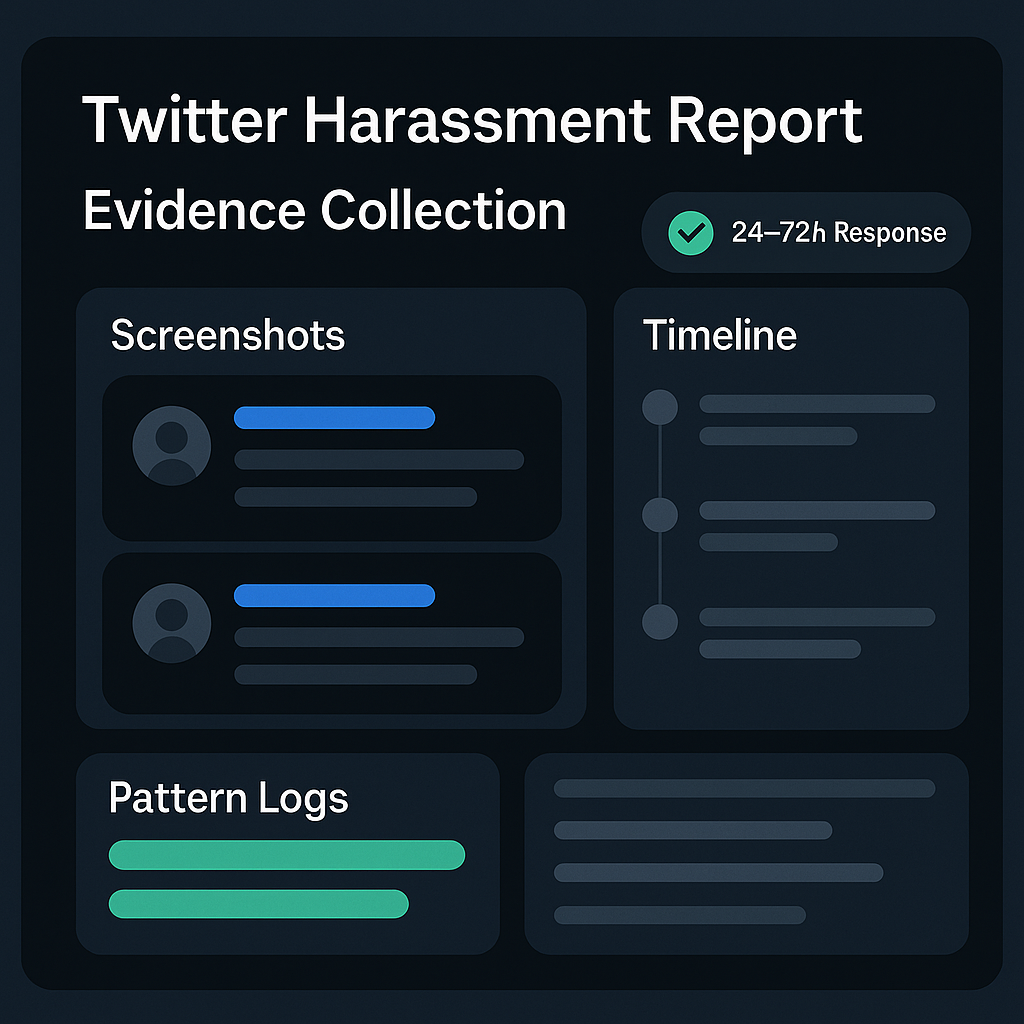
There's no separate "ban this person" tool — to report someone on Twitter to get a harassment account banned, you use ••• → Report → "It's abusive or harmful," which routes the case under X's abusive behaviour policy. Follow-up questions sort it into targeted harassment, hateful conduct, or a coordinated pile-on. The honest framing: a report doesn't ban anyone — it asks X to review, and X alone decides whether to warn, limit reach, or suspend, usually escalating for severe or repeated breaches. What tips a borderline case is documentation. Before you file, capture the campaign: permalinks, dated screenshots, and every handle involved, because harassers prune timelines the moment they sense a report. If several accounts are hitting one target in lockstep, say so and link the examples — a coordinated effort weighs more heavily than scattered replies. Keep that file after submitting; if it escalates, police or a lawyer will ask for it first. When a clear breach keeps slipping through review, that's when handing it to a service that knows how to get a rule-breaker actioned earns its place.
How do you report death threats and violent threats on Twitter?
Death threats sit under their own rule, not generic harassment. X's violent speech policy — relaunched as "zero tolerance" in 2023 — prohibits threats to kill, torture, or sexually assault, plus wishing or hoping for harm, glorifying violence, and incitement. Report it through ••• → Report and the violent-threat sub-category; a clear, credible threat should draw removal and often read-only mode or suspension. But treat a death threat as two problems at once. The platform report addresses the post; your safety is the bigger issue. If a threat is specific or you feel in danger, contact the police — 911 in the US, 999 in the UK — before or alongside the X report, and do not delete the evidence or reply to bait. Preserve full screenshots, the handle, the post URL, and timestamps; that record is what an officer or the FBI's IC3 will need. The next section covers exactly when a Twitter case belongs with law enforcement rather than a moderator.
How do you report doxxing on Twitter?
Posting someone's private details — home address, phone number, identity documents — falls under X's private information and doxxing policy, and X treats "live" same-day location or contact info as the highest-risk category. There are two routes to report doxxing on Twitter. When the post is clearly abusive, anyone can flag it through the in-app report flow; when it's more ambiguous, X usually needs to hear from the person whose information was exposed (or an authorised representative) via the dedicated private-information form. Enforcement bites: on a first violation X forces removal and temporarily locks the account; a repeat means permanent suspension. The scale is real — X removed 34,497 pieces of content for personal-privacy violations in the first half of 2024. Move fast, because doxxing tends to travel; screenshot the post and any reposts before they spread, and if the information has already escaped X, our post-removal routes cover chasing it down and de-indexing it elsewhere.
How do you report a deepfake on Twitter?
"Deepfake" splits into two very different reports. A fabricated intimate image — the most common and most damaging — is non-consensual content, and X's non-consensual nudity policy treats AI-generated sexual imagery of a real person as a zero-tolerance violation. Report it through the in-app flow as a depicted person, and you now have a legal backstop: the federal TAKE IT DOWN Act, signed in May 2025, requires platforms to remove reported NCII — including AI deepfakes — within 48 hours of a valid request. A misleading deepfake, by contrast — a faked video of a public figure — goes under X's synthetic and manipulated media (authenticity) policy, and the bar is higher: X only acts on manipulated media "likely to cause harm," and often labels rather than removes it. Be aware that X retired its general "misleading information" report option in 2023 and now leans on Community Notes, so for ordinary misinformation there's frequently no report button at all — only the manipulated-media and NCII routes remain live.
How do you report someone on Twitter for impersonation or ban evasion?
These are both "identity" violations with their own quirks. To report someone on Twitter for impersonation, use the standalone impersonation form — no X account required, which helps when a brand that isn't even on the platform gets cloned — and attach proof you're the real party. Since X's April 2025 parody rules, a real parody or fan account must put the label word at the start of the display name and in the bio and must not reuse your exact avatar; a clone that skips those is reportable, not satire. Ban evasion is different: when a suspended user returns on a fresh handle, report it as ban evasion, but know X detects it mainly through device fingerprinting that survives a new email and a VPN, and it suspends linked accounts regardless of when they were created. For the full copycat walkthrough see our impersonation-report guide; if the fake is squatting a name you own, that's the separate path to claim an inactive username.
How do you report defamation on Twitter?
Defamation is the case where the report button usually fails you. A false statement of fact that harms your reputation is a legal claim, not a clear breach of the X Rules, so X generally won't remove a tweet for defamation on its own say-so — it typically wants a court order before acting. That means how to report defamation on Twitter is really a legal question: document the posts, send a preservation request, and have a lawyer issue a takedown demand or pursue a court order, after which X will act. The in-app report still matters if the same content also breaks a rule — harassment, a privacy violation, impersonation — so file on that ground too. For the legal removal routes, the defamation playbook, and getting the content out of Google's index, see our tweet-removal service guide, which goes deep on exactly this.
When should you report a Twitter account to the police or the FBI?
When behaviour crosses from rule-breaking into crime, X stops being the right venue. Credible threats, stalking, sextortion, and non-consensual intimate images are criminal in most places, and how to report a Twitter account to the police starts with your local force: 911 or 999 for anything urgent, and a non-emergency line (101 in the UK) or online tool otherwise. For a cyber-enabled crime in the US — fraud, extortion, organised scams — how to report a Twitter account to the FBI runs through the Internet Crime Complaint Center (IC3) at ic3.gov, and you may file on behalf of someone else. Set expectations honestly: IC3 is an intake-and-referral desk that routes complaints to FBI field offices and partners — it doesn't investigate every report or guarantee action, so your own evidence carries the case. For an immediate threat to life, use 911 or tips.fbi.gov. One practical reason the police report matters: X discloses account data only under valid legal process, per its law-enforcement guidelines — so a criminal case is often the only way to unmask an anonymous attacker.
Can you use a Twitter report tool against a competitor?
This is the request we turn down. Searches for a "twitter reporting tool for competitors" want to weaponise reporting against a rival, and it doesn't work — it backfires. Filing reports against accounts that haven't broken a rule, or organising others to pile on, breaches X's Misuse of Reporting Features rules, and because X triages by rule-match rather than volume, false flags simply get discounted. Worse, the system can flag the reporter: coordinated false reporting is itself an actionable abuse of the platform, and knowingly false legal notices (a bogus DMCA, say) carry real liability. There's no safe "report bot" shortcut here either — the free ones are largely credential-stealers or no-ops. The only durable approach is the one this whole guide describes: report genuine violations with real evidence. That's also the line we hold — see the violation types we take on — and it's why honest, evidence-led cases are the ones that actually stand up to review.
Reporting well comes down to matching the harm to the right policy and bringing evidence a reviewer can act on — and for most cases you won't need a service to do it. Where one helps is the stubborn case: a scam that keeps relaunching under new handles, a ring of impersonators, stolen art a reposter keeps re-uploading, or a valid report X wrongly closed. That's the narrow job of our independent X reporting service — we screen every case for a genuine breach, file through X's own channels, and never touch a legitimate account. If that's where you are, send us the handle and the rule it breaks.
Sources
- X Global Transparency Report — rules-enforcement and report volumes
- X Help Center — platform manipulation and spam policy
- X Help Center — copyright (DMCA) policy
- U.S. Copyright Office — DMCA §512 (notice, counter-notice, perjury)
- arXiv (2024) — audit study of NCII and copyright takedown response times
- X Help Center — abusive behaviour policy
- X Help Center — violent speech policy
- X Help Center — private information and doxxing policy
- X — report content that violates your privacy (form)
- X Help Center — non-consensual nudity policy
- U.S. Congress — TAKE IT DOWN Act (S.146, 2025)
- X Help Center — synthetic and manipulated media (authenticity) policy
- X — report impersonation (form, no account required)
- FBI Internet Crime Complaint Center (IC3)
- X Help Center — guidelines for law enforcement
FAQ
How many reports does it take to get a Twitter account banned?
No fixed number. X triages by whether the content matches a rule, not by how many people flagged it — it logged 224 million-plus user reports in the first half of 2024 alone and weighs evidence over headcount. One precise, well-evidenced report on a real violation outperforms hundreds of copy-paste duplicates, which can breach the Misuse of Reporting Features policy.
Can you report a Twitter account anonymously?
An in-app report is effectively anonymous — your handle is never shown to the account you flagged. The exception is a DMCA copyright notice and some legal filings, which name you to the other party and can appear in public databases. So reporting a scam or harassment is private; filing copyright over stolen art is not.
Is there a mass report tool or bot that actually bans accounts?
No legitimate one exists. Paid "mass report" panels and free "report bots" either do nothing or automate flags in a way X's misuse rules treat as abuse — which can get your own account actioned. Coordinated reporting does not move X faster, because review is rule-led, not volume-led.
How do I report a scammer on Twitter if I've already lost money?
Report the account to X under the scam or fraud option to get it actioned, but understand that won't recover funds. In parallel, alert your bank or card issuer immediately and file with a fraud body — the FBI's IC3 (ic3.gov) in the US, or your national cyber-crime unit. Preserve the handle, posts, DMs and any wallet or payment details first.
What's the fastest way to get stolen art removed from Twitter?
For your own copyrighted artwork, a DMCA copyright notice is usually the most reliable lever, because it triggers a legal process X must act on rather than a discretionary review. A 2024 academic audit found copyright reports were honoured far faster and more consistently than several other report types. Keep proof you are the creator.
Can I report a Twitter account to the FBI?
For a cyber-enabled crime — fraud, extortion, credible threats — you can file with the FBI's Internet Crime Complaint Center at ic3.gov, and you may file on behalf of someone else. IC3 is an intake-and-referral desk: it routes complaints to field offices but does not investigate every case or guarantee action. For an immediate threat to life, call 911 or use tips.fbi.gov.