8 June 2026 · Twitter Ban Service · ~11 min read
How to report Twitter brigading, job scam rings and coordinated abuse on X
To report Twitter brigading, open each post in the pile-on, choose ••• → Report → "They're being abusive or harmful," and flag several posts so X sees the coordinated pattern. To report a Twitter job scam, report the account as suspicious or spam under X's financial-scam policy — then tell your bank and a fraud body, because a report never claws money back.
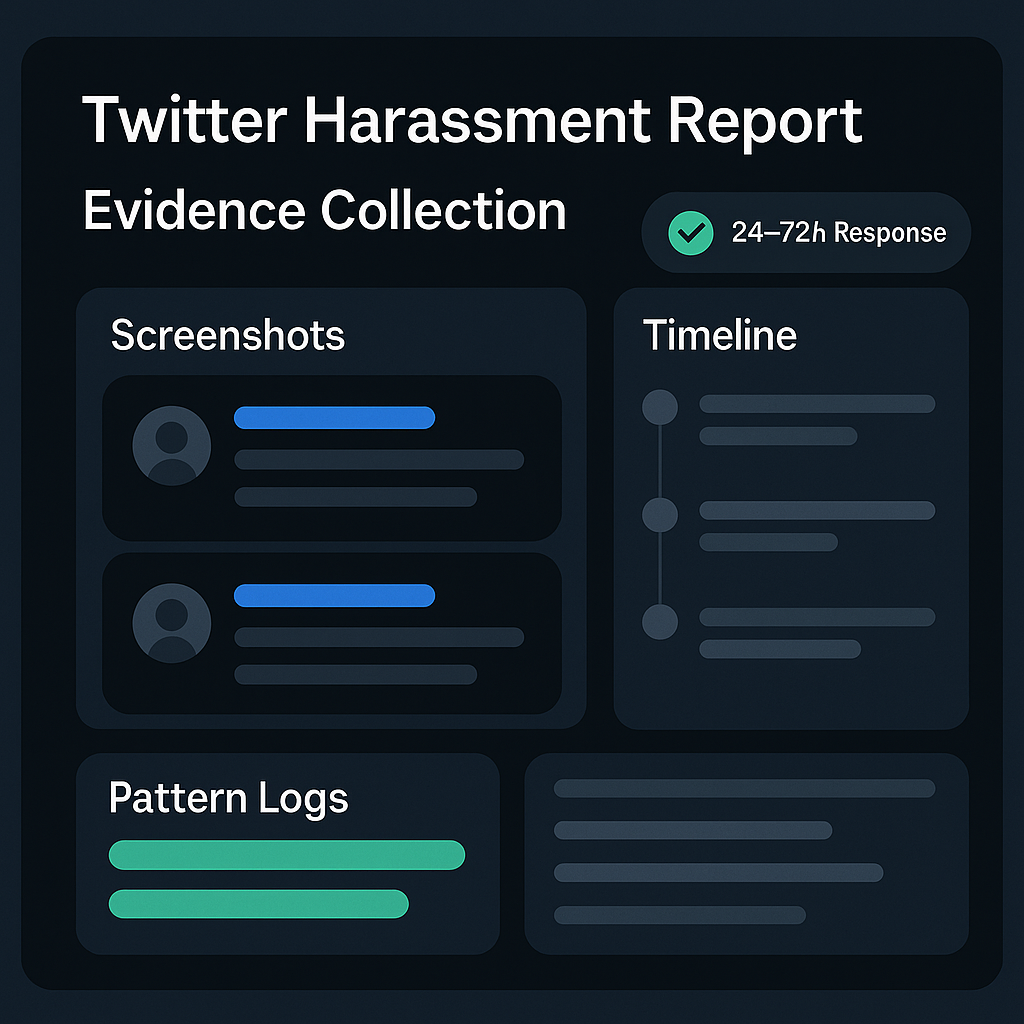
What is brigading on X, and how do you report a coordinated pile-on?
Brigading is when many accounts target one person in a coordinated burst — a wall of hostile replies, quote-posts and DMs meant to overwhelm. X has no button labelled "report a brigade" and no policy page that uses the word. It sits inside the broader Abusive Behavior policy, which bans "malicious, unreciprocated targeting," accounts "dedicated to harassing an individual," and posts that encourage others to pile on. So you report the parts. Open a post, tap ••• → Report → "They're being abusive or harmful," and when X asks, select several more posts from that account so a reviewer sees a pattern, not one stray reply. Repeat for each ringleader you can identify. Raw volume isn't what moves X — documented, coordinated targeting is. For the wider map of which report path fits which harm, our per-violation report guide lays them out; this page stays on the organised cases.
How do you report racism, a hate raid or racist pile-on on X?
A hate raid is a brigade with a bias motive: a coordinated, often bot-assisted flood of slurs aimed at someone for who they are. The researchers who first mapped the pattern (Han and colleagues, "Hate Raids on Twitch," ACM CSCW, 2023) found these waves landed overwhelmingly on Black and LGBTQ+ targets. On X it breaks the Hateful Conduct policy, which protects race, ethnicity, religion, gender, sexual orientation, disability and more. To report racism or a raid, use ••• → Report → "Hate," or file the standalone hateful-conduct form, attaching the worst posts and the handles driving them. Set expectations honestly. X removed or labelled 4,950,321 user-reported posts for hateful conduct in the first half of 2024, yet actioned only 2,361 accounts for it over the same months (X Global Transparency Report, H1 2024) — so reporting the content reliably beats assuming every account will vanish.
How do you report a Twitter job scam or fake recruiter?
A Twitter job scam usually opens as a too-easy offer — remote work, strong pay, "no experience needed" — from an account posing as a recruiter or a real company's HR team. The 2026 staple is the task or "gamified job" scam: you complete simple tasks for fake commission, then get asked to deposit your own money to "unlock" the earnings. Most start in replies or DMs and steer you onto Telegram or WhatsApp fast. On X, report the account through ••• → Report → "It's suspicious or spam," which maps to X's financial-scam policy. The damage is real: the FTC logged more than 105,000 job-scam reports and over $513 million in losses in 2024, with task scams making up roughly 40% of them (FTC, December 2024). Reporting gets the account actioned but won't refund you. If you paid, treat it as fraud in parallel — tell your bank now and file with ReportFraud.ftc.gov, the FBI's IC3, or the UK's Report Fraud service that replaced Action Fraud in December 2025.
How do you report a crypto giveaway or tech-support scam?
These two scams share a tell: urgency, plus a stranger steering you off-platform. A crypto giveaway scam promises to double whatever you send — "deposit 0.5 ETH, get 1 back" — usually behind a cloned Elon Musk or exchange account, a countdown, and a wallet-drainer link. Once sent, the crypto is gone. A tech support scam runs the other way: a fake "official support" handle watches for your complaint, replies "DM us to resolve this," then fishes for your login or a fee. One rule ends it — legitimate X support never slides into your DMs to restore an account or ask for payment. Report both through ••• → Report → "It's suspicious or spam"; impersonated brands also go through the impersonation form. The numbers are sobering. The FTC says consumers lost $1.4 billion to crypto-related fraud in 2024, and analysts at Chainalysis traced about $9.9 billion to scam-linked wallets that year. Tech-support scams fall hardest on older users — $159 million in reported 2024 losses from people over 60 (FTC, 2025).
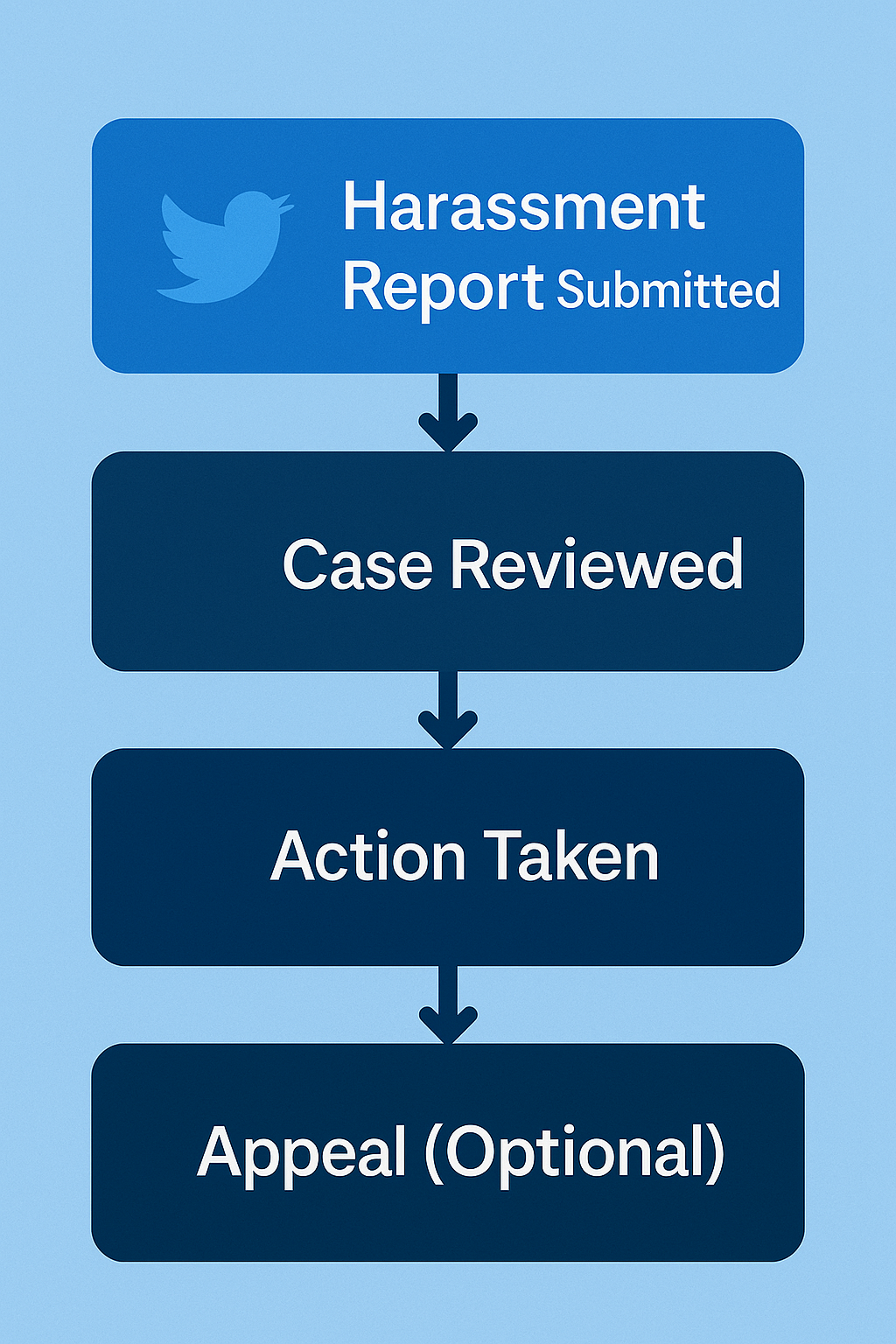
If you report an account, is it anonymous — and can you report it more than once?
Two worries surface the moment you hit report, especially when a group is involved. First, anonymity. A standard abuse report is confidential — the account you flag is never told who reported it, per X's abuse-reporting process. The one big exception is a copyright (DMCA) notice, which forwards your name and address to the other party, so it's the wrong lever for a grudge. Second, repetition. There's no magic number and no quota, so you can report a Twitter account multiple times only in the sense of filing again when you have genuinely new evidence. What you can't do is treat volume as a weapon or recruit others to flag in lockstep: coordinating duplicate or false reports breaches X's Misuse of Reporting Features policy and can get the reporters actioned. A free "report bot" that promises to automate it is usually a credential-stealer, not a shortcut — and it doesn't work anyway, as our look at mass-reporting an account explains. If several of you are genuinely targeted, each reporting your own experience is fine. For the full set of report types and limits, see reporting an X account.
Can you report an account on behalf of someone, or someone on Twitter who blocked you?
Yes to both, with caveats. When you start a report, X asks whether it concerns "Myself" or "Someone else," so you can report a Twitter account on behalf of someone — useful when a friend is being brigaded, or the target is offline, shaken, or a vulnerable relative. For most abuse types a bystander's report is accepted; a few routes, like privacy and impersonation, still prefer the affected person or an authorised representative to file. Reporting someone on Twitter who blocked you is fiddlier. Once you're blocked, you can't open their profile or flag their posts the usual way. You can still report their posts that mention or quote you, report a public post through its direct permalink, or use a standalone Help Center form — the impersonation and privacy forms don't need you to follow or view the account in-app. If the post itself is the real problem, our tweet-removal routes cover getting it down even when you can't reach the account.
How do you report a cyberstalker who keeps coming back?
A cyberstalker is the inverse of a brigade — one determined person, not a crowd — and the hard part is persistence: block them, and they return on a fresh handle. On X, report the behaviour as targeted harassment under the Abusive Behavior policy. When a suspended stalker reappears, report the new account for ban evasion — X's ban-evasion policy calls for permanent suspension "at first detection" and lets X suspend other accounts it believes the same person runs. Keep a running evidence log across handles; that cross-account history is what proves it's one stalker rather than scattered trolls. Two honest limits. X can suspend accounts but can't make a person stop, and it discloses identifying data only under valid legal process, per its law-enforcement guidelines — so unmasking an anonymous stalker usually runs through the police. Persistent stalking is a crime in itself: in the US under 18 U.S.C. §2261A, in the UK under the Protection from Harassment Act 1997. If you feel unsafe, make it a police matter first and a reporting case second.
How do you report a minor on X, or report someone targeting a child?
"Report a minor" splits into two very different things, and it matters which you mean. If you've found an account that belongs to a child under 13 — X's minimum age — use the dedicated underage-user form, which lets anyone flag an account they suspect is run by an under-13. That's an age-and-privacy matter, handled quietly. The other case is far graver: an adult sexualising, grooming or exploiting a child. X's Child Sexual Exploitation policy is zero-tolerance and now explicitly covers AI-generated material. Report the content to X through its CSE form, but don't stop there — in the US, also report it to the NCMEC CyberTipline (1-800-843-5678), which fielded roughly 1.4 million online-enticement reports in 2025. If a child is in immediate danger, call 911 or your local emergency number first. This is the one category where a platform report is never enough on its own.
How do you report a parody account, or one impersonating a celebrity or business?
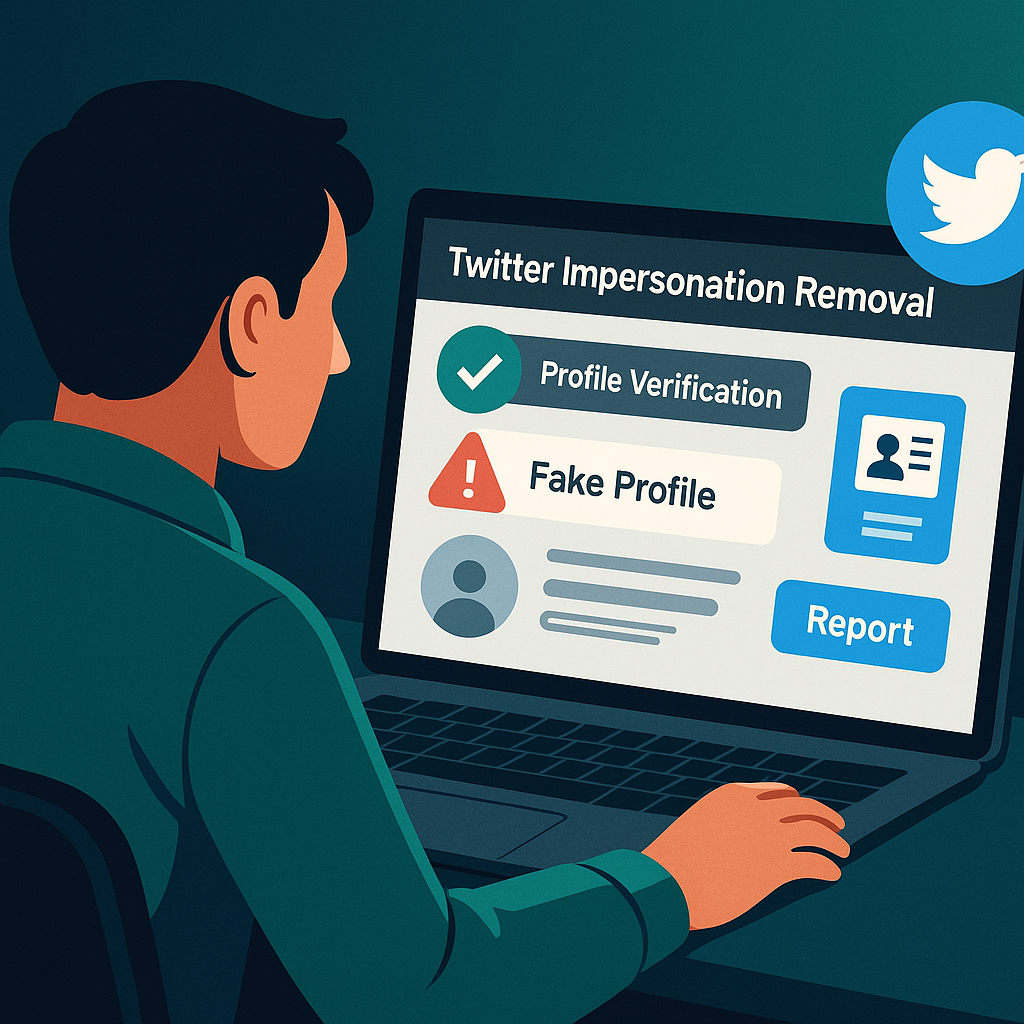
Impersonation comes in three flavours that route a little differently. A genuine parody account is allowed — but since X's April 2025 rules, it must put a label word such as "parody" or "fan" at the start of its display name and in the bio, and must not reuse the real avatar; a bio disclaimer alone no longer counts. So to report a Twitter parody account, the test is simple: if it's unlabelled and dressed up to pass as the real person, it's deceptive impersonation, not satire, and it's reportable under the authenticity policy. For an account impersonating a celebrity or public figure, file the standalone impersonation form — no X account required, which helps a representative act on their behalf. For an account impersonating a business, use that form's company route and, faster still, the trademark form with your registration attached. The full copycat walkthrough lives in our impersonation-report guide; if the fake is squatting a handle you own, that's the route to claim the username.
How do you report piracy, stolen content or a spam bot on X?
Three quick ones that share a theme — content and automation, not people. To report piracy on X, such as a pirated film, a stream link or leaked paid content, the lever depends on who owns it: if it's your work, a copyright (DMCA) notice is the strongest move, and our guide to every official X form walks through filing one. To report stolen content — your art, photos or writing reposted without permission — the same copyright route applies, and "but I credited you" is not a legal defence. A spam bot, meaning the reply-spam, fake-giveaway and follow-farm accounts, is reported through ••• → Report → "It's suspicious or spam" under X's platform-manipulation rules. X clears these in bulk, but individual bots are whack-a-mole, so flag the worst offenders and move on. None of this needs a paid tool. The official forms are free, and the only thing that genuinely speeds a copyright case is solid proof you own the work.
How do you contact Twitter Trust and Safety to escalate a report?
Here's the honest answer most pages dodge: there is no public Trust and Safety hotline, and no priority escalation line for an ordinary user whose report came back rejected. To contact Twitter Trust and Safety you use the Help Center forms — the harassment, privacy, impersonation and legal categories are the real intake, while @Safety is an announcements account, not a desk. So how do you escalate a Twitter report that closed as "no violation"? Three realistic moves. Re-file with sharper evidence: the exact rule broken, permalinks, a tight timeline — thin reports get auto-closed. Appeal anything done to your own account through X's appeals form, which X says it usually answers within 48 hours. And if you're in the EU, the Digital Services Act gives you leverage a US user lacks: a DSA illegal-content report, a written Statement of Reasons, and an out-of-court appeal to a certified body. Paid "priority support" via Premium speeds account tickets, not abuse reports, so don't buy it expecting a fast lane. When a clear breach keeps surviving review, that's the point to hand it to a service that knows the escalation paths.
Most of these reports you can file yourself, for free, and this guide is written to let you do exactly that. Where an independent service earns its place is the stubborn, organised case: a brigade that regroups under new handles, a scam ring relaunching daily, a stalker X keeps closing as "no violation." That's the narrow job of our X reporting service — we screen every case for a genuine X Rules or legal breach, map it to the right one of the violations we report, file through X's own channels, and never touch a legitimate account. If that's where you are, send us the handles and what they're doing.
Sources
- X Help Center — Abusive Behavior policy (targeting, coordinated harassment)
- X Help Center — Hateful Conduct policy
- X Help Center — financial-scam policy
- X Help Center — authenticity (parody, commentary & fan) policy
- X — report impersonation (form, no account required)
- X — trademark report (form)
- X Help Center — ban-evasion policy
- X Help Center — Child Sexual Exploitation policy
- X — report an underage (under-13) account (form)
- X Help Center — Misuse of Reporting Features policy
- X — appeal an account action (form)
- X Help Center — guidelines for law enforcement
- FTC (Dec 2024) — job and task-scam reports and losses
- FTC (Mar 2025) — 2024 fraud data ($12.5B; $1.4B crypto)
- Chainalysis (2024) — scam-linked crypto wallet revenue
- FBI Internet Crime Complaint Center (IC3)
- NCMEC CyberTipline
- 18 U.S.C. §2261A — federal stalking statute (Cornell LII)
- "Hate Raids on Twitch" — ACM CSCW (2023)
FAQ
If you report a Twitter account, is it anonymous?
Yes. A standard abuse or spam report is confidential, and X never tells the reported account who flagged it. The main exception is a copyright (DMCA) notice, which forwards your name and contact details to the other party, and a court order can also compel disclosure. So reporting harassment or a scam stays private; filing copyright does not.
Can you report a Twitter account multiple times?
There is no quota and no magic number, so you can report an account again if you have genuinely new evidence. What you cannot do is spam reports or organise others to pile on. Coordinated or duplicate false reports breach X's Misuse of Reporting Features policy and can get the reporters suspended instead.
How do you report a Twitter parody account?
Only if it breaks the rules. Since April 2025, a genuine parody account must put a label such as parody at the start of its display name and bio and must not reuse the real avatar. An unlabelled clone dressed up to pass as the real person is deceptive impersonation, and you report it through X's impersonation form or the in-app authenticity option.
How do you report someone on Twitter who blocked you?
Being blocked stops you opening their profile or flagging posts the usual way, but you can still report their posts that mention or quote you, report a public post through its direct permalink, or use a standalone Help Center form. The impersonation and privacy forms do not require you to view the account inside the app.
How do you escalate a Twitter report or contact Trust and Safety?
There is no public Trust and Safety phone line. To escalate, re-file with sharper evidence, appeal any action taken against your own account through X's appeals form, and, in the EU, use the Digital Services Act report and appeal routes. The Help Center web forms are the real intake; the @Safety account is not.
How do you report a Twitter job scam?
Open the post, choose Report, and pick the suspicious-or-spam option, which maps to X's financial-scam policy. That can get the account suspended but will not refund you, so if you paid, tell your bank immediately and file with a fraud body such as ReportFraud.ftc.gov or the FBI's IC3. Preserve the handle, posts and any payment details first.