2 July 2026 · Twitter Ban Service · ~9 min read
How do you take down a Twitter account? The four real routes
How you take down a Twitter (X) account depends entirely on whose account it is. You can deactivate your own from Settings, but you can't delete someone else's; only X can suspend it, and only after a report shows it broke a rule. A single tweet, or a court order, each follow a different path.
What does "taking down" a Twitter account actually mean?
Taking down means four different things, and the right route depends on which one you're after. Search results blur them together, but the mechanics don't. Whether you type how to take down a twitter account or drop the article and search how to take down twitter account, the first fork is ownership: is the account yours, or someone else's? That is really what how do you take down a twitter account comes down to — four separate jobs wearing one phrase. Sort your situation into the right row below before you touch a single form.
| What you actually want | The real route | Who holds the power |
|---|---|---|
| Your own account gone | Deactivate, then a 30-day window, then deletion | You |
| Someone else's account removed | Report a specific rule violation; X reviews it | X only |
| One tweet gone, not the whole account | Report the post, or file a DMCA notice | The author or X |
| Illegal or defamatory content removed | Court order or law-enforcement request | A court / X's legal team |
A fifth case looks similar but isn't a takedown at all. If you only want a dormant @handle that someone is squatting, that's reclaiming an inactive username, a separate track with its own rules. When a case reaches us, sorting it into one of these buckets is the first thing we do, because the paperwork for each is completely unlike the others.
How do you take down your own Twitter account?
Removing your own account is the one takedown you fully control. X gives you no instant delete button; instead, deactivation starts a countdown. Log back in within 30 days and everything returns. Leave it, and X permanently deletes the account and its data once the window closes, per its deactivation guidance. Do these four things in order:
- Download your archive first, under Settings → Your account → Download an archive of your data. Deletion is final, so grab it while you can.
- Open Settings → Your account → Deactivate your account, and confirm.
- Your profile, posts, and handle drop out of public view straight away.
- Changed your mind? Log in before day 30 to restore it. After that, there is no undo.
One detail people miss: while the 30-day clock runs, your old @handle is not released for anyone else to grab. It frees up only after the account is fully deleted. And if the account is one you can no longer reach, say it's tied to a dead email with the password long gone, you can't deactivate it the normal way. X's account-access recovery is the only door in, and no third party can delete a live account on your behalf.
How do you take down a Twitter account you don't own?
You cannot take down someone else's X account yourself, however badly you want it gone. The honest version of how to take down someone's twitter account is narrow: you report the account for a specific rule it breaks, and X, not you, decides whether to suspend it. The same holds whether you search how to get someone's twitter account taken down or how to get a twitter account taken down. There is simply no user-facing delete switch for another person's profile.
What you do control is the strength of the case. Three moves decide whether a report lands:
- Name the rule. Pin the behaviour to a specific X Rule instead of a vague complaint. The wrong category is where most valid reports quietly die.
- Capture proof. Save the permalink to each offending post and a dated screenshot before the poster deletes them.
- File it right. Use the ••• → Report menu, or the dedicated form when the category has one.
Our guide to what reporting an X account actually does walks the flow, matching an account to the rule it breaks covers category choice, and if you're unsure which form fits a given harm, the per-violation routing guide maps each one.
Volume is a trap. Coordinated or bulk reports breach X's Misuse of Reporting Features policy, which the platform detects and discounts, and it can get the reporter suspended instead of the target. We take that apart in why mass reporting fails. Report the genuine breach once, properly, and stop.
Which violations get an X account taken down fastest?
Severity decides the speed. X runs a graduated ladder of enforcement options rather than a single ban button: it can label a post, force its removal, drop an account into a read-only lock for anywhere from about 12 hours to 7 days, and reserve permanent suspension for repeat or serious breaches. Most rule-breaks climb that ladder one rung at a time.
A few categories skip it. Credible violent threats, terrorist or violent-extremist content, and child sexual exploitation can bring an immediate permanent suspension on first detection, with no warning stage. Ban evasion sits in the same fast lane: under X's authenticity policy, an account spun up to dodge a prior suspension gets linked back through device and behaviour signals and removed on sight. If your reports keep coming back closed as "no violation," the category was usually wrong — we cover that failure mode in why X ignores some reports, and the coordinated pile-on and scam-ring cases in reporting brigading and job scams. Automated "ban bots" belong nowhere in this: our report-bot threat model explains why they mostly endanger the person running them.
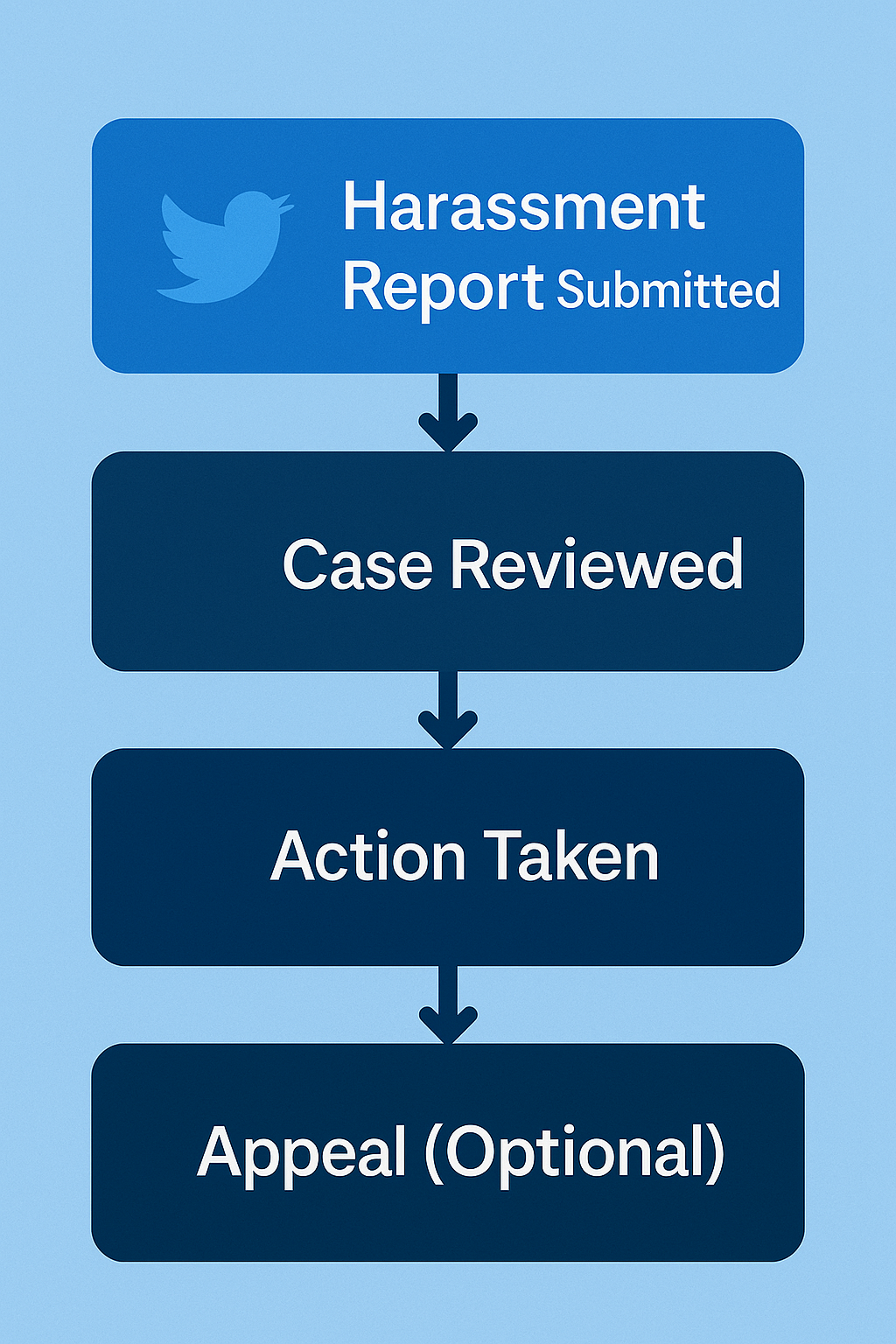
How do you take down a single tweet instead of the whole account?
Often you don't need the whole account gone, just one post. That is a smaller and far more winnable target. You can't delete another user's tweet yourself, but you can report that individual post, and for content that copies your own work you can file a copyright claim against it specifically. This is worth trying first when the problem is one bad tweet rather than a pattern.
Copyright takedowns run on the DMCA (17 U.S.C. §512). X's dedicated DMCA form pulls infringing media quickly, but unlike a standard report it is not anonymous: your details reach the poster, and a knowingly false claim carries liability under §512(f). For the routes beyond copyright, our guide to getting a tweet taken down lays out the honest options, every official X removal form maps each one, and removing tweets and filing an impersonation report covers the case where a fake account is posting as you.
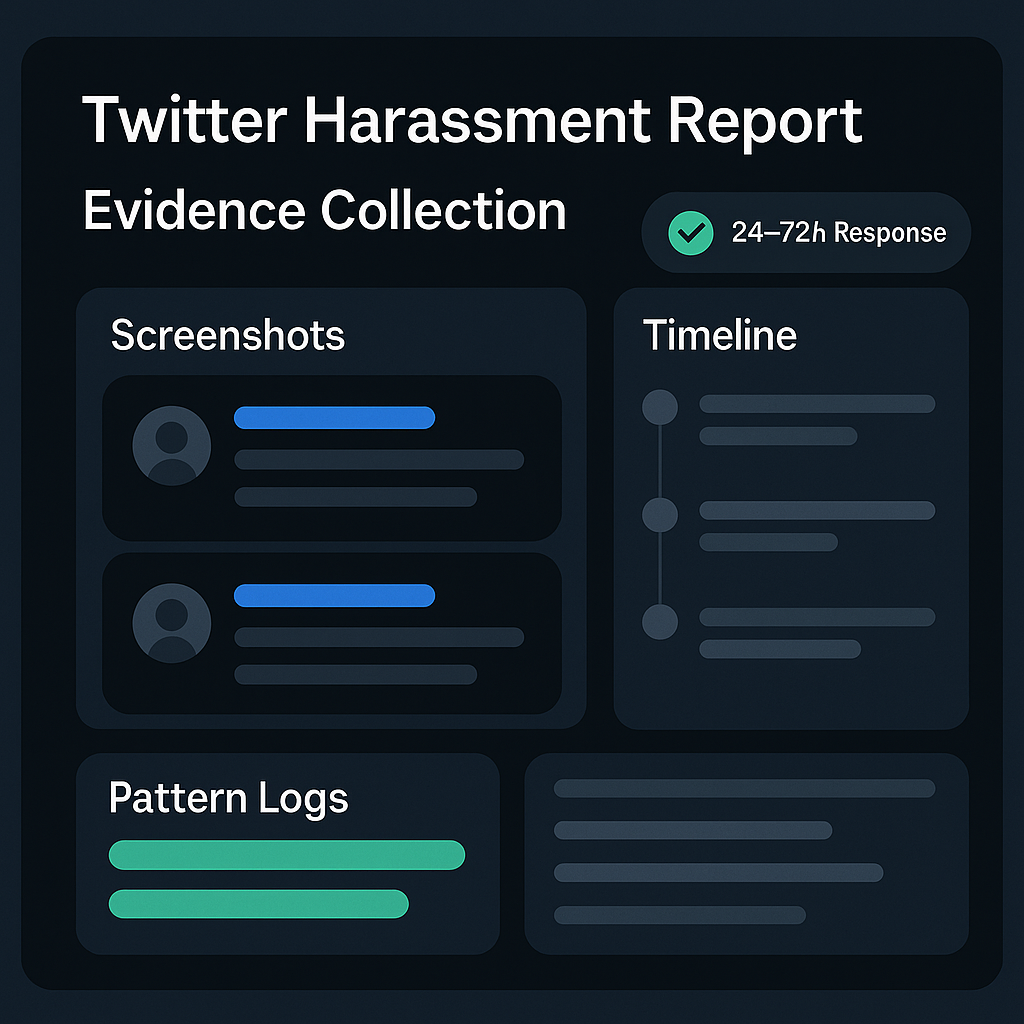
When can the law take down a Twitter account?
Some takedowns are decided by a court, not a moderator. When content is defamatory, criminal, or breaks a local law rather than the X Rules, the lever is legal process: a court order, a law-enforcement request, or a formal government demand. These sit outside the report button entirely, and the volume is larger than most people assume. X received 47,572 legal demands to remove content in the second half of 2024, naming 198,931 accounts, a record, and acted on 51% of them, according to its Global Transparency Report. Some 97% of those demands came from just five countries, led by Japan and Russia.
Two practical paths sit under that heading. If you're in the EU or UK, the GDPR right to erasure (Article 17) lets you ask X to delete personal data an account holds about you, though free-expression and public-interest exceptions apply and it rarely removes a whole profile. For defamation, the realistic move is a lawyer's letter or a court order naming the specific posts; X generally won't pull lawful-but-offensive speech on request alone. Legal takedowns are slower and cost money, but they reach content that no in-app report ever will.
Can a service take down a Twitter account for you?
A service can't do anything you couldn't do in principle, but it can do the tedious, decisive parts well. What a legitimate X account reporting service earns its fee on is documentation, choosing the exact policy, filing impersonation or DMCA paperwork, and pressing an escalation when X wrongly closes a valid case. What it cannot do is promise a ban or move against an account that broke no rule. Anyone selling a guaranteed takedown is selling a bot panel or a plain scam. If your situation is a genuine breach, our solutions page lists the violation types we take on; when you're ready, tell us the handle and the rule it breaks. For anything involving immediate danger or clearly illegal material, contact local law enforcement in parallel, because a platform takedown is never a substitute for the police.
Sources
- How to deactivate your X account (30-day window) · X Help Center
- Our range of enforcement options · X Help Center
- Authenticity policy (ban evasion) · X Help Center
- Misuse of Reporting Features policy · X Help Center
- Copyright and DMCA policy · X Help Center
- DMCA takedown form · X Help Center
- Legal removal requests (H2 2024 figures) · X Transparency Center
FAQ
How to get someone's twitter taken down, is there a fast way?
There is no shortcut that beats a clean, accurate report. Every phrasing of how to get someone's twitter taken down resolves to the same thing: name the exact X Rule the account breaks, attach proof, and file it through the right channel. Speed comes from the severity of the breach, never from a bot, a bought panel, or a crowd of duplicate reports.
Does reporting an account actually delete it?
No. Reporting flags an account for X to review; it does not delete anything. If a reviewer confirms a rule was broken, X chooses the response, from a label or a temporary lock up to permanent suspension. There is no report count that deletes a profile, and only its owner can truly delete an account.
How many reports does it take to take down a Twitter account?
There is no set number. X weighs whether content genuinely breaks a rule, so one well-evidenced report on a real violation outranks thousands of empty ones. Coordinated bulk reporting is not a counter that fills up; X detects and discounts it, and it can get the people running the pile-on suspended instead.
Can I take down a Twitter account anonymously?
A standard report is confidential; the account you flag never learns who filed it. The exception is a copyright (DMCA) claim, where your name and contact details are passed to the poster as part of the legal process, which is why brands often file through an agent.
What's the difference between deactivating and deleting on X?
Deactivating is reversible for 30 days: your profile and posts vanish from view, but logging back in restores everything. Deletion is what happens automatically once that 30-day window passes without a login. X has no separate one-tap delete button; deactivation is the start of the delete process.
How long does X take to act on a report?
There is no fixed clock. A severe, obvious breach can be actioned within minutes or hours; a case that needs human judgement can take several days. Temporary locks themselves run from about 12 hours to 7 days. If you hear nothing, that silence usually means the reviewer found no rule-break in what you sent.
Someone made a Twitter account in my name. How do I take it down?
Impersonation has its own route. X lets the impersonated person, or their authorised representative, file a dedicated impersonation report, and you can do it without holding an X account. Attach proof you are the real party: an ID, your official website, or the matching brand logo. That side-by-side evidence is the whole case, so gather it before you file.