3 August 2026 · Twitter Ban Service · ~9 min read
How to delete someone else's Twitter account or tweet, and who is allowed to ask
How to delete someone else's Twitter account or tweet has one honest answer: you can't, and nobody can sell you that power. What exists instead are six official X routes, each open to a different person, from a bereaved relative to a parent to an impersonation victim.
Six different situations are hiding inside one search
Standing decides everything here, and it is the word every guide on this query leaves out. X does not ask how badly you want an account gone; it asks who you are to the person or the content. A bereaved daughter, a parent, an impersonation victim and a stranger with a grudge type the same words into Google and get four completely different answers. Find your row before you touch a form.
| Your situation | Who X will hear from | The official route | What it actually ends in |
|---|---|---|---|
| The account holder has died | A verified immediate family member, or someone authorised to act for the estate | Deactivate account for an incapacitated or deceased person | Deactivation, then deletion after 30 days |
| The holder is alive but incapacitated | A person authorised to act on their behalf | The same deceased or incapacitated form | Deactivation, and never account access |
| A child under 13 opened it | Anyone may report it; only a parent or guardian can restore it | Underage user report | The account is locked, not deleted |
| Somebody is posing as you or your brand | You, your authorised representative, or a bystander | Impersonation form | Suspension, or a forced name and avatar change |
| Your address, ID or intimate images are posted | Usually the person depicted, or their lawyer | Private information report, or the US Take It Down form | The post comes down; the poster may be suspended |
| The account is yours and you are locked out | You alone | Login and password recovery | Access back, or nothing at all |
A seventh case gets mistaken for this one constantly. Plenty of people who search how to delete someone's twitter account actually mean their own, and Google agrees with them: drop the word "else's" and the results fill with privacy-brand guides to deactivating your own profile. If that is you, the route is Settings, a 30-day window and then permanent deletion, and our walkthrough of the four takedown routes covers it properly. The apostrophe-less spelling people actually type, how to get someones twitter account deleted, pulls the same muddle. Everything below is about accounts and posts that belong to somebody else.
Who can ask X to deactivate a deceased or incapacitated person's account?
Only a verified immediate family member or a person authorised to act on behalf of the estate. This is the largest unserved group on the whole query and the one the ranking pages ignore completely: a relative sorting out a late parent's digital life, working through a form none of the top results mention. X runs it through its policy on contacting X about a deceased family member's account, and the request itself goes through the deceased or incapacitated deactivation form.
Two limits matter more than the form does. X deactivates; it does not hand anything over. Its stated position is that it cannot provide account access to anyone, regardless of their relationship to the deceased, so the login, the direct messages and the archive stay shut. And X has no memorial state at all. Where Meta freezes a profile and keeps it visible, X has exactly two outcomes: live, or gone. Anyone offering to memorialise or unlock a late relative's account is describing a feature that does not exist.
The submission runs in two stages, which trips people up because the first stage looks too easy:
- Submit the form with the account's @handle and your relationship to the account holder. No documents are attached at this point.
- Wait for X's reply by email. The request is not being reviewed on the merits yet; the email is what opens the document exchange.
- Send back the three items X asks for: information about the deceased, a copy of your own government-issued ID, and a copy of the death certificate. X says the ID requirement exists to stop false or unauthorised reports, which is also why a request without it stalls silently.
- Expect deactivation. The account then follows the ordinary 30-day path to permanent deletion, and the handle is released only at the end of it.
The incapacitation route uses that same form; there is no separate one. Here the paperwork shifts from a death certificate to proof of authority, typically a power of attorney or a guardianship order, and that document carries the whole request: a family relationship on its own does not clear this lane. If a released handle is what you are ultimately after, note that X now routes many freed usernames through a subscriber marketplace rather than back into open registration, which we cover in claiming an inactive X username.
Can a parent get a child's X account deleted?
A parent can get it locked, which is not the same as deleted. X sets its floor at 13, and anyone may flag a suspected under-age account through the underage user report; you do not have to be the family. What follows is an age review, not a deletion. X offboards accounts that fail it by locking them behind a notice saying parental consent is required, so the profile stops functioning rather than vanishing. Restoring it runs the other way: a parent supplies proof of identity and proof of guardianship, and X says that consent form can take up to 60 days to process. One correction worth carrying, because plenty of pages get it wrong: there is no worldwide rule that every 13 to 17-year-old needs parental permission. X's wording is jurisdictional, applying where local law sets a higher age of digital consent.
How to delete someone else's tweet: what you actually control
One control, and it belongs to whoever wrote the original post. If a reply under your own tweet is the problem, X lets you hide it. The hide-reply power sits with the author of the parent post and nobody else, which is exactly why how to delete someone's tweet has no answer when the post is standalone. X's own developer documentation for the feature is refreshingly blunt about what hiding achieves: "Hidden replies are still accessible but require an extra click to view." A hidden-reply icon appears on your post, any reader can tap it, and the reply carries on living on its author's profile untouched.
The neighbouring control is Leave this conversation, the feature X's engineers called unmentioning. It unlinks your @handle from the thread, stops anyone re-tagging you in it, and silences the notifications. It is also one-way; there is no rejoining, and nothing is removed for anyone else. Both tools are worth using and neither is a takedown, so treat them as noise reduction while a real report runs. For the routes that do remove a post, our guide to getting a tweet taken down and the map of every official X removal form are the practical pair, and clearing out your own back catalogue of tweets is a separate job again.
The route with legal teeth beats the route with the sympathetic name
Where two routes cover the same post, take the one backed by a statute. Scale is part of the reason. X logged more than 181 million user reports between July and December 2024, a figure that excludes spam and platform manipulation entirely, with over 69 million of them filed under abuse and harassment; separately it suspended roughly 335 million accounts for spam and manipulation in the same window, per its Global Transparency Report for the second half of 2024. A queue that size gets triaged by policy category, not by how strongly the reporter felt.
The sharpest evidence sits in an audit study by researchers at Michigan and Harvard, posted as arXiv preprint 2409.12138 and due at ACM CSCW in October 2026. They uploaded 50 AI-generated nude images to X, reporting half through X's non-consensual nudity mechanism and half as copyright infringement. Every one of the 25 copyright-reported images was gone within 25 hours. Not one of the 25 filed under the safety policy had come down after three weeks: a 100% removal rate against 0%. Read it with its limits attached, though, because they are real: 25 items per arm, synthetic rather than authentic imagery, and fieldwork that predates the law described next.
That law changed the arithmetic for one category. The US TAKE IT DOWN Act took effect for platforms on 19 May 2026 and gives non-consensual intimate imagery something no X policy does, a statutory clock: a valid request obliges removal within 48 hours, with reasonable efforts to clear known identical copies, enforced by the FTC at up to $53,088 per violation. X built a dedicated Take It Down route for it, and no X account is needed to file. Two cautions. There is no private right of action, so the deadline is a regulator's lever rather than a personal guarantee. And the FTC has already sent warning letters to a dozen platforms, X among them, over inadequate victim removal processes.
| Route | Can a third party file? | Confidential? | Realistic end state |
|---|---|---|---|
| In-app rule report | Yes | Yes | Label, removal, lock, or suspension |
| Impersonation form | Yes, but weighted toward the impersonated party | Yes | Suspension or forced profile change |
| Private information report | Often needs the person depicted | Yes | Post removed |
| US Take It Down request | The depicted person or their representative | Yes | Removal inside 48 hours when valid |
| Trademark complaint | Rights holder only | No | Rename, suspension, or handle released |
| EU DSA Article 16 notice | Anyone | No, name and email required | Content restricted in the EU |
| GDPR Article 17 erasure | No, your own data only | No | Your data erased, not their account |
The last two rows are where non-US readers gain and lose at once. An Article 16 notice under the EU Digital Services Act is the strongest lever an ordinary European has, because a sufficiently substantiated notice gives X actual knowledge of the content and strips the hosting shield that normally protects it. What it buys is usually geo-restriction rather than global deletion. Article 17 erasure is narrower still: it reaches your personal data inside someone's post, never their account.
What we turn down, and why your report came back "no violation"
We decline more cases than we take, and the commonest reason is the plainest one: the post breaks no rule. Being wrong about you is not a violation. Neither is being unkind, and defamation is not a reportable category on X at all, so a case that hinges on falsity belongs with a lawyer rather than a report form. We also turn down anything that arrives as a coordinated push. Report volume does not decide outcomes, each report opens its own case against one named policy, and organised campaigns get flagged as manipulation with the reporters carrying the consequence. We take that apart in what mass reporting actually does, why report bots endanger their operators, and how a genuine violation gets escalated instead.
When a valid case dies, miscategorisation is nearly always the cause. Harassment filed where private information was the real breach is the single most frequent miss we see, followed by impersonation filed where the winning route was trademark, and abuse filed over content that was actually intimate imagery and therefore statutory. We rebuilt our own intake around that pattern: before anything else we ask whether the person whose data or likeness is exposed can sign the request themselves, because several routes quietly need that signature and a well-meaning third-party filing simply closes. That asymmetry is why so many honest reports vanish without a reply.
Then there is the evidence itself. A screenshot is the weakest thing you can send, because it proves nothing about where the post lived. Send permanent post URLs, the handle together with the numeric user ID, timestamps, and a short pattern table when the harm is cumulative rather than a single post. If the answer still comes back negative, re-file under the correct policy with the missing evidence attached and use the appeal path; resubmitting the same complaint unchanged is wasted effort. Our notes on why X closes valid reports, what reporting an X account really triggers, picking the right route per violation, handling brigading and job scams, and the shadowban tools people confuse with all this cover the recurring failure modes. The same errors repeat on other platforms, which is why we keep parallel write-ups on Instagram account takedowns, Instagram mass reporting, Instagram spam report bots and TikTok mass reporting. If you would rather hand the case over, the violation types we take on are listed in full, our reporting desk explains the process, and you can reach us through the contact page.
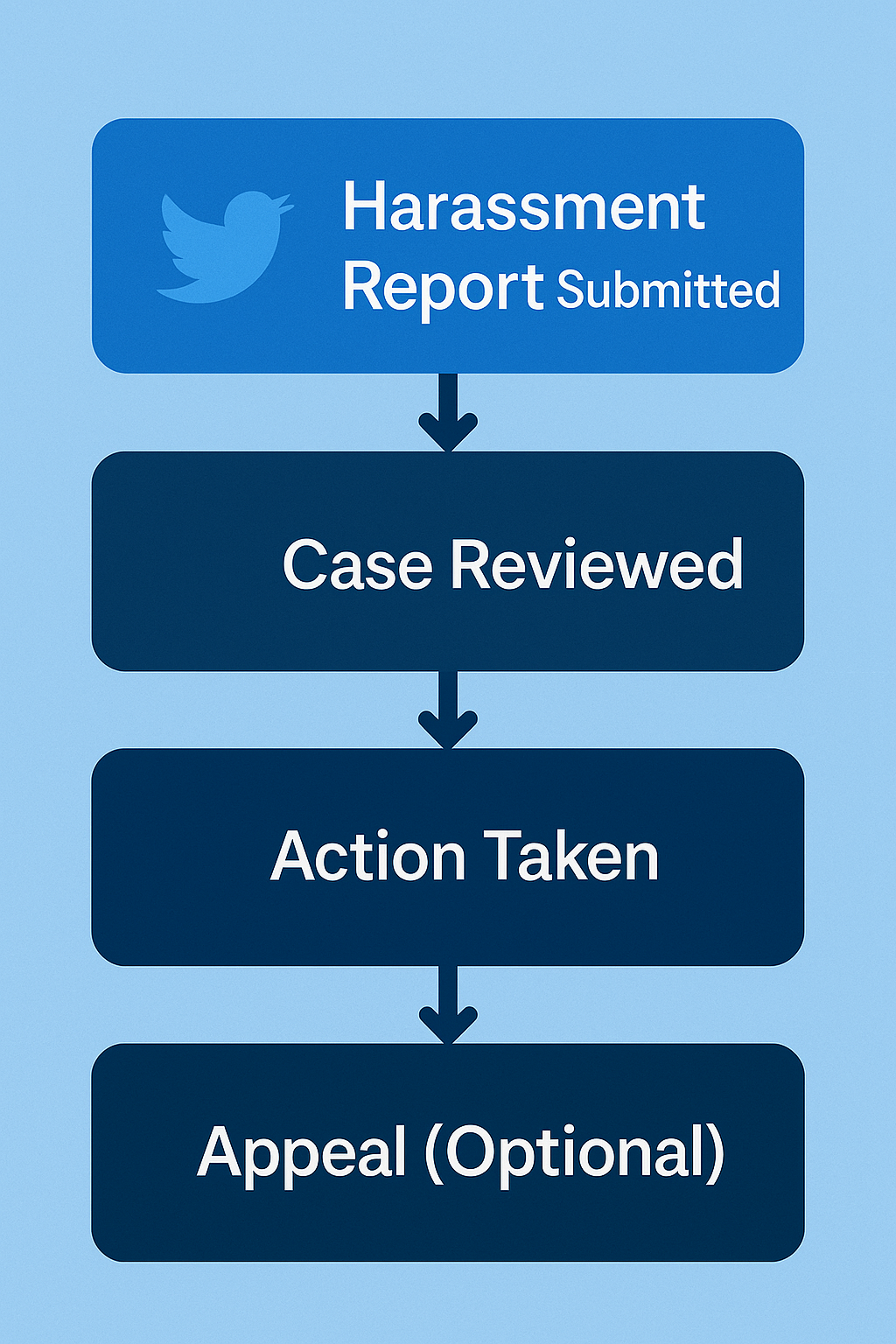
Sources
- Contacting X about a deceased family member's account · X Help Center
- Deactivate account for an incapacitated or deceased person · X Help Center
- Information for parents and minor users · X Help Center
- Hide Replies: hidden replies remain accessible · X developer documentation
- Reporting under the US TAKE IT DOWN Act · X Help Center
- Reporting non-consensual intimate media: an audit study of deepfakes · arXiv 2409.12138
- The TAKE IT DOWN Act · Congressional Research Service
- Global Transparency Report, second half of 2024 · X Transparency Center
FAQ
How to get someone's twitter account deleted when it is breaking the X Rules?
You report it and X decides. File once, under the single policy the behaviour actually breaks, with permanent post links rather than screenshots. X can label the post, remove it, lock the account for a period, or suspend it permanently. Deletion in the literal sense stays with the owner alone.
How to delete someone's twitter account when it is a duplicate of your own?
Treat it as impersonation rather than duplication. A copied name and avatar with no parody label breaks X's rules on deceptive identities, and the impersonation form is open to you, your representative, or a bystander. A successful case ends in suspension or a forced name change, not in the handle passing to you.
How to get someone's tweet deleted when it names you?
Being named is not itself a violation. The lever depends on what the post exposes: your address or ID goes to the private information report, intimate imagery goes to the Take It Down route, your copyrighted work goes to the copyright form. A post that is merely unflattering has no removal path on X.
How to delete someone's tweet that is sitting under your own post?
You cannot delete it, but you can hide it. X gives the author of the original post a hide-reply control, which moves the reply out of the conversation and behind an icon. X's own documentation is blunt that hidden replies stay accessible in one extra click. Nothing is deleted and the reply survives on its author's profile.
Can I report a fake X account without having an X account?
Yes, for some routes. The impersonation form, the underage-user report and the US Take It Down form all run on the web and accept a submission from someone with no X login. The in-app three-dot report menu is the one that requires an account, which is why non-users should start from the Help Center forms.
Does X tell the account who reported it?
Not for ordinary rule reports, which stay confidential. Legal routes are different by design. A trademark complaint needs identifiable holder details, an EU illegal-content notice carries your name and email, and a copyright notice reaches the poster. Anonymity and legal force pull in opposite directions here.
Why does the same fake account come back a week later?
Because suspension removes an account, not a person. X treats spinning up a replacement as ban evasion and links the accounts through device and behaviour signals rather than IP alone. Report the new handle against the old case, note that it is a return, and keep the original permalinks even after the first account disappears.
What happens if X answers no violation?
Usually the category was wrong, not the case. Harassment filed where private information was the real breach is the failure we see most. Re-file under the policy that matches the harm, add the evidence the first submission lacked, and use the appeal path. Filing the same complaint again unchanged achieves nothing.