20 October 2026 · Twitter Ban Service · 12 min read
YouTube harassment policy: the evidence each report needs, and what happens to the channel after
YouTube's harassment policy removes content that targets an identifiable person with repeated insults, threats, doxxing, unwanted sexualisation or blackmail. Report the exact video, comment or Short with a timestamp. False claims about you fall outside it: YouTube won't judge truth there, so libel needs its separate defamation form.
What does the YouTube harassment and cyberbullying policy cover?
It covers content aimed at a person you can identify, not at an idea. The YouTube harassment and cyberbullying policy lists prolonged insults or slurs, threats against someone or their property, unwanted sexualisation, encouraging viewers to pile on, and "stalking or attempting to blackmail users". Doxxing sits inside the same page. It also reaches patterns: a creator who targets one person across many uploads can be actioned even when no single video would be.
What the policy leaves up matters as much. Debate about public officials, documentary or educational context, and scripted satire are allowed, though YouTube says satire is no excuse to harass. In practice the line is the target. "This MP's housing plan is a disaster" is commentary. "Here is where this nurse parks, go tell her what you think" is harassment, and probably doxxing too.
What evidence does each YouTube complaint need?
Different proof for each one, because a different reviewer reads it. A harassment flag is checked against the Community Guidelines. A defamation complaint goes to a legal team that wants exact quotes. A privacy complaint asks whether you can be identified. Blackmail needs the police before YouTube. The chart and table below set out what each reviewer needs to see.
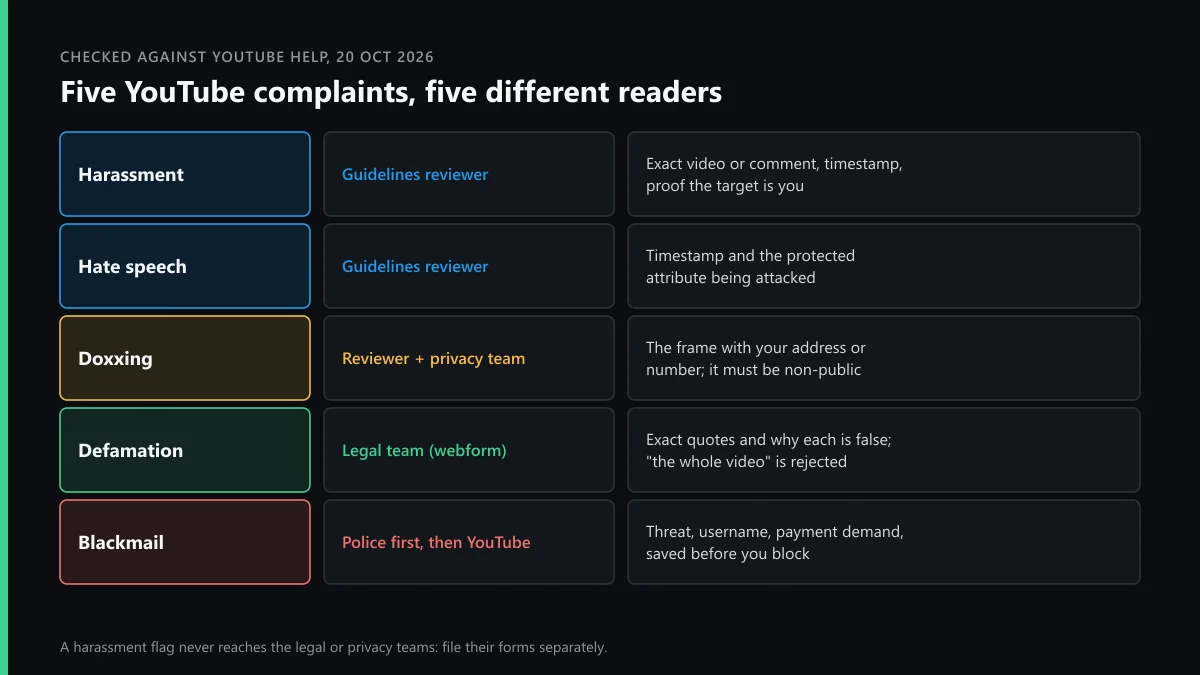
| Complaint | Who reads it | Capture first | Where reports fail |
|---|---|---|---|
| Harassment or bullying | Community Guidelines reviewer | Timestamp, the words used, proof it's about you | Flagging the channel instead of the video |
| Hate speech | Community Guidelines reviewer | The protected attribute attacked, timestamp | Choosing harassment when the attack is on a group |
| Doxxing | Reviewer, plus the privacy team | The frame showing your address or number | Details that are already public, like a shop address |
| Defamation (libel or slander) | Legal team | Exact quotes and why each is false | "The whole video" as the complaint |
| Blackmail | Police first, then YouTube | The threat, the username, any payment demand | Blocking before saving the messages |
Most cases fill two rows. A video that calls you a thief and shows your street is defamation and doxxing at once. File both, because neither team reads the other's part.
How do you report harassment on YouTube, step by step?
To report YouTube harassment, flag the exact item that does the harm, then file the side forms a flag can't carry. You need to be signed in. These five steps work on the app and on desktop:
- Capture before you flag. Screenshot the video frame, the comment and the channel URL, and note the timestamp. A removed video takes your evidence with it.
- Pick the item, not the channel. Use the three-dot menu on the exact video, comment, Short or live chat message that does the harm.
- Choose the matching reason. Harassment or bullying for targeting, hateful or abusive content for attacks on a protected group.
- Add the timestamp and a short note. Name the second where it happens and who is targeted. Reviewers read flags quickly.
- File the side forms the flag can't carry. Privacy complaint for your address or face, the defamation webform for false claims, police for threats or blackmail.
A YouTube report harassment flag doesn't name you to the creator, and the reviewer checks the item against every guideline, not only the reason you chose. One flag on a channel doesn't put every upload on trial, so report each video separately. Instagram works item by item too, as the guide to reporting a person, post or comment on Instagram shows. If the same people are messaging you on Instagram and X as well, reporting harassment on Instagram and X covers both inboxes.
How is the YouTube report hate speech option different?
The difference is the target. Hate speech attacks people for who they are, harassment attacks a particular person. YouTube's hate speech policy protects age, caste, disability, ethnicity, gender identity and expression, nationality, race, immigration status, religion, sex or gender, sexual orientation, victims of major violent events and their kin, and veteran status. Choose hateful or abusive content for the YouTube report hate speech flag, and name the attribute in your note.
One detail decides many appeals. YouTube's educational exception needs the context inside the video's images or audio, and a disclaimer in the title or description doesn't count. A slur aimed at you because of your religion is often both harassment and hate speech. Pick hate speech, since its rules are tighter.
Where does the YouTube doxxing policy draw the line?
At information that isn't already public. The YouTube doxxing policy covers content that shares, threatens to share or encourages others to share non-public personal details: a home address, a private phone number, a workplace tied to a named person. A threat to post the details counts, which helps when the video is a warning rather than the leak itself.
Flag the video under harassment, then file a privacy complaint. That route judges whether you can be identified, not whether the creator meant harm. YouTube usually gives the uploader 48 hours to remove or edit the content before it decides. If your photo is also being reposted on other platforms, getting a picture of you taken down on Instagram and X explains the image side.
Libel and slander on YouTube: what the YouTube defamation policy will and won't do
It won't decide who is telling the truth. YouTube's defamation help page says it is "not in a position to adjudicate the truthfulness of postings". That is why a harassment flag on a video that lies about you often comes back clean. To a moderator, "this man is a fraud" reads as opinion until a court says otherwise. The YouTube defamation policy routes these claims to a legal form and, in some countries, asks for a court order.
Libel is the written or published form, slander the spoken one. A recorded video is usually treated as YouTube libel because it's published. Slander on YouTube still comes up with live streams, where the words exist only in the replay, so clip the stream before it's edited or deleted.
What a YouTube defamation complaint asks for
A YouTube defamation complaint goes through the webform on the defamation complaint requirements page. Only the person defamed or their authorised legal representative may file. You pick your country first, give your full legal name, quote the exact words and explain why each statement is untrue. The page says statements such as "the whole video" are invalid. The uploader is notified, and you can ask that your legal name and email stay hidden. When a claim is upheld, the video is often blocked only in the country whose law it breaks.
When a YouTube defamation lawsuit makes sense
A YouTube defamation lawsuit is brought against the person who made the video, not the platform. In the US, Section 230 shields platforms from liability for user posts. A court can still order Google to identify an anonymous uploader. It makes sense when the false claim is specific and provable, the harm is measurable and the uploader can be found. Insults and opinions aren't defamation anywhere, and in England and Wales the claimant must also show serious harm. Speak to a defamation lawyer where you live. This page is general information, not legal advice.
YouTube blackmail: why the report comes last
Because the report can make the evidence disappear. YouTube blackmail usually arrives in comments, a community post or an email after a video: pay, send more images, or the clip goes public. Don't pay and don't reply. Screenshot the threat, the username and the channel URL, then go to the police. In the US the FBI's Internet Crime Complaint Center takes sextortion cases. Under-18s can hash images with Take It Down, and adults with StopNCII, so platforms block them before upload.
Only then file the YouTube blackmail report on the comment or channel, citing blackmail under the harassment policy. Threats that began on Instagram follow a similar order, set out in reporting Instagram blackmail and sextortion. When the blackmailer's real aim is money through a fake giveaway or investment pitch, how to report an Instagram scammer handles the fraud account.
What happens to the channel: YouTube's strikes next to X's enforcement
On YouTube, a ladder with published steps. YouTube's strike rules say the first breach is typically a warning, which expires after 90 days if the creator completes a policy training. After that, the first strike freezes uploads for one week and stays for 90 days. A second within that window freezes them for two weeks. Three strikes in the same 90 days may remove the channel permanently, and a single case of severe abuse can end it without warning.
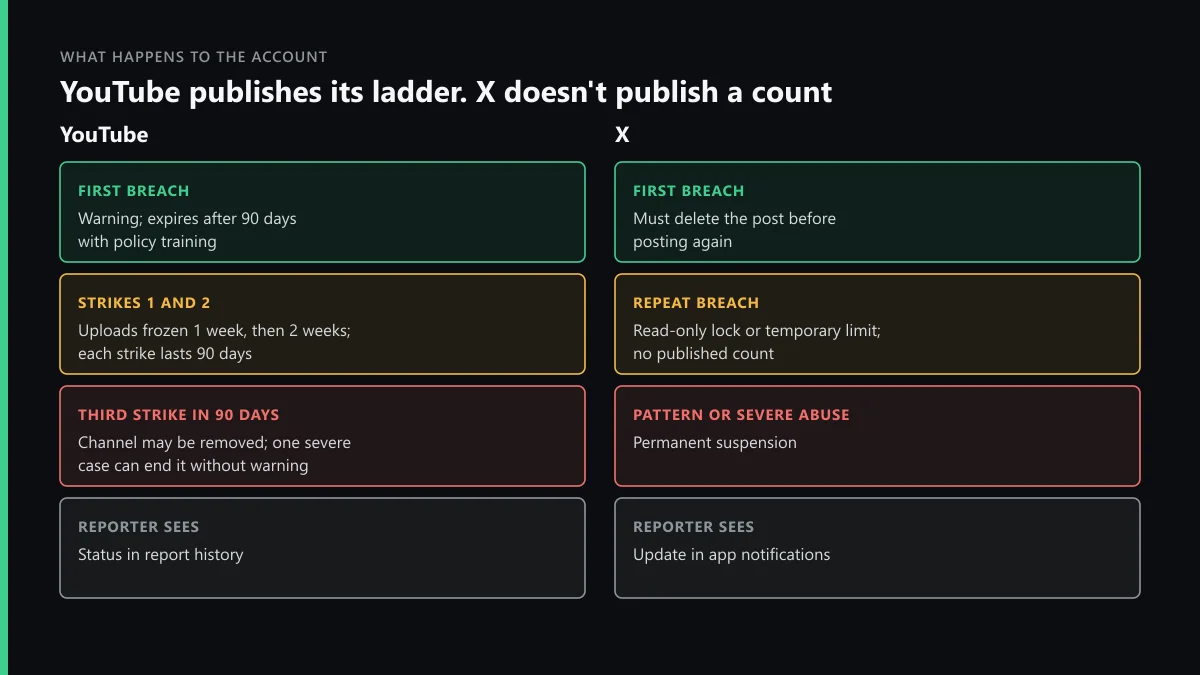
| Stage | YouTube | X |
|---|---|---|
| First breach | Warning; can expire after policy training | Post removal required before the account can post again |
| Repeat breach | Strike: 1-week upload freeze, then 2 weeks | Read-only lock or a temporary limit; no count published |
| Pattern or severe abuse | 3 strikes in 90 days, or one severe case: channel removed | Permanent suspension |
| What the reporter hears | Status in report history | An update in the app notifications |
The practical difference is visibility. A YouTube creator can see their strike count, while X publishes no number, so a harasser on X can't tell how close they are. If you're the one locked out after a dispute, reactivating an X account covers the deactivated case, and checking whether X is limiting your reach covers the quieter penalty.
Cross-platform harassment: YouTube first, then X
Start where the original content lives. Most of the harassment YouTube acts on starts with one video and spreads as clips, quote posts and replies on X. Getting the video removed takes the source out of every repost. Then deal with the X accounts one by one, each against X's abuse rules. X has no inbox for these complaints, and the contact routes X uses instead of a support email list the forms that exist. Before you begin, blocking someone on YouTube and X keeps them out of your mentions while the reports run.
Keep the same order on every site. Capture the evidence, report the exact item, file the side form the flag can't carry, then block.
FAQ
Does YouTube tell the creator who reported harassment?
No. A harassment or hate speech flag doesn't name you. The defamation webform is different: the uploader is told a complaint was filed, though you can ask YouTube not to pass on your legal name and email.
Why did my YouTube report harassment flag come back with no violation?
Usually the video criticises rather than targets, or the report pointed at the channel instead of the exact item. Re-report the specific video or comment with a timestamp, and use the defamation form if the problem is a false claim.
How many strikes before YouTube removes a channel for harassment?
The first breach is usually a warning. After that, the first strike freezes uploads for one week, the second within 90 days for two weeks, and a third within the same 90 days can remove the channel. Severe abuse can end it at once.
Is slander on YouTube handled the same way as libel?
Yes, through the same defamation webform. A recorded video is usually treated as libel because it's published. Live streams can be closer to slander, so save the recording or clip before the stream ends.
Can I sue YouTube over a defamatory video?
Rarely. In the US, Section 230 shields platforms from liability for what users post. A YouTube defamation lawsuit is normally filed against the uploader, and a court can order Google to disclose who runs an anonymous channel.
What should I do if someone threatens to leak a video of me on YouTube?
Don't pay and don't delete anything. Save the threats, report to the police, use StopNCII or Take It Down for intimate images, then file the YouTube blackmail report on the channel or comment.
Does X have strikes like YouTube?
Not a published count. X can ask the person to delete the post, lock the account to read-only until they do, or suspend it permanently for repeated or severe abuse. YouTube publishes its three-strike rule; X doesn't publish a number.