23 October 2026 · Twitter Ban Service · 11 min read
Facebook copyright claim: filing it, and filing the same claim on X
A Facebook copyright claim goes through Meta's intellectual property form: pick Copyright, then Facebook, paste each post link and sign. You don't need an account. If the same copy is on X, file X's own copyright form too; it needs a signed-in account and forwards your full notice to the poster.
What counts as copyright infringement on Facebook, and which report fits?
A Facebook copyright claim is a legal notice to Meta saying a post, photo, video or Page uses a work you own without permission. It isn't a normal report from the three-dot menu. That menu handles community-standards problems; copyright goes through a separate form because the law, not the rulebook, decides it.
Copyright infringement on Facebook usually looks like one of four things: your photos reposted on a Page, your video re-uploaded with the logo cropped, your text copied into a post, or a product listing using your pictures. Most people who hit it also see the copier on X, which is why this page sets the two platforms side by side. The question to settle first is which right you hold, because Meta's form splits on it.
| What you have | The right report on Facebook | The X equivalent |
|---|---|---|
| Your photo, video, music or text reposted | Copyright branch of Meta's IP form | X copyright (DMCA) form, signed in |
| Your brand name or logo used to confuse buyers | Trademark branch | X trademark form, registration number needed |
| Fake goods sold under your brand | Counterfeit branch | X counterfeit form |
| A photo of you that someone else took | Privacy report, not copyright | X private information report |
| Defamation, a court order or a local law | Legal removal request | X legal request routes |
How to file a Facebook copyright claim, step by step
The copyright report form fb filers need is Meta's intellectual property reporting form. It opens signed out, and it covers Facebook, Instagram, Threads and WhatsApp in one place. The order of screens decides most of what goes wrong:
- Answer "What right is being violated or infringed?" with Copyright.
- Pick Facebook as the platform. A copy on Instagram needs its own pass through the form.
- Say whether you are the rights owner or report for them. Agents give the owner's name.
- Describe the original work and, if it is online, link to it.
- Paste the link to every infringing post, photo or video, one per line. A link to a whole profile or Page is weaker than links to the exact posts.
- Sign the statement of good faith and accuracy. A typed full name works.
A copyright report fb confirmation arrives by email with a reference number, and the outcome follows in a later copyright report from Facebook. Keep both: the first email also holds the link to retract the claim. A Facebook takedown request filed with five exact links is processed faster than one with a profile URL and a paragraph of context.
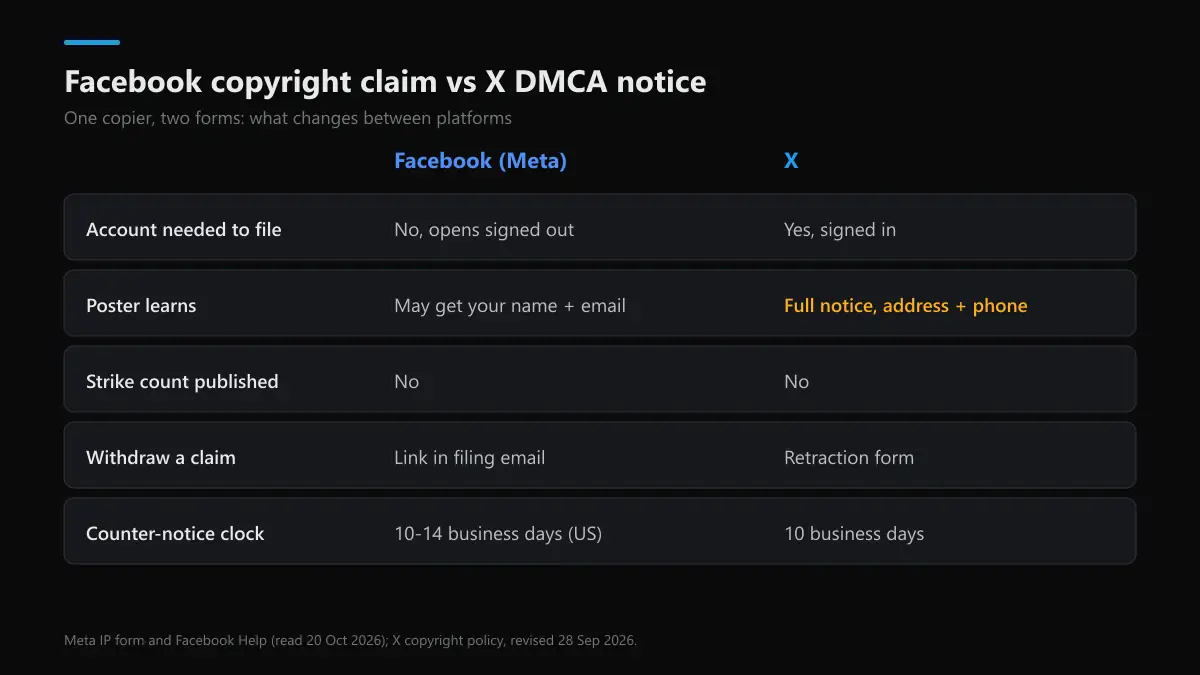
Facebook copyright claim vs X DMCA notice: the same copy on both
File once per platform. Meta can only remove Facebook copies, and X only removes X copies, so a copier who reposts on both needs two claims. They ask for the same core facts, but they differ in ways that matter for your privacy and your timing. X's details come from its copyright policy, revised 28 September 2026, and its IP form.
| Step | Facebook (Meta) | X |
|---|---|---|
| Account needed to file | No, the form opens signed out | Yes, the owner branch says it "requires a X account" |
| Who may file | Owner or authorised representative | Owner or representative; "none" ends the form |
| What the poster learns | May include your name and email | The full notice, including address and phone |
| Strike count published | No number | No number |
| Withdrawing the claim | Retraction link in the filing email | Retraction form or copyright@twitter.com |
| Counter-notice clock | 10 to 14 business days under US law | 10 business days, as X states it |
The privacy gap is the one people miss. If you don't want a copier to see your home address, file X's notice through an agent or with a business address. For the X side, X's support email addresses lists which inboxes still answer, and reaching X customer service covers what to do when the copyright ticket email never arrives.
Facebook DMCA: is a DMCA takedown request different?
Not on Facebook. A facebook dmca takedown request and a Facebook copyright claim go through the same Meta form; the form collects the elements the US Digital Millennium Copyright Act, section 512 lists, and Meta handles filers from other countries through the same screens. People searching facebook dmca often expect a separate email address or PDF. There isn't one you need.
On X the word matters more, because the form's branch is literally named dmca, with sister branches for a counter-notice and a retraction. Who may use that branch on Instagram, the closest Meta comparison, is set out in who can file an Instagram DMCA takedown.
Facebook photos copyright: who owns the picture?
The person who pressed the shutter, unless they assigned the rights or took it as an employee. That one rule settles most facebook photos copyright arguments. A wedding photographer owns the wedding photos, even though the couple is in them. Your selfie is yours. A photo a friend took of you belongs to the friend.
So facebook and copyright infringement only line up when the claimant owns the image. If someone posts a picture of you that they or a stranger took, a copyright claim will usually be rejected; use a privacy report, or an impersonation report if they use the photo to pose as you. On Instagram the same split runs through Instagram's report forms, one by one.
Facebook copyright strikes: how many before a ban?
Meta doesn't say. Its repeat infringer page says an account may be disabled, a Page or group removed, and the ability to post photos or videos limited after repeated copyright reports. It gives no count. Each facebook copyright violation that sticks counts against the account, and a post restored after a successful appeal is "taken into account", so it shouldn't weigh against the poster.
X's policy is just as vague: no published number, and reposting removed material can mean permanent suspension. On both platforms, one valid claim removes a post; a pattern of them removes the account. When a removed account comes back under a new name, a Twitter shadowban check won't help, but filing against the new posts will.
Got a Facebook copyright notice? Your three options
A facebook copyright notice arrives in your notifications and support inbox when someone claims a post you made. Meta's help page on removed content says the poster sees what was removed and who claimed it, and only the poster can appeal; Page admins learn which admin posted, and group admins learn which member.
- You used it without permission. Leave it down. Reposting the same content is the fastest way to a disabled account.
- You had a licence or it's your own work. Appeal from the notification and attach the proof.
- It was a US DMCA removal and you believe it's wrong. Send a counter-notice. Under section 512(g) the content returns in 10 to 14 business days unless the claimant files a lawsuit.
Be careful with emails. Fake copyright notices with a 24-hour deadline and a "review" link to a fake login page are common on X and Facebook alike. Open the notice from inside the app; if a stranger keeps sending them, treat it as fraud, and reporting a scammer on Instagram shows the same pattern on Meta's other app.
Facebook counterfeit report and trademark claims
A facebook counterfeit report is for fake goods: a Marketplace listing, shop or ad selling copies under your brand. It sits in the same Meta form under Counterfeit and asks for your registered trademark. Using your brand name in a Page title without selling anything is a trademark report instead. On X, a pending trademark application isn't enough, and the form wants a registration number and class.
Brand owners who want the matching handle on X face a separate question; claiming a Twitter handle a brand owns explains why X doesn't release usernames on trademark grounds. The Instagram side of the same eligibility test is in who may file a trademark report on Instagram and X.
Facebook legal removal request: when it isn't copyright
A facebook legal removal request covers content that breaks a law other than copyright or trademark, such as defamation, a privacy law or a court order. Meta runs it through a separate legal reporting form, country by country, and it can restrict content only where the law applies. Filing defamation as copyright gets the claim rejected, and filing it repeatedly risks Meta's warning about fraudulent reports, which can end in account termination and, in the US, damages under section 512(f).
Instagram uses the same split; the legal-request side of Instagram lists those routes. If the goal is removing a whole Instagram account, post or Reel rather than one copy, removing an Instagram account, post or Reel covers which report reaches which.
How often do Facebook and X act on copyright infringement?
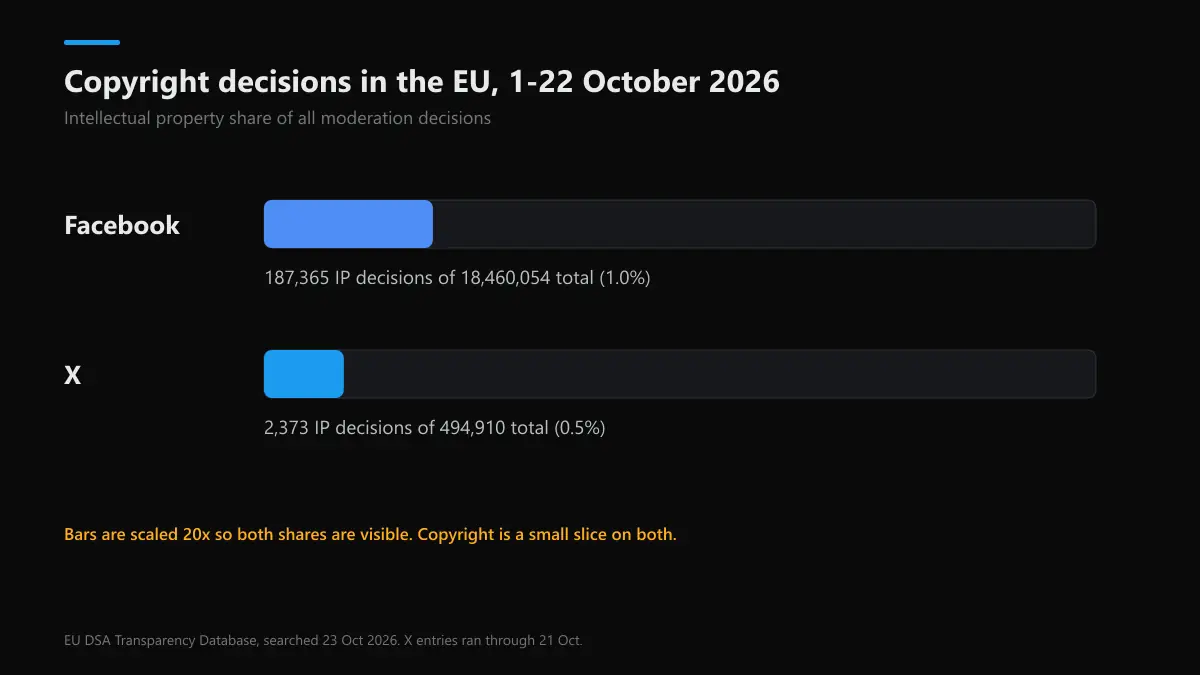
We searched the EU DSA Transparency Database on 23 October 2026 for every decision each platform logged from 1 to 22 October. Facebook logged 18,460,054 statements of reasons, and 187,365 of them (1.0%) were in the intellectual property category. Of those, 182,947 removed content, 34,749 were decided without automation and 3,736 suspended an account.
X logged 494,910 decisions in the same window, the same total we counted for 1 to 21 October, so its 22 October uploads hadn't landed yet. Only 2,373 (0.5%) were intellectual property, and 511 of those were decided without automation. The share is the useful number: copyright is a small slice of each platform's moderation, handled through its own form and queue. It also shows that account suspensions for copyright are rare next to post removals, which matches both policies: claims take down posts first.
When the same copier is on Instagram or X too
Copiers rarely stay on one app. A claim against Facebook posts does nothing to the Instagram or X copies; each needs its own report under its own form. For X, removing copyrighted posts from X and reporting a single X post under the DMCA walk through the signed-in form. On Facebook itself, an account pretending to be you is a Facebook impersonation report, not copyright, and a seller taking payments with your photos is better handled through Facebook's scammer report.
FAQ
How do I file a Facebook copyright claim?
Use Meta's intellectual property form, choose Copyright, then Facebook, and give the link to each post, your contact details, a description of your work and a signed statement. You don't need a Facebook account to file, and every link needs its own line.
Is a Facebook copyright claim the same as a DMCA notice?
For US law, yes in practice: Meta's copyright form collects what a DMCA notice needs. Filers outside the US use the same form; Meta applies its own policy and local law, so there is no separate Facebook DMCA form for other countries.
Does Facebook tell the poster who filed the copyright claim?
It can. Meta says the notice to the poster may include the rights owner's name and email address. X goes further and forwards the full notice, so use an agent or a business address if that worries you.
How many copyright strikes before Facebook disables an account?
Meta publishes no number. Its repeat infringer policy says accounts may be disabled and Pages or groups removed after repeated reports, and that posts restored after an appeal are taken into account.
Can I report copyright infringement on Facebook for a photo of me?
Usually not. Copyright belongs to whoever took the photo. A picture of you posted without consent is a privacy report or, if someone poses as you, an impersonation report.
What should I do with a Facebook copyright notice I think is wrong?
Check the notice inside Facebook, not a link from an email. If the claim is mistaken, appeal from the notification or, for a US DMCA removal, send a counter-notice; the filer then has 10 to 14 business days to go to court.
Do I need two claims if the same copy is on Facebook and X?
Yes. Each platform only acts on its own copies. File Meta's form for the Facebook posts and X's copyright form for the X posts, with the exact links for each.