9 October 2026 · Twitter Ban Service · 11 min read
Instagram legal requests: what goes through the law, what goes through the rules, and how X differs
Instagram legal requests go through forms, not a legal department inbox. A legal removal request on Instagram asks Meta to act under a country's law, but nearly all removals happen under Instagram's own rules: in EU records for 8 September to 7 October 2026, just 386 of 10.4 million Instagram decisions cited the law.
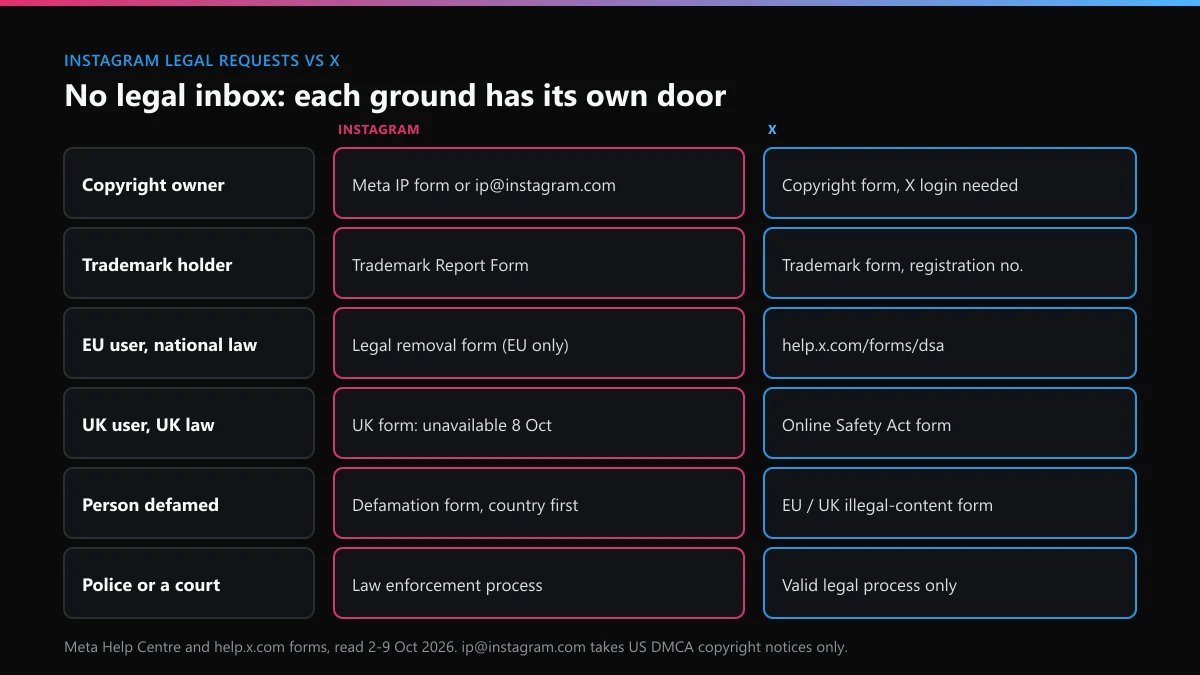
Is there an Instagram legal department you can email?
Not one that takes requests from the public. Anyone hunting for an Instagram legal department email address usually lands on [email protected], and that inbox has one job: it's Instagram's designated agent for copyright notices under the US DMCA. The US Copyright Office's agent directory lists it with Meta's Menlo Park postal address and the phone number +1 650 543 4800; the current designation took effect on 12 December 2025. A defamation complaint or a court order sent there isn't a copyright notice, so don't expect it to be handled as one.
Meta's page for law enforcement prints a postal address for police and courts and warns that it "will not review or respond" to messages from anyone who isn't law enforcement. For EU authorities, Meta's points-of-contact page names Meta Platforms Ireland Ltd on Merrion Road, Dublin. So how to contact Instagram legal department staff, in practice? You don't. You pick the form written for your legal ground, and the form routes it. Our guide to which Instagram report forms still open signed out lists the forms we tested on 8 October.
| Who is asking | Instagram's door | X's door |
|---|---|---|
| Copyright owner | Meta's IP reporting form, no login needed, or a DMCA notice to [email protected] | X's copyright form, which required an X account when checked on 2 Oct 2026 |
| Trademark holder | Trademark Report Form, one registered mark per report | Trademark form with no login; "Pending trademark applications are not sufficient" |
| EU user citing national law | Legal removal request form for EU users; from outside the EU it bounced to the Help Centre home | X's EU form for illegal content at help.x.com/forms/dsa |
| UK user citing UK law | UK unlawful-content form, which led to an unavailable page on 8 Oct 2026 | Online Safety Act report form; X says it doesn't disclose who complained |
| Person defamed | Defamation form; it asks which country's law first | The EU or UK illegal-content form; elsewhere, a rules report |
| Police or a court | Meta's law enforcement process, with legal papers | Account data released only "as required by valid legal process" |
What changes when you cite the law instead of Instagram's rules?
The reach of the result. A post that breaks Instagram's Community Guidelines comes down everywhere. A post that breaks only one country's law is usually made unavailable in that country or territory and stays up for everyone else. Meta's Help Centre explains it with a German example: content illegal there is blocked in Germany, not deleted.
That changes what a legal removal request Instagram receives can achieve. Meta checks a notice against its own rules first, and most notices end there. In Meta's DSA report for January to June 2026, Instagram took 1,820 actions under the law and 66,327 under its terms in response to EU notices. Meta also reported more than 27 million local-law restrictions across Facebook and Instagram in the second half of 2025, down from over 35 million six months earlier.
- Lead with the rule if one fits. Harassment, a scam or a fake account is faster through reporting someone on Instagram for what they did than through a legal claim.
- Cite the law when no rule fits. A true but unlawful disclosure, or speech illegal where you live, is what the legal forms exist for.
- Name both when you can. The legal form lets you describe the content; say which guideline it also breaks. One post rather than a whole account? Reporting a single Instagram post is the shorter path.
What do 30 days of EU records show about legal removals on Instagram and X?
That the word "illegal" means very different things on the two platforms. We counted the EU's DSA Transparency Database, where platforms log every moderation decision affecting EU users, for 8 September to 7 October 2026, on 9 October.
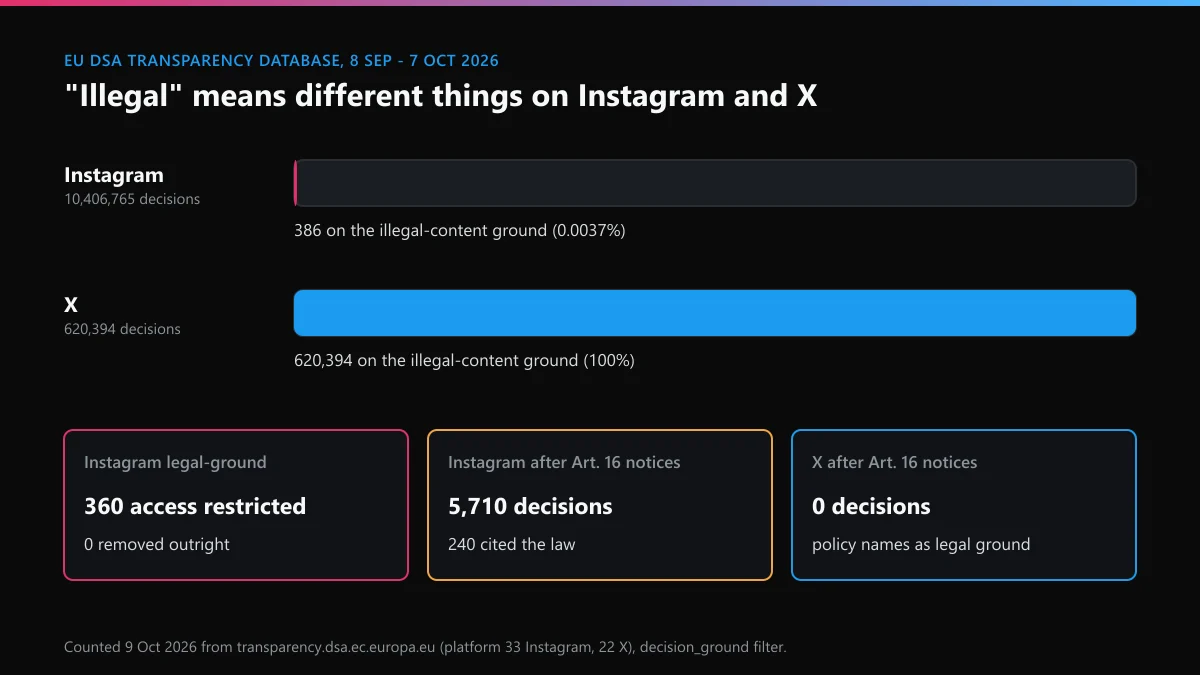
- Instagram logged 10,406,765 decisions in total. Only 386 cited illegal content as the ground, about 1 in 27,000. Of those 386, 360 restricted access and none removed the content outright.
- X logged 620,394, and every one of them was filed on the illegal-content ground. Not one cited X's own terms.
- On EU notices, Instagram recorded 5,710 decisions that followed a notice under Article 16 of the DSA, and 240 of those cited the law. X logged none under Article 16; it files its decisions as "other type of notification".
Read X's figure with care. Its records name the policy as the legal ground, with tokens such as "PlatformManipulation", and describe account suspensions "triggered by the system with no human intervention". A court found nothing. On Instagram the pattern runs the other way: almost every decision is a rules decision, and the few legal ones are country blocks. If you need content gone everywhere, a rules breach is the stronger case on both platforms.
What goes into an Instagram takedown notice?
The same core facts whether you call it an Instagram takedown request or a formal notice: who owns the work, what was copied and where, and a signed statement that you're telling the truth. For copyright, Meta's form and the DMCA agent both expect this list, and an Instagram takedown notice missing any of it gets sent back.
- Your full name, postal address and phone number, or your client's if you're an authorised agent.
- A description of the original work, with a link to where you published it if you did.
- The exact URLs of the posts, reels or profile that copied it. A username alone doesn't point at the content.
- A statement that you believe in good faith the use isn't authorised.
- A statement that the notice is accurate and, under penalty of perjury, that you own the right or act for the owner.
- Your signature. On X's copyright form, typing your full name is enough.
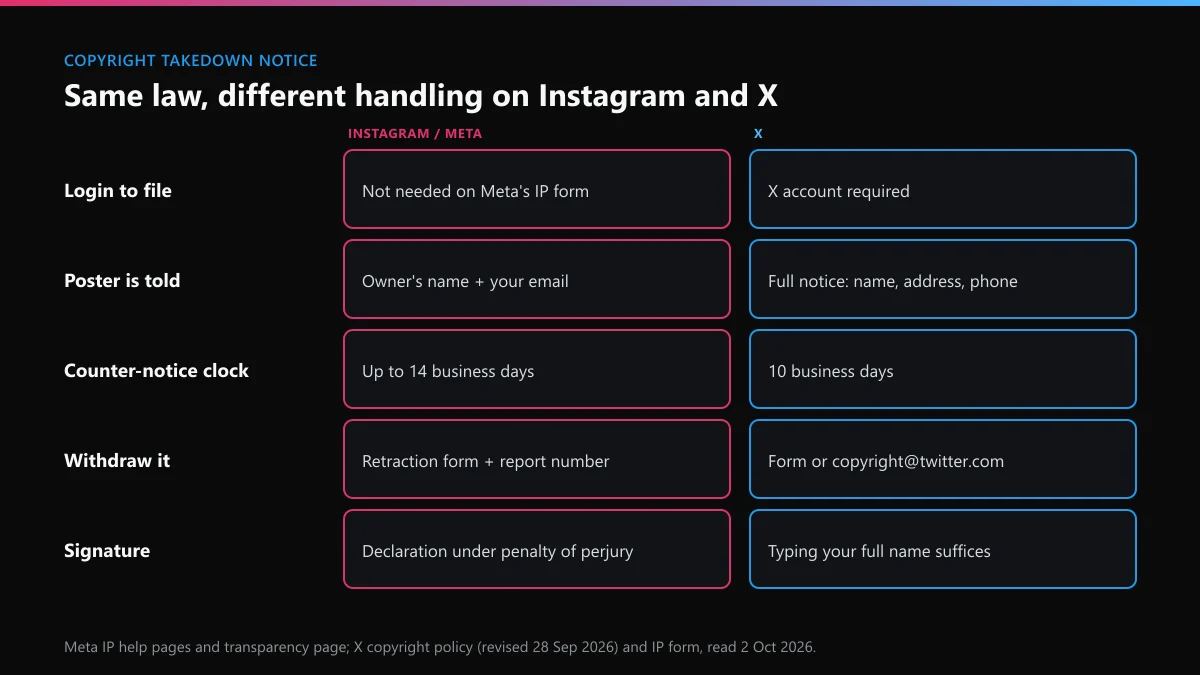
Meta's intellectual property page says valid reports are typically handled "within a day or less". The poster is told the rights owner's name and your email, so it's worth knowing in advance whether the person learns who reported them: on intellectual property reports, usually yes. X goes further and sends the full notice, phone number and postal address included, so its copyright policy suggests filing through an agent if that worries you.
If the post owner fights back, the clocks differ. After a valid counter-notice, Instagram may restore the content within up to 14 business days unless you show you've gone to court; X's window is 10 business days. Filed against the wrong account? Withdrawing an IP report is possible with your report number, and our page on taking back a report you sent by mistake covers the other report types.
Which route takes down a photo of you on Instagram?
It depends on who took the photo, not who is in it. An Instagram photo removal request goes one of three ways.
- You took it. You probably own the copyright, so the IP form above is the fastest Instagram takedown route.
- Someone else took it. Appearing in a photo doesn't make it yours under copyright, so use the privacy violation form (contact/512241091300432). Instagram says it removes such posts if the relevant privacy laws in your country require it, which is why the form asks your country first.
- It's intimate or sexual. Report it as non-consensual intimate imagery straight away. In the US, the TAKE IT DOWN Act requires covered platforms to remove such images within 48 hours of a valid request, and the FTC began enforcing it on 19 May 2026.
Searchers also ask for an Instagram content removal form for other people's posts in general. There's no single one: the privacy, copyright, trademark, defamation and legal forms each cover one ground, and choosing the ground is most of the work.
Can you make Instagram delete an account, or your data?
Your own, yes; someone else's, only on narrow grounds. "Deletion" covers four different requests, and they don't share a form.
An Instagram deletion request for your own account is made by you, signed in, from Accounts Center. The account is removed 30 days after the request, although the period "varies by region", and deletion can take up to 90 days to finish. Instagram's help page says, "For security reasons, we can't delete a profile for you", so the request has to come from inside the account.
An Instagram data deletion request under privacy law, such as Article 17 of the GDPR, now starts at Meta's Privacy rights requests page on help.meta.com; the older Instagram privacy forms redirect there. If an app you logged into with Instagram holds your data, ask the developer. Meta asks such apps for a data deletion request URL, and its callback hands you a confirmation code to track the request.
An Instagram account removal request for someone else needs a ground Instagram recognises:
- A deceased person's account: verified immediate family can ask for removal with documents such as a death certificate; anyone can ask for memorialisation with an obituary link.
- A child under 13: the under-age form, which warns you won't be told whether the account was deleted.
- An impersonator: the impersonation form, or reporting the whole Instagram account or page if it breaks other rules.
- A court order naming the account, sent through the legal route for your country.
Everything else, from rudeness to a grudge, is an ordinary Instagram removal request, which means a report under the rules.
Can a trademark or other legal claim win you a username?
Rarely, and not on X. Instagram allocates usernames first come, first served, and its trademark form lets a registered owner report a mark used in a "profile picture, name, username or bio". The usual result is action against the account, not a transfer to you. X's trademark policy lists suspension, a chance to comply, or permanent suspension. It doesn't promise to release the handle.
So test the name before you spend money on lawyers. Checking if an X name is available takes seconds, an X handle checker runs the variants for you, and a quick X username check tells you why a name failed. An X username shown as unavailable isn't always held by a live account, and a sample of X usernames we found unclaimed shows how small a change can be enough.
When a dormant account sits on your brand, read whether X deletes inactive accounts and prising a name from an inactive X account, then getting an X username someone else holds. Securing a freed handle on X is the last step. Sellers will offer a shortcut; before paying someone for an X handle, see the marketplaces where X handles trade and the risks of X usernames listed for sale. X's rules forbid selling usernames, and a bought one can be taken back.
What if the same person is targeting you on X?
X splits the same harms differently from Instagram, and most of its routes are rules reports rather than legal ones. These are the closest matches for an Instagram legal request:
| On Instagram | On X | Our guide |
|---|---|---|
| Privacy form or exposed private information | Private information and threats to publish it, reported under X's rules | reporting blackmail and doxxing on X |
| Spam and fake-account reports | Bot swarms reported account by account as platform manipulation | clearing bot accounts out of your X replies |
| Account Status after a legal restriction | Reach limits that X doesn't label as a penalty | lifting a shadow ban on X |
If you'd rather contest a visibility limit than wait it out, file a shadow ban appeal on X. Note one date: X's new Terms of Service take effect on 9 October 2026, and outside the EU, EFTA and the UK they send disputes to courts in Texas under Texas law. That matters if you're weighing a lawsuit over X content rather than a report.
What if a legal request is filed against your account?
Treat it as a deadline, not a verdict. On Instagram, removals under the DMCA are contested with a counter-notice, while other removals go to an appeal from Account Status. Appeals win more often than people expect: Meta's DSA report counted 7,816,585 EU complaints against Instagram account bans between January and June 2026, and reversed 2,838,533 of them, roughly 36%.
On X, start by reading the reasons X suspends accounts, then getting a suspended X account reinstated. A ban called permanent has its own track in appealing a permanent X suspension, and unbanning an X account covers what's left. Keep to habits that keep an X account out of trouble while the case is open.
Locked out rather than banned? Try unlocking a locked X account or the X recovery route that fits your case. Missing details have their own fixes: recovery when you've lost the username, finding a forgotten X username, and the options left for an X account deleted more than 30 days ago.
FAQ
What is an Instagram legal request?
Any request asking Instagram to act because of the law rather than its Community Guidelines: a copyright or trademark notice, a removal request under a country's law, a defamation complaint, a court order, or a police request for account data. Each has its own form or process.
Does Instagram have a legal department email address?
Not for the public. [email protected] is the designated agent for US DMCA copyright notices only. Police and courts use Meta's law enforcement process, and everyone else uses the form for their legal ground.
Where is the Instagram legal removal request form?
In the Help Centre article on legal removal requests, and it is offered to people in the EU. When we tried it from outside the EU it bounced to the Help Centre home. UK users have a separate unlawful-content form, which led to an unavailable page when we checked on 8 October 2026.
How long does an Instagram takedown take?
A complete copyright or trademark report is typically handled within a day or less, according to Meta's intellectual property transparency page. EU notices took a median of 28.89 hours from notice to action in January to June 2026, counting only notices Instagram acted on.
Will Instagram remove content worldwide after a legal request?
Only if it also breaks Instagram's rules. Content that breaks just one country's law is usually made unavailable in that country. In EU records for 8 September to 7 October 2026, 360 of the 386 legal-ground decisions restricted access and none removed the content.
Can I ask Instagram to delete someone else's account?
Only on grounds it recognises: impersonation, a child under 13, a deceased person's account requested by verified family, or a court order. Otherwise you report the account for breaking the rules and Instagram decides.