2 October 2026 · Twitter Ban Service · 13 min read
How to avoid a Twitter ban when a machine makes the first call
To avoid a Twitter ban, stay clear of the patterns X's systems catch on their own: follow churn, copy-paste replies, hashtag piles, engagement swaps, automation apps, mass reporting and new accounts during a suspension. Daily limits only trigger an error message. Patterns trigger suspensions, and X marked 98% of its September 2026 EU suspensions fully automated.
What does X count before anyone reads your posts?
Behaviour, mostly. X's Authenticity policy says that when its systems "detect suspicious levels of activity", an account may be locked and asked for a phone number or a puzzle, and none of that waits for a person to read a post.
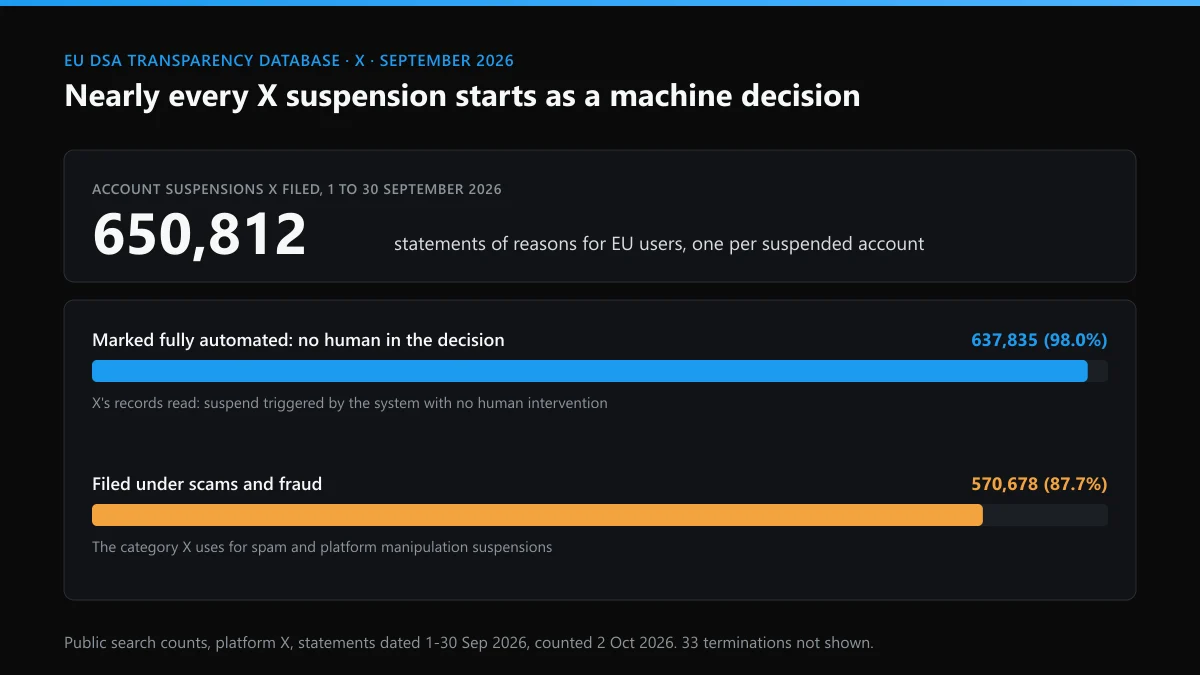
The clearest public view of how mechanical this is sits in the EU's DSA Transparency Database, where X must file a statement of reasons for each restriction it puts on a user in the Union. We counted X's filings dated 1 to 30 September 2026 on the morning of 2 October. There were 650,812 account suspensions. X marked 637,835 of them, or 98.0%, as fully automated decisions, and it filed 570,678, or 87.7%, under the scams and fraud category. Only 33 accounts were terminated outright. Those numbers cover EU users only, and they say nothing about how many of the suspensions were deserved. They do settle one thing: on X, the first decision about your account is almost always made by software.
So the practical way to avoid a Twitter suspension is to stop resembling the accounts that software is tuned to catch.
Software misfires too. On 13 March 2026, Nikita Bier, then X's head of product, posted that a new spam filter had falsely tagged a subset of accounts for about 12 hours, and that 99% of them had been reverted. A glitch like that is outside anyone's control. The distance between your normal habits and the patterns those filters hunt for is not.
Which everyday habits get people banned on Twitter?
Patterns, not volume. X's limits page says that hitting a ceiling, such as 400 follows or 500 direct messages a day, earns "an error message telling you which limit you've hit", and the counter resets with time. Suspensions come from behaviour described in the Authenticity and automation rules, and that behaviour can trip a filter far below any ceiling.
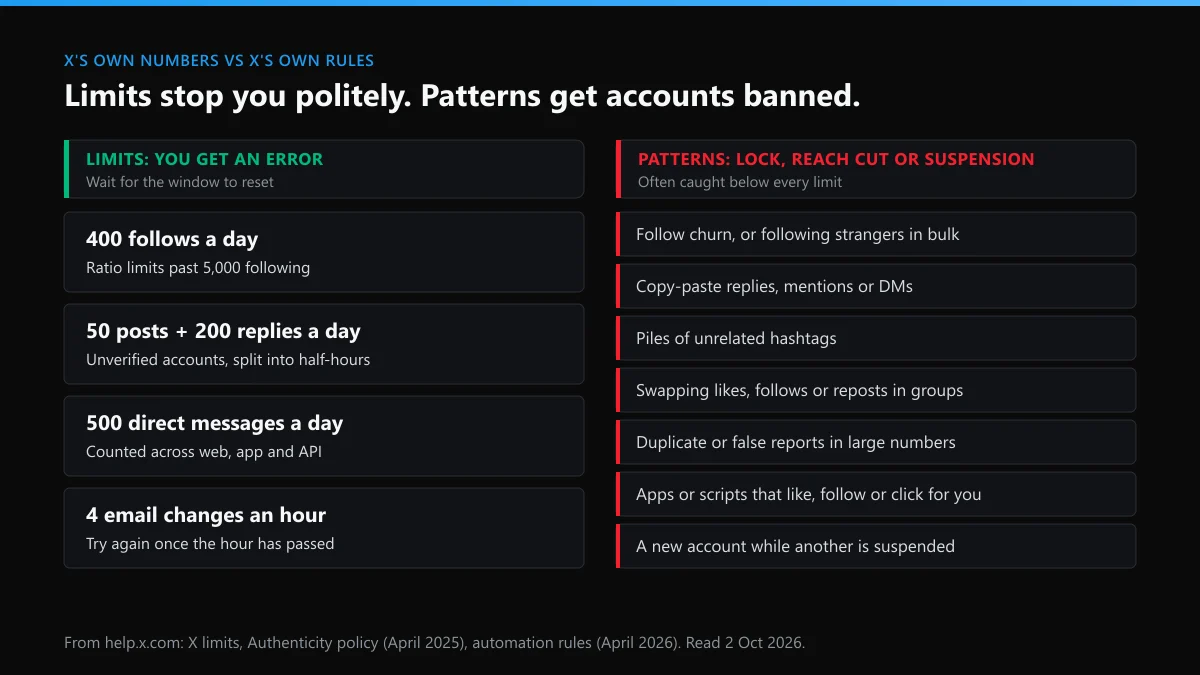
When we read the limits page on 2 October 2026, one sentence did most of the work. The 400-follow cap is "a technical account limit only, and there are additional rules prohibiting aggressive following behavior." Staying under 400 proves nothing, in other words. An account that follows 150 unrelated strangers in ten minutes and drops them the next day is doing what the policy calls follow churn, whatever the counter says. The same page adds that limits count actions "from all devices", the API included, so a scheduling app and your phone draw from one allowance. Unverified accounts get 50 original posts and 200 replies a day, split into half-hour slices.
| Habit | Where X's rules draw the line | What to do instead |
|---|---|---|
| Follow-for-follow sprees, then mass unfollows | "Follow churn" and "indiscriminate following", particularly by automated means | Follow accounts you would actually read, a few at a time |
| The same reply pasted under trending posts | "Copypasta" and replies irrelevant to the original post | Write a reply for the post in front of you, or skip it |
| Eight hashtags on every post | "Excessive, unrelated hashtags" in one post or across many | One or two tags that describe the post |
| Like-for-like pods and engagement groups | Coordinating to exchange Likes, Reposts, Replies or Follows | Let reach come from the posts themselves |
| Auto-likers, growth apps, browser scripts | Automation rules (April 2026): no automated likes, no follower-growth apps, no scripting the X website | Revoke anything you don't recognise in Apps and sessions |
| Bare links, post after post | Links shared without commentary making up the bulk of your activity | Say in a line why the link is worth opening |
| Editing a popular post into an ad | Deceptive edits that reuse a post's engagement for different content | Publish the promotion as a new post |
| Buying, renting or selling an account or handle | Trading, buying or selling access to accounts and usernames | Use X's own route for a dormant handle |
That last row trips up more people than you'd think. If the handle you want sits on a dormant account, our guide to claiming an inactive X username covers what X permits. Paying the current holder for it falls under the account-trading ban.
Does Twitter (X) IP ban you, and how do I avoid a Twitter IP ban?
X does not publish an IP ban as a penalty, and none of the rules pages we read on 2 October 2026 mentions blocking an IP address. What it does say is wider: after a suspension it can also suspend "any other account we believe the same account holder or entity may be operating", and it doesn't list the signals behind that belief.
That gap is why IP-ban stories never die. Someone is suspended, opens a fresh account on the same phone and the same home Wi-Fi, and loses it inside a week. From the outside, it looks as if the address is blocked. Under the policy the explanation is plainer: the new account is a second account run by a suspended person, which is ban evasion whatever network carries it. A VPN doesn't change that ruling, only the disguise. When we checked the results for "how to avoid Twitter ban" on 2 October 2026, we saw several antidetect-browser vendors ranking, and their whole pitch is hiding a new account from that judgement, which is the one move the policy names as a violation in its own right.
The honest worry is narrower. If you share a campus, office or family network with someone who was suspended, X won't tell you what its "same account holder" decision rests on. What protects you is having nothing to explain: your own phone number and email on the account, your own content and no shared logins. X's suspended-accounts help page admits that "sometimes a real person's account gets suspended by mistake", and the appeal form exists for exactly that case.
Public Wi-Fi carries a different risk. The Authenticity policy lists logging in "on a compromised network" as one way accounts get hijacked, and a hijacked account that starts spamming gets suspended like any other.
What is ban evasion on X, and how do I avoid Twitter ban evasion flags?
Ban evasion is any attempt to keep using X after an enforcement action against you. The Authenticity policy names four forms: creating new accounts, imitating a suspended account to replace it, repurposing an existing account, and "having someone else operate an account on your behalf". The flag attaches to the person rather than the device, and it reaches backwards, covering other accounts "regardless of when the other account was created".
Three ordinary situations lead people into it without any intent to dodge anything.
Your old side account becomes your main one
Your main account is suspended, so you start posting from the meme account you opened in 2019. The policy calls that repurposing an already-existing account, and it's the commonest way one suspension becomes two. Appeal the original first and leave the others quiet until you have an answer.
A friend posts for you while you're suspended
A social media manager running a brand's account is fine. A friend posting your threads from their account while yours is suspended is not.
Extra accounts that start working together
X lets one person "create and/or operate up to ten (10) accounts for different, non-duplicative purposes". Its own examples include a personal account alongside pseudonymous or hobby accounts, brand accounts in several languages and separate accounts for separate branches. Trouble starts when the accounts cooperate: boosting the same hashtag, liking the same posts, replying under each other or cross-posting identical text. When X decides a group of accounts breaks the rule, it may ask you to "choose one account to keep", and suspends the rest. Give each account a distinct job, never use one to lift another, and never open a new account while another is suspended. X's page on enforcement notices says a permanently suspended person will not be allowed to create new accounts, so the appeal form is the only clean way back.
How can I avoid a shadow ban on Twitter?
Avoid the behaviour X punishes with what it calls restricting reach, since that is what people mean by a shadow ban. In X's own list, a reach limit can exclude posts from search, trends and recommended notifications, drop them from the For You and Following timelines, confine them to your profile and push them down in replies.
Most of the triggers sit in the content-spam section of the Authenticity policy: link-only posting, replies that have nothing to do with the original post, hashtag stuffing, posting and deleting the same thing over and over, and editing a link so it lands somewhere new. Adult or graphic media is a separate matter. X's enforcement page says it may put such media behind a warning screen, which is not a penalty on the account.
The same enforcement page says posts limited for breaking a rule get a visible label that the author can appeal. It still describes those labels in the future tense, as something that would begin in April 2023, so treat a label as likely rather than certain. A reach drop with no label and no notice is very often a drop in interest instead, and no setting fixes that.
EU users have one extra lever. In July 2024 an Amsterdam court found that X had breached the Digital Services Act in a shadow-ban case brought by a user, Danny Mekić, because X had restricted his account without telling him why.
How long does a Twitter shadowban or suspension last?
X publishes no fixed number of hours for any of its penalties. Its enforcement and Authenticity pages, as we read them on 2 October 2026, set conditions rather than clocks, and the length depends on which of six things happened.
| What happened | When it ends | What still works meanwhile |
|---|---|---|
| A daily limit | When the window resets; post limits run in semi-hourly slices, and X says to try again in a few hours | Everything except the capped action |
| An anti-spam lock | When you clear the phone, email or puzzle challenge | Nothing public: the account drops out of follower counts, Reposts and Likes |
| Read-only mode | X only calls it temporary; any time limit is in your notice | Reading timelines, and DMs to followers only |
| A required post removal | When you delete the post or win the appeal | Reading, but no new posts |
| A reach limit on one post | No published end date; a label, where shown, can be appealed | The rest of the account |
| A suspension | A successful appeal; severe violations are permanent at first detection | Signing in to file the appeal |
Ranges like "12 hours to 7 days" circulate on third-party sites, but the current enforcement page we read contains no such figure.
Can a verified (Premium) account get banned or shadowbanned on X?
Yes. X's Premium FAQ says "The X Rules won't apply differently to subscribers", and that enforcement cases stay with the existing enforcement teams under the current review process. Paying buys features and help with the subscription itself, not protection.
Premium can even add costs when things go wrong. X treats subscriptions as non-refundable and names those linked to suspended accounts, and it can remove the checkmark. The 50-post and 200-reply ceilings on the limits page are written for unverified accounts, so subscribers get more room, including more room to post at a pace the content-spam rules dislike. A higher ceiling isn't an invitation to fill it.
Why can buying a report bot get your own account banned?
Because X bans it by name. The Authenticity policy prohibits using report features "manually or through the use of automation, in order to submit duplicate or false reports in large numbers", coordinating others to misuse reporting, and using or promoting third-party services to do any of it. The person who pays for the reports is the one breaking the rule.
Sellers leave that part out. We've examined this market from several sides: what a Twitter mass report bot actually does once it's downloaded, why paying to mass report a Twitter account doesn't move X's review queue, and which of the mass-report sellers we checked could show any evidence at all. The same report-count myth is sold under other labels, as a Twitter ban tool or a Twitter report tool, and an offer to get someone banned from Twitter for a fee usually means fake reports filed from accounts that are themselves at risk. For how long a genuine report takes to reach a decision, our X report-to-ban timeline lays out the stages.
Other platforms get the same pitch. Sellers push an Instagram spam report bot and Instagram mass report packages with identical promises, an Instagram account takedown still needs a real violation behind it, and our TikTok page looks at whether mass reporting works on TikTok at all. Everywhere, one accurate report with evidence beats a hundred copies, and only the accurate one puts the sender at no risk.
Content rules that catch ordinary accounts
Most people assume these rules exist for trolls. X's enforcement page says it suspends accounts for "repeated violations" or for single violations that cause significant risk, so a run of borderline posts can count as much as one bad one.
Heated arguments are where ordinary accounts slip. Slurs and dehumanising language get posts removed, and a pattern of them puts the whole account at risk; our page on what X treats as hate speech shows where the line sits. Joining dozens of others against one person can amount to targeted harassment on Twitter even when each reply looks mild on its own, because the target experiences the pile, not the single reply.
Parody accounts are the next trap. X requires a PCF label, an avatar that isn't identical to the original, and words such as "parody" or "fan" at the start of the account name and in the bio. Skip those and the account reads as a fake Twitter account, however obvious the joke feels to you. When the copying runs the other way and someone imitates you, the routes are X's impersonation removal process and the impersonation report that removes copied tweets. Media is the third. Films, music and photos you don't own invite copyright notices, repeat notices put an account at risk, and our guides to filing a DMCA report on a Twitter post and Twitter copyright removal show that process from the rights holder's side.
Selling is the last one. Counterfeit listings break X's trademark rules, and brand owners do chase them, as our note on what to do when a counterfeit report is ignored explains. Giveaway schemes, money-flipping and phishing sit under the scams rule, so learn to spot a Twitter scammer before you repost one, and to report a brigading or job scam aimed at your followers.
How to avoid a Twitter ban this week: what should you check first?
Start with what is connected to the account, then its habits. These six checks take about fifteen minutes and cover most of what X's automated systems look for.
- Revoke apps you don't use. Open Apps and sessions in Settings and privacy and remove every connection you don't recognise. X's automation rules make you responsible for what those apps do in your name.
- Remove clicking extensions. Anything that likes, follows, replies or scrolls for you in the browser has to go. Scripting the X website is the automation X singles out for possible permanent suspension.
- Add a current phone number and email. Then an anti-spam lock costs you one code instead of the account.
- Audit your extra accounts. One purpose each, no cross-boosting, and none opened while another account was suspended.
- Read your last 50 posts. Look for copy-paste replies, hashtag stacks and link-only posts, and pace any large clean-up. Before wiping years of history in one go, read what bulk-deleting your tweets costs in 2026. If you'd rather leave altogether, deleting your Twitter account permanently is cleaner than abandoning it.
- Quit the shortcuts. Leave engagement pods and stop paying any service that sells likes, follows or reports.
When someone else is trying to get you banned
Report them accurately and keep your own account calm while you do. Bad-faith reporting is itself a breach of the Authenticity policy, which lists reports submitted manually and in good faith as the allowed use.
Start inside X. Our walkthrough on how to report an X account covers profile-level reports, while reporting a single tweet deals with one post, and it helps to know what a Twitter report can remove before you file. Nobody outside X can delete someone else's X account, whatever a seller claims. When the campaign comes from an account that clearly breaks the rules, we can help take down a Twitter account through official channels or remove posts about you that cross a legal line. Where the harm is serious enough for court, working out who you'd actually sue matters more than suing X.
Our other Twitter account reporting guides are on the solutions page, and the Twitter Ban Service home page explains how we work. If an account is impersonating you or organising reports against you, send us the details with links and screenshots, and we'll tell you plainly whether it breaks a rule X acts on.
FAQ
How do I avoid getting banned on Twitter with a brand-new account?
Fill in the profile, add a phone number and an email address, and let activity build at a human pace. A new account that follows hundreds of strangers on day one, replies with bare links or posts the same sentence again and again matches the follow-churn and content-spam patterns X's systems are built to catch.
Does using a VPN get you banned on X?
Not by itself. None of the X rules pages we read forbids a VPN, and plenty of people use one for privacy. It becomes a problem when it is used to run a new account during a suspension, because that is ban evasion however the connection is routed.
Can scheduling posts get my Twitter account suspended?
Scheduling through X itself or an app that uses the official API is allowed. The automation rules forbid automated likes, follower-growth apps, auto-replies triggered by keyword searches alone and scripting the X website, and AI reply bots need X's written approval first.
Will X warn me before it suspends my account?
Sometimes. For an isolated or first offence, the Authenticity policy describes lighter steps, from requiring you to delete posts to a temporary lock. For severe violations it says accounts are permanently suspended at first detection, with no warning step in between.
Can I get banned for reporting too many accounts?
Yes, if the reports are duplicates or false. X bans submitting duplicate or false reports in large numbers, by hand or by automation. Paying a service to file them for you counts against your account too. Reporting several accounts that genuinely break the rules, one honest report each, is the use X explicitly allows.
Does deleting a flagged post lift the restriction?
When X requires a post to be removed, deleting it is what lets you post again, or you can appeal the removal request instead. Deleting posts does not reverse a suspension. That needs X's appeal form, filed while signed in to the suspended account.
Is a temporary lock the same as a ban?
No, a lock asks you to confirm a phone number, an email address or a puzzle, and it lifts once you do. A suspension is a decision that the account broke a rule, and only a successful appeal reverses it.
Can an AI-generated profile photo get my account banned?
Only when it is used to deceive. X's Authenticity policy lists stock, stolen or AI-generated profile photos among the marks of a fake persona when the purpose is misleading people. A plainly stylised avatar on an honest account is not what that rule is aimed at.