8 September 2026 · Twitter Ban Service · 13 min read
Twitter scammer or a real account? The 8 signals that decide
A twitter scammer is identified by signals, not instinct: a display name that borrows a brand its @handle does not match, a missing parody label, a link that resolves somewhere else, and an unprompted DM. Two of those together justify a report. One rarely does.
How do you spot a twitter scammer before you engage?
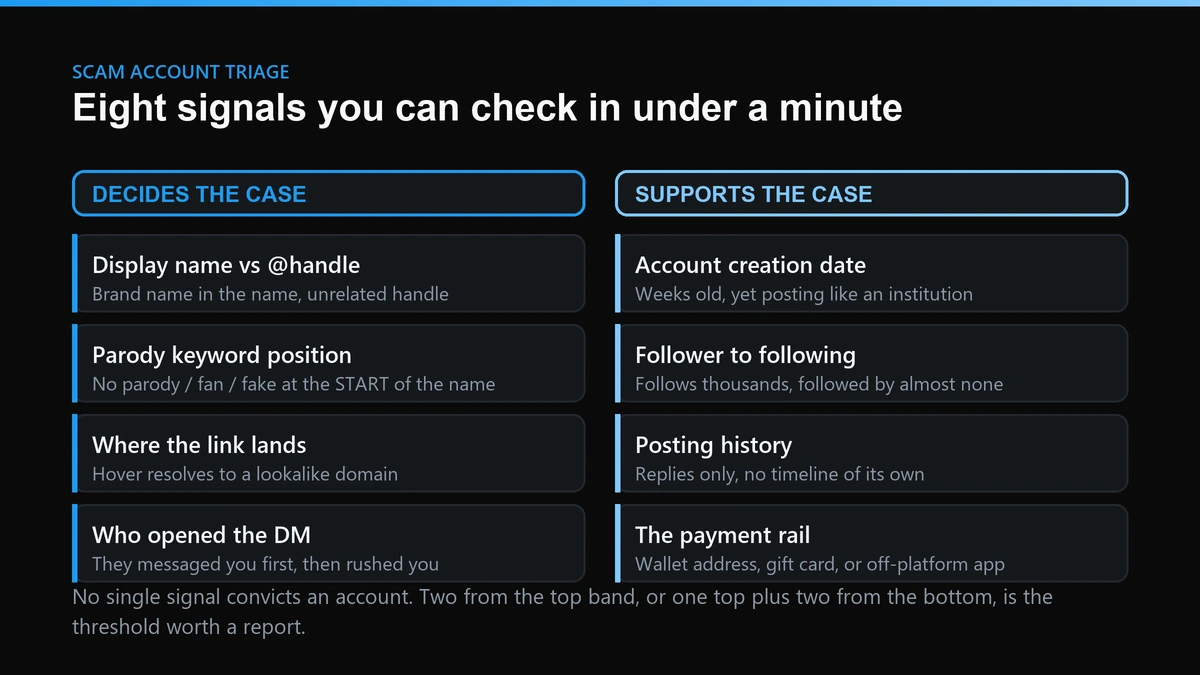
Read four things before you read the pitch: the display name against the @handle, the age of the profile, where its links actually resolve, and who opened the conversation. Every one of those is visible in about forty seconds and none of them depends on judging a stranger's tone. Tone is what the scam is built to get right.
That ordering matters because social platforms have become the main delivery route for fraud. Bitdefender's Consumer Cybersecurity Survey put social media at 34% of scam delivery, ahead of email, in analysis published in March 2026. The volume means you will meet these accounts whether or not you go looking, so a repeatable check beats a good instinct.
Our work on X takedowns starts the same way every time, and the full solutions index covers the routes that follow once an account is identified. The checks below are the part you can do yourself, today, before anyone else is involved.
Which signals actually separate scam accounts from real ones?
Eight, split by how much weight each carries. Four of them can decide a case on their own; four only corroborate. Most guides list red flags without ranking them, which leaves you with a pile of suspicions and no threshold.
| Signal | A real account | A scam account | Weight |
|---|---|---|---|
| Display name vs @handle | Handle matches or abbreviates the name | Brand in the name, unrelated handle full of digits | Decides |
| Parody keyword position | Label sits at the start of the name, if it is a parody | No label, or one buried at the end | Decides |
| Where the link lands | Resolves to the organisation's own domain | Lookalike spelling, shortener, or a fresh domain | Decides |
| Who opened the DM | You made contact first | They arrived unprompted with a deadline | Decides |
| Account creation date | Age matches the history it claims | Weeks old, posting like an institution | Supports |
| Follower to following ratio | Roughly proportionate either way | Follows thousands, followed by almost nobody | Supports |
| Posting history | A timeline of its own | Replies only, clustered under big accounts | Supports |
| The payment rail | Checkout on the company's own site | Wallet address, gift card, or a chat app | Supports |
Two signals from the deciding band, or one plus two from the supporting band, is the point where a report is justified. Below that you are looking at an account that is merely odd, and odd is not reportable. A different rulebook applies when an account is attacking you rather than defrauding you, and that split decides which form you file: sustained pile-ons belong under targeted harassment on Twitter, while an attack on a protected characteristic goes through the hateful conduct route. Holding that line is what keeps your own record clean, for reasons the last section explains.
Which twitter scam is it, and what does each one ask for?
Five families cover almost everything on X, and each is identified by its ask rather than its story. The story changes weekly. The ask does not.
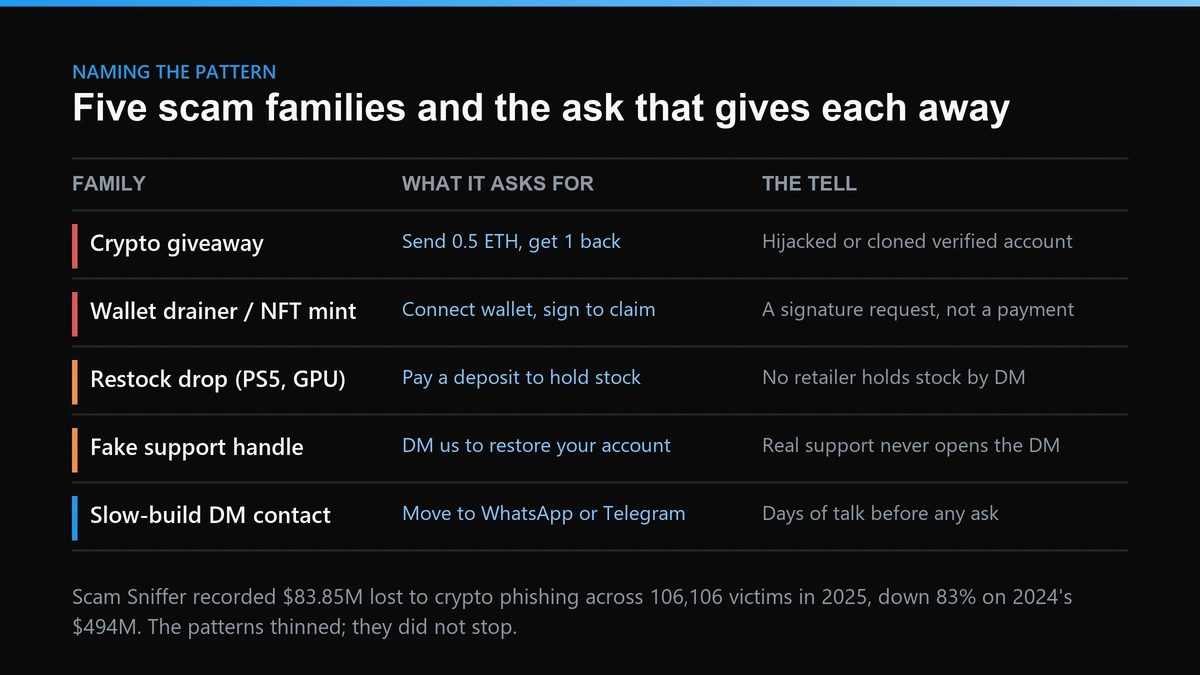
A twitter crypto giveaway scam promises to return more than you send, usually from a hijacked or cloned account wearing a verified badge. Researchers at Italy's CNR traced one such campaign in detail: 143 accounts posted 146,546 tweets promoting a fake Uniswap giveaway and collected roughly $100,000 of UNI between 18 and 28 September 2020. As Cola, Mazza and Tesconi record in that paper, 48 of those 143 accounts were still active as of February 2023.
Newer twitter cryptocurrency scam pages ask for a signature instead of a transfer, which is why victims describe losing funds without ever pressing send. Scam Sniffer counted $83.85 million lost across 106,106 victims during 2025, down 83% on the $494 million of 2024, with the largest single theft at $6.5 million through one Permit signature in September. Any crypto scam twitter thread ending in "connect your wallet to claim" belongs in this family.
Where an nft scam twitter link actually leads
To a signing prompt, not a mint. An nft scam twitter post advertises a drop, routes you to a cloned marketplace page, and asks you to approve a transaction that hands over spending rights on assets you already hold. Read what the wallet is asking before you approve it. Artwork is set dressing.
Why the ps5 twitter scam still works
A ps5 twitter scam runs on scarcity rather than greed, which makes it feel unlike fraud. Its operator claims to be holding restock and wants a deposit to reserve a console, something no retailer does, in DMs or anywhere else. Sneaker drops and graphics cards recycle that script whenever supply tightens.
One family moves slower than all of these. A stranger talks for days, asks for nothing, then moves the conversation to WhatsApp or Telegram before money is ever mentioned. Patience is the tell there, not urgency. If the account is impersonating a business rather than inventing one, the counterfeit and brand-abuse route applies instead, and coordinated pile-ons and recruiter fraud are handled in our guide to brigading and job scams on X.
Does a blue check mean an X account is real?
No. The blue check has indicated a paid X Premium subscription since legacy verification was retired in 2023, so it confirms that someone pays, not that anyone confirmed who they are. Gold and grey badges mark verified organisations and government bodies respectively, and those still involve vetting.
This matters because the badge is the cheapest prop in the giveaway playbook. A cloned account with a subscription outranks the real one in replies and reads as legitimate to anyone scanning quickly. Check the handle and the creation date instead. When a badge and a two-week-old join date appear together on an account claiming to be a bank, the badge is the weaker evidence of the two. Handle availability itself is worth understanding here, since scammers hunt abandoned names the same way legitimate users do, a process covered in claiming an inactive username on X. Readers who suspect their own reach has been throttled rather than a rival's account boosted will find the mechanics in our note on ban tools and shadow banning.
Parody, fan, or a fake X account? Read the display name
X gave you a bright-line test on 10 April 2025, when parody, commentary and fan accounts became required to carry a keyword at the start of the display name and forbidden from reusing the depicted entity's avatar. Names get truncated in feeds, so a label at the end was hiding the disclosure exactly where it mattered.
Apply it directly. An account mimicking a person or brand whose name does not begin with "parody", "fan" or "fake", and which wears the same profile picture, is not a protected parody under the current rules. That is a fake x account in the sense X will act on, and the x fake account you are looking at has failed a published test rather than your personal taste. Non-compliance draws visibility limits, labels or suspension.
A twitter fake account report on that basis goes through the authenticity route rather than the spam menu, because the breach is identity, not behaviour. The evidence pack and the wording differ from a scam filing, and we set both out in filing a Twitter impersonation report. Not every counterfeit profile is reportable in the first place, and what X removes versus what it protects separates the four situations that share the name. Where a specific post rather than the whole profile is the problem, the post removal route is narrower and usually faster, and content you own outright may qualify for the DMCA process, which is the one route that does not stay anonymous. The wider question of which instrument closes an account at all is set out in how a Twitter account is taken down.
What does "scam likely" mean on Twitter, and is Scam Sniffer an X tool?
Neither phrase describes anything X does. "Scam Likely" is a caller-ID label your phone carrier applies to inbound calls, and X ships no equivalent badge, so a search for scam likely twitter mostly returns accounts that adopted the phrase as a joke handle. There is no hidden flag on a profile waiting to be read, and searching very scam likely twitter surfaces handles rather than any platform feature.
Scam Sniffer is real, useful, and not part of X. It is a Web3 anti-phishing firm publishing loss data and a browser extension at scamsniffer.io, posting as @realScamSniffer. Anyone searching scam sniffer twitter is looking for that account, not for a reporting route. Its extension warns about drainer sites before you sign; it cannot suspend anything, and neither can any other third-party checker. Only X removes accounts from X, which is also why tools promising bulk removals are what they are, examined in the mass report bot question and in the mechanics of mass reporting an account.
"I accidentally reported your account" is the opener, not the notification
If a stranger DMs to say they reported you by mistake, you are being phished. X sends no such notice, and no third party can withdraw a report on your behalf. Bitdefender documented the script in March 2026: the approach runs "I was scammed by someone with a similar profile, I accidentally reported your account, can you help me fix it?", after which the target is moved to a fake support contact and asked for personal details or a payment to restore the account.
The whole thing runs on a false premise, which is what makes it durable. People believe reports can be reversed, so a message offering to reverse one feels plausible. Anyone searching twitter accidentally reported scam is usually two steps into that conversation already. Treat the DM as the incident, report it, and change nothing about your account settings at a stranger's request.
When we filed a batch of scam cases last winter, two of the accounts renamed themselves midway through review, which left the handle in our evidence pointing somewhere the reviewer could no longer match. Screenshots of the profile, the post and the DM thread, taken before anything is submitted, now go into every file we open. Adjacent questions about who is even permitted to act on someone else's profile are covered in who can delete another person's X account, while people looking to close their own account will want permanent deletion or the narrower bulk tweet removal.
What does a wrong twitter scam report cost you?
Your own account, in the worst case. X's Misuse of Reporting Features policy prohibits coordinating or encouraging others to file reports under false pretenses, and states that X may weigh metrics such as actionable and inactionable rates as a percentage of a reporter's overall reporting volume. Good-faith reports you genuinely believe describe a breach are explicitly permitted.
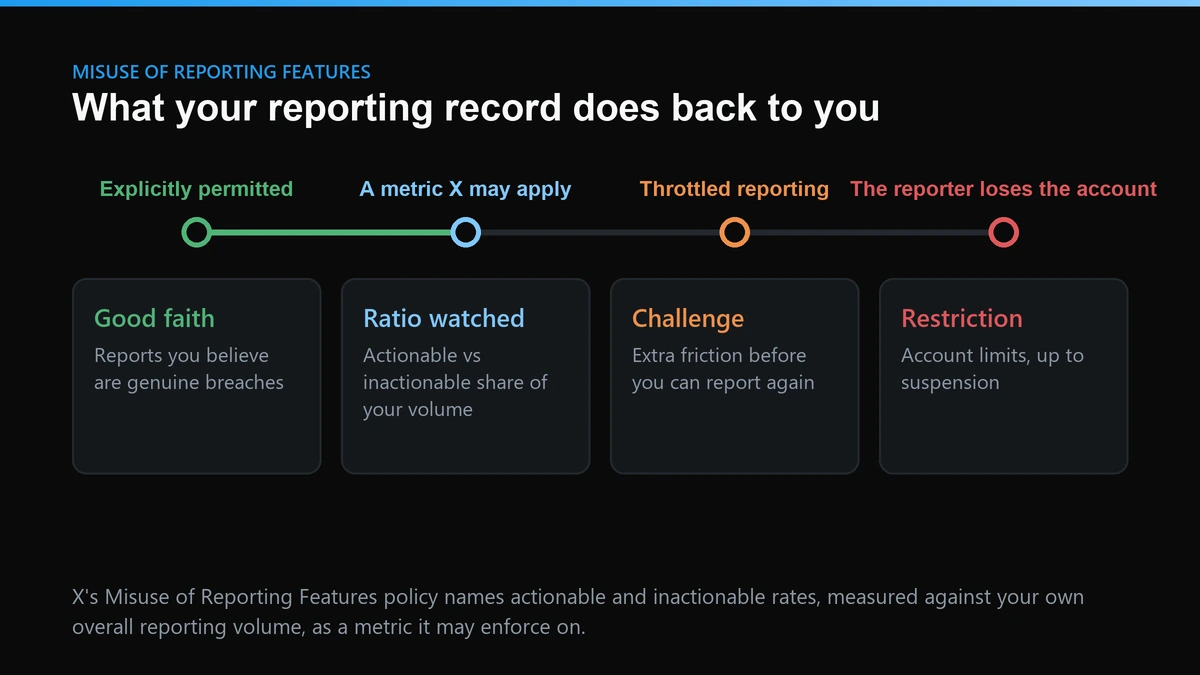
Read that as a ratio you carry. Filing eight thin reports to catch one real breach moves your inactionable share in the wrong direction, and the account that pays for it is yours rather than the scammer's. That is the practical argument for the threshold in the signals table, and it is the reason a twitter scam report filed on evidence beats a dozen filed on suspicion. Twitter Ban Service submits and escalates the case; X alone decides the outcome, and no honest service can promise otherwise. The same restraint applies across platforms, which is why our notes on whether mass reporting works on TikTok, on Instagram mass reporting, on Instagram spam report bots and on Instagram takedowns reach the same conclusion from different directions, as does our guide to getting someone banned from Twitter the honest way.
Reporting is also not a delete button, which the Uniswap campaign above makes plain: 48 of those 143 accounts survived more than two years past the fraud. So pick the category that matches the breach, file once with your screenshots attached, and stop. If it stalls, escalate through the routes in reporting an X account and the per-violation report guide rather than filing again, or send us the case.
Sources
- Misuse of Reporting Features Policy · X Help Center
- Report an impersonation account · X Help Center
- 2025 crypto phishing losses, 3 January 2026 · Scam Sniffer
- Cola, Mazza and Tesconi, From Tweet to Theft · arXiv 2406.18503
- Scams on X, March 2026 · Bitdefender
- X's parody account requirements · Social Media Today
FAQ
How to report a scammer on twitter when no menu option says scam?
Pick the category that describes the behaviour, not the outcome. A fake giveaway or a drainer link goes in under the suspicious or spam route, which maps to X's financial scam and platform manipulation rules. An account wearing a brand's name and picture goes in as impersonation instead, through the authenticity form. The category decides which reviewer queue reads it.
How to report fake twitter account profiles without an X account of your own?
X accepts impersonation reports from people who do not hold an account, through the web form rather than the in-app menu. You will be asked for the impersonating handle, the identity being copied, and proof that you are that person or their authorised representative. Government ID is the usual proof for an individual.
Does the person find out who reported them?
No. X does not pass your handle to the account you reported, and there is no notification telling someone a report exists. Copyright is the documented exception, because a DMCA complaint carries the complainant's details. Anyone who messages you claiming to know you reported them is guessing or running a script.
How many reports does it take to get a scam account suspended?
There is no threshold number, and volume is not what moves a case. One well-evidenced report naming the right rule outperforms fifty identical ones, which X's misuse policy treats as a signal against the reporters. Ten friends filing the same thin complaint changes nothing except your own actionable rate.
Can you undo a report you sent by mistake?
X publishes no withdrawal route, so treat every submission as final. That sounds harsher than it is. A single honest mistake carries no penalty, because the misuse policy targets patterns rather than one mis-tap. Ignore any page promising an undo trick, and ignore any stranger offering to fix a report on your behalf.
Is an Elon Musk crypto giveaway on X ever genuine?
No giveaway that requires you to send funds first is genuine, whoever appears to be running it. Doubling your money is the whole mechanic, and a deepfaked video stream does not change it. Treat any request to connect a wallet and sign to claim as the same trap wearing different clothes.
What comes first if you have already sent money to a scam account?
Start with your bank or card issuer, because a reversal window closes in hours and no platform report can recover funds. File with the FBI's IC3 or your national fraud service next, then report the account to X so the profile stops reaching other people. Reporting protects the next target, not your balance.