8 September 2026 · Twitter Ban Service · 13 min read
Targeted harassment on Twitter, and what X requires before it acts
Targeted harassment on Twitter has a narrower definition than most guides suggest. X's Abusive Behavior policy prohibits malicious, unreciprocated targeting of individuals, usually by mentioning or tagging them, and treats humiliation as an aggravating factor rather than a requirement. Reports fail most often because the conduct sits outside those words.
What is targeted harassment on Twitter, in X's own words?
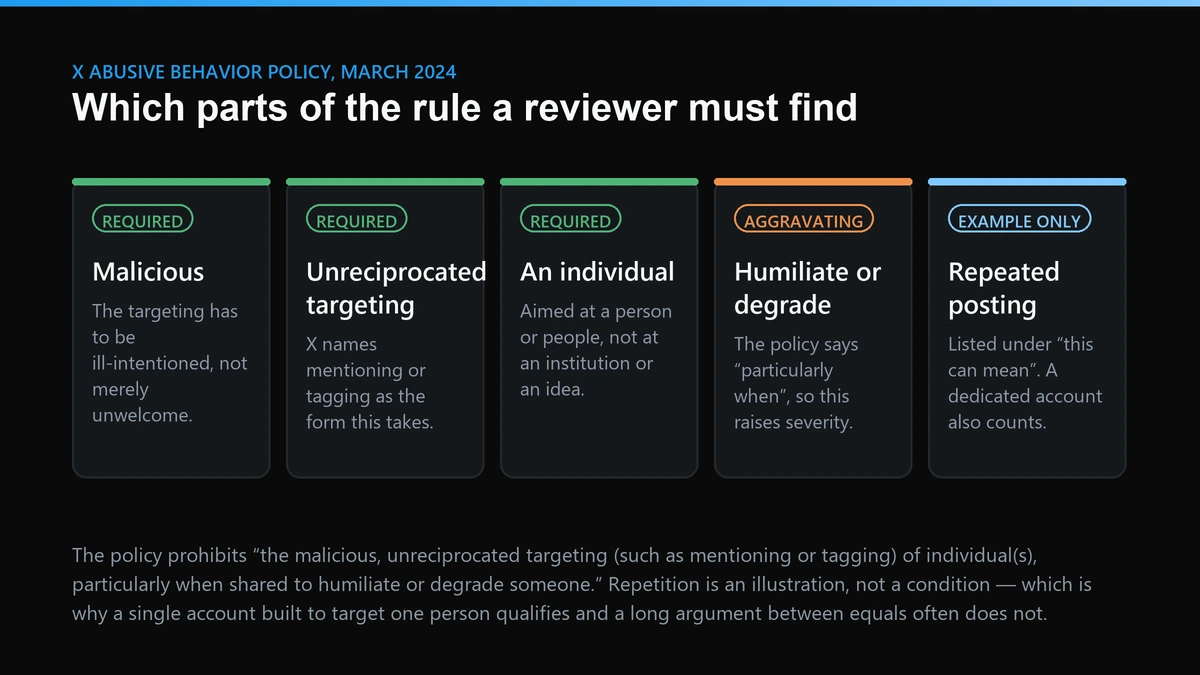
It is a defined offence with a short definition, not a general word for unpleasant treatment. The Abuse and Harassment policy, last dated March 2024, states: We prohibit the malicious, unreciprocated targeting (such as mentioning or tagging) of individual(s), particularly when shared to humiliate or degrade someone.
Twenty-two words, and every dispute about a refused report lives inside them.
Read the sentence slowly and the structure appears. Three things are required: malice, targeting that is not reciprocated, and a human being on the receiving end. Humiliation is introduced by particularly when
, which makes it an aggravator that raises severity rather than a gate you must pass. Repetition is not in the definition at all. It arrives afterwards as an illustration, under the words this can mean
, alongside a second illustration that matters far more than people expect: accounts dedicated to harassing an individual.
That second illustration is the reason a brand-new account with one post can be actioned while a fortnight-long argument between two equals is not. The first is dedicated to a target. The second is reciprocated, and reciprocation is fatal to the claim.
Where the twitter harassment policy sits among X's other rules
Targeted harassment is also only one clause of a larger rule, and the neighbouring clauses have their own tests: an attack that hooks onto a protected characteristic is judged as hateful conduct rather than harassment, and an account pretending to be you is handled as a deceptive identity case. The same twitter harassment policy covers violent event denial, incitement of harassment, unwanted sexual content and graphic objectification, insults, and the use of prior names and pronouns. Each clause is judged on its own terms, which is why choosing the right one at the point of reporting changes the outcome more than anything you write afterwards.
Does your case clear the bar, or only feel like it should?
Run the three required elements against your own facts before you file anything. This is the step almost no guide includes, and it is the step that separates a report that gets actioned from one that is closed within a day. Be unsentimental about it. A reviewer who has never met you will apply the words above to a handful of posts, with none of the history you carry.
| Your situation | Malicious? | Unreciprocated? | Aimed at a person? | Likely reading |
|---|---|---|---|---|
| An account posting replies about you daily, none of which you answer | Yes | Yes | Yes | Squarely inside the rule |
| A handle created to post about you and nothing else | Yes | Yes | Yes | Named in the policy as a dedicated account |
| A row you have been trading insults in for a week | Arguable | No | Yes | Reciprocated, so the claim usually fails |
| Harsh criticism of your company, product or public argument | No | Yes | No | Criticism of ideas and institutions is protected |
| One rude quote post with no tag, name or photo of you | Arguable | Yes | Weakly | Targeting is hard to evidence, so severity drops |
| A pile-on where each account posts once | Yes | Yes | Yes | Fits, but files better as coordinated behaviour |
The last row deserves care. A crowd arriving at once is real harassment and it is exhausting, yet each individual account may only have posted a single reply, which reads thinly on its own. Cases like that are stronger when the coordination itself is the claim, and we set out that route separately in the guide to coordinated pile-ons and hate raids.
Notice what is missing from that table. No column for how upset the conduct made you, and none for how many people reported it.
Can you report harassment aimed at someone else?
Anyone can file, but not every clause can be carried by a bystander. X's policy says plainly that Anyone can report violations of this policy using our dedicated reporting flow
, then immediately qualifies it: the team sometimes need to hear directly from the person being targeted
before it acts. The reporting screen reflects this by asking who the report is for, offering Myself, Someone else or a specific group of people, and Everyone on X.
Choose honestly. A bystander report is genuinely useful for surfacing an account, and it is the right route when the target is offline, frightened, or a person you are trying to protect. It is weaker when the clause turns on how the conduct landed on a specific person, because only that person can supply the missing context. One sub-policy makes this absolute rather than occasional: for the use of prior names and pronouns, X says it must always hear from the target
.
If the account is impersonating the person rather than abusing them, the case belongs in a different queue altogether, and the impersonation report route moves faster because the evidence is documentary. Where the question is who has standing to act at all, the same logic governs who X will hear from on deletion requests.
How to report harassment on Twitter: the three choices that set the outcome
Reporting harassment on Twitter is not one decision but three, and the clicking is the least important of them. X rebuilt this flow around what it calls a symptoms-first
approach, which asks you to describe what is happening before it asks you to name a rule. That change helps distressed reporters and hurts precise ones, because the wrong description quietly routes a strong case to the wrong reviewer.
- Who the report is for. Myself carries the clauses that need the target's voice. Someone else surfaces the account but may stall on those same clauses. Everyone on X suits content that harms the platform generally rather than one person.
- Which rule you are invoking. Abuse and harassment, hateful conduct, violent speech and private information are separate policies with separate tests. A death threat filed as harassment is measured against the weaker rule and often survives.
- How much of the pattern you attach. X states that
Multiple posts can be included in the same report
, and it may ask you to select more posts from the account for context. One post describes an incident. Five describe a campaign.
That third choice is where most reports are quietly lost. A pattern is the thing the policy actually prohibits, so a report carrying one screenshot asks a reviewer to infer the pattern from nothing.
Reporting harassment on Twitter when you are the target
When we first filed cases under this wording at Twitter Ban Service, we learned to read the reported posts back against those twenty-two words before touching the report screen at all. The ones that went nowhere had gone wrong at the selector rather than in the writing, and no amount of rephrasing rescued them afterwards. Filing in your own name matters here too, because the clauses that turn on how the conduct landed are the ones X will not decide without the target. If you want the mechanics of the report screens themselves, the walkthrough sits in our guide to how reporting works on X, and the rule-by-rule map is in the per-violation report routes.
When the in-app route stalls: the Twitter abuse report form
X publishes a standalone form as an alternative to reporting from the post itself, linked from its own help page on how to report abusive behavior with the line You can also use our form to report abusive behavior
. It sits under help.x.com/en/forms/safety-and-sensitive-content, the same hub that carries the impersonation, private information and sensitive media branches.
How to report someone on Twitter for harassment once the posts are gone
The twitter abuse report form earns its place in two situations. The first is when the posts have already been deleted and there is nothing left to press the report button on, which happens constantly once a harasser senses a case building. The second is when the in-app flow gives you no branch that matches the facts. Working from the form also lets you describe a sequence rather than an incident, which is the shape this policy is written to catch.
It is not a shortcut. A report abuse form submission enters the same queue and is measured against the same rule, so a weak case does not become strong by changing the door it arrives through.
Why does X return "no violation" on harassment that is plainly real?
Because the policy carves out several things that feel like harassment and are not, and because two procedural mistakes account for most of the rest. X's own text names the carve-outs. Posts that look harmful in isolation may read differently in a longer conversation; friends using terms between themselves is given as the example. Calling attention to, condemning or highlighting someone's harmful behaviour is protected counter-speech even when it quotes the abuse. And criticism of institutions, practices and ideas
is explicitly outside the rule, which is the single most common reason a business owner's report is refused.
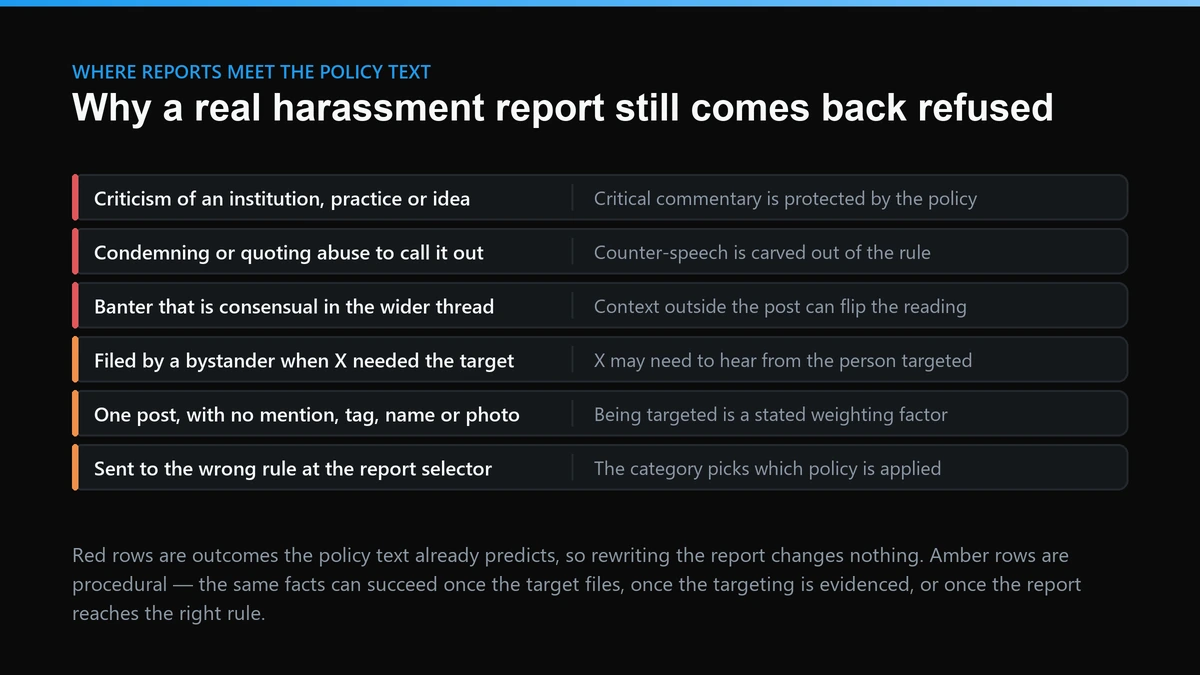
| Reason it was refused | Fixable? | What actually changes it |
|---|---|---|
| The posts criticise your work, not you | No | Nothing on X. Defamation or copyright may apply instead |
| The account was condemning conduct, not committing it | No | Nothing. Counter-speech is carved out by design |
| Context in the wider thread reads as consensual | Rarely | Evidence that you asked them to stop and they continued |
| Filed by a bystander on a clause needing the target | Yes | The target files, in their own name |
| A single post with no mention, tag, name or image | Yes | Attach the pattern, and evidence the targeting |
| Sent under the wrong policy at the selector | Yes | Re-file under the rule the conduct genuinely breaks |
Scale explains the rest. X's Global Transparency Report for H2 2024 records 927,892 accounts suspended and 1.49 million posts labelled or removed under abuse and harassment in that half-year. Set against the tens of millions of reports the same report logs, suspension is plainly the exception rather than the ordinary outcome. Those figures also moved in opposite directions: posts removed fell about 43% against the first half of 2024, while suspensions fell only about 15%. Reports are counted per submission rather than per account, so the ratio describes volume against outcomes, not the odds on any one case.
What should you change before you file again?
Fix the case, not the wording. A second report identical to the first is measured by the same rule and closed the same way, so the only useful re-file is one carrying something the first lacked.
- Collect permalinks rather than screenshots alone, since a deleted post takes your evidence with it. Keep dated screenshots as a backup.
- Establish the targeting explicitly. A mention, a tag, your full name, or your photo is what turns a rude post into a targeted one, and X names that distinction as a factor it weighs.
- Show that it is unreciprocated. If you replied early on, note where you stopped, because the argument matters less than the point at which you disengaged and they did not.
- Pick the clause deliberately. Threats, private information and hateful conduct each have their own rule and a lower tolerance than general abuse.
- File as the target where the clause requires it, even if a friend reported first.
Twitter Ban Service handles the assembly and the escalation of these files; the decision itself always belongs to X, and no service can promise a suspension. Where the harassment has spread beyond one platform, the same evidence usually needs restating in each venue's own language: our notes on Instagram takedowns, Instagram mass reporting, the risks of an Instagram spam bot, and whether TikTok mass reporting achieves anything cover the equivalents. If what you actually want is your own posts gone rather than theirs, that is a different job again, covered in deleting your own account and clearing your own timeline.
Where does a refused report go next in the EU?
Into a complaints process X is legally required to run. Under Article 20 of the Digital Services Act, anyone who has submitted a notice, not only the person whose content was removed, may lodge a complaint against the decision, electronically and free of charge, for at least six months from being told the outcome. X must handle it in a timely and non-arbitrary way, and must reverse a decision not to act where the complaint shows it was unfounded. This is the route almost no guide mentions, because it is written from the reporter's side rather than the poster's.
If the internal complaint fails, Article 21 opens a certified out-of-court dispute settlement body. The Appeals Centre Europe is one, and its figures are instructive for anyone whose harassment report was refused: across more than 24,000 disputes handled between April 2025 and March 2026, it sided with the user 63% of the time in cases where a platform had chosen to leave content online. That is the exact posture of a rejected harassment report. The catch is real and worth stating plainly: Article 21 decisions do not bind the platform, so the body's finding is persuasive rather than enforceable.
Outside the EU there is no equivalent reporter-side appeal, which is why the evidence work has to happen before the first submission rather than after the refusal. Where the conduct crosses into threats or stalking, treat it as a police matter first and a platform matter second.
Sources
- Abuse and Harassment policy (March 2024) · X Help Center
- How to report abusive behavior on X · X Help Center
- Our range of enforcement options · X Help Center
- Global Transparency Report, H2 2024 · X
- Article 20, internal complaint-handling system · Digital Services Act
- Appeals Centre Europe · Article 21 dispute settlement body
Related routes on this site: Twitter Ban Service covers the wider service, the full index sits under our X takedown solutions, and you can open a case directly. For adjacent problems see mass reporting an account, mass report bots, getting an account banned, taking an account down, shadowban checkers, removing a single post, the DMCA route, counterfeit reports that stall, the signals that mark a scam account, and claiming an inactive handle.
FAQ
Does the number of reports change whether X suspends an account?
No. X lists the factors it weighs when setting a penalty: the severity of the violation, whether someone was targeted, and the account's previous record of rule violations. Report volume is not among them. Ten thoughtful reports from ten people who were each targeted carry weight because each one is evidence; a hundred from strangers who saw a screenshot do not.
Will the person find out that I reported them?
X does not tell the reported account who filed. There is an indirect tell in Direct Messages, because reporting a conversation stops that account from messaging you and clears the thread from your inbox, which is visible to them. In replies and quote posts, nothing identifies you.
How long does X take to respond to a harassment report?
X says a confirmation message may take up to 24 hours to appear, but it publishes no deadline for the decision itself. Treat any site quoting a fixed 24 to 48 hour turnaround as guessing. The honest answer is that review time varies and X does not commit to one.
Can I report harassment that happened in Direct Messages?
Yes. Open the conversation, select the information icon, then Report, and choose the abusive or harmful option. X may ask you to select further messages for context. Reporting also stops that account from messaging you, though the thread resumes if you message them again afterwards.
Does blocking someone weaken a later harassment report?
Blocking does not invalidate a report, but it does make evidence harder to collect, because you lose the live view of the account's replies and mentions. Capture permalinks and dated screenshots first, file second, then block. The order costs nothing and protects the record.
What if the account keeps coming back on a new handle?
That is ban evasion rather than a fresh harassment case, and it is judged under a different rule with its own evidence needs. The link between the old and new handle is what matters. Keep a log that spans both, noting timestamps and any repeated phrasing that ties them together. Persistent stalking may also be a criminal matter where you live.
Is misgendering or deadnaming reportable on X?
Only in part. X reduces the visibility of posts that deliberately use a previous name or the wrong pronouns where local laws require it, so the outcome depends on your jurisdiction. That sub-policy is also the one place X says it must always hear from the target, so a bystander report will not carry it.