9 September 2026 · Twitter Ban Service · 13 min read
Fake Twitter account: what X removes, what it protects, and what it cannot reach
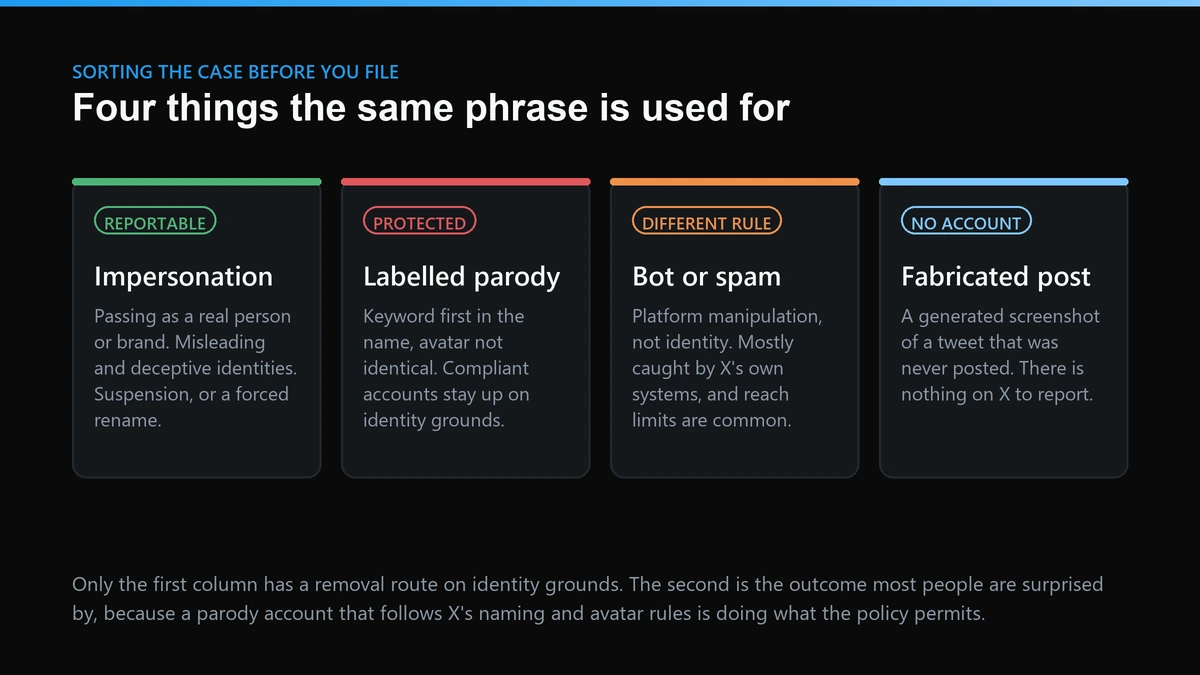
Fake Twitter account covers four different situations on X, and only some have a removal route. An account impersonating a real person or brand is reportable under X's misleading and deceptive identities policy. A correctly labelled parody account is not. Bots fall under a separate rule, and a fabricated screenshot is not an account at all.
Four different things share one name on X
The phrase does four jobs at once, which is why generic advice about it so often fails. Someone searching for a fake account twitter problem might be looking at a clone of their own profile, a satirical account they find irritating, an engagement bot, or a screenshot circulating on another platform entirely. X has a different rule for each, and for one of them it has no rule at all because there is nothing on the platform to act against.
Sorting the case first is not pedantry. It decides which form you open, what evidence a reviewer will expect, and whether the honest answer is that nothing can be done through X.
| What you are looking at | The rule that applies | Where it goes | Realistic outcome |
|---|---|---|---|
| An account passing itself off as a real person or brand | Misleading and deceptive identities | The standalone impersonation form | Suspension, or a forced change of name and avatar |
| A parody, commentary or fan account that follows the naming rules | Permitted under the same policy | Nowhere. It is allowed | No action on identity grounds |
| An automated or engagement-farming account | Platform manipulation and spam | The in-app spam report | Usually reach limits rather than the suspension you wanted |
| A generated image of a post that was never published | None, unless it was posted on X | The host that is actually carrying the image | Nothing X can remove from its own platform |
Row two is the one that surprises people. A fake account on twitter that carries the word "parody" at the front of its display name and does not reuse your photograph is doing what the policy expressly permits, and reporting it repeatedly achieves nothing except a record of reports that did not stick. Each row gets its own section below, beginning with how to tell them apart. If you already know the account is impersonating you and want the mechanics, what reporting an X account actually does covers the enforcement ladder in more detail, and the routes for taking an account down sets out the non-policy options. Twitter Ban Service files and escalates the report; X makes the final decision, and no service can promise otherwise.
How can you tell if a Twitter account is fake?
Start with the profile photograph, because it is the signal that has survived every rule change. Run it through a reverse image search. A stolen portrait usually surfaces on a real person's other profiles, and a generated face tends to return nothing at all while still looking oddly centred, with the eyes at the same height in every crop.
Then read the account's history against its claims. The join date sits on every profile, and an account created three weeks ago that talks as though it has years of standing is thin. Compare the handle character by character with the real one, since swapped letters, an inserted underscore and trailing digits remain the cheapest disguise on the platform.
Engagement direction matters more than engagement volume. Real accounts are talked to; fake ones mostly talk at people, replying into large threads and initiating direct messages with strangers. Where the account's angle is money rather than identity, the behavioural tells run deeper than the profile, and the signals that separate a scam account from a real one goes through them properly. Recruitment fronts follow their own pattern, which reporting job scams and coordinated abuse on X covers.
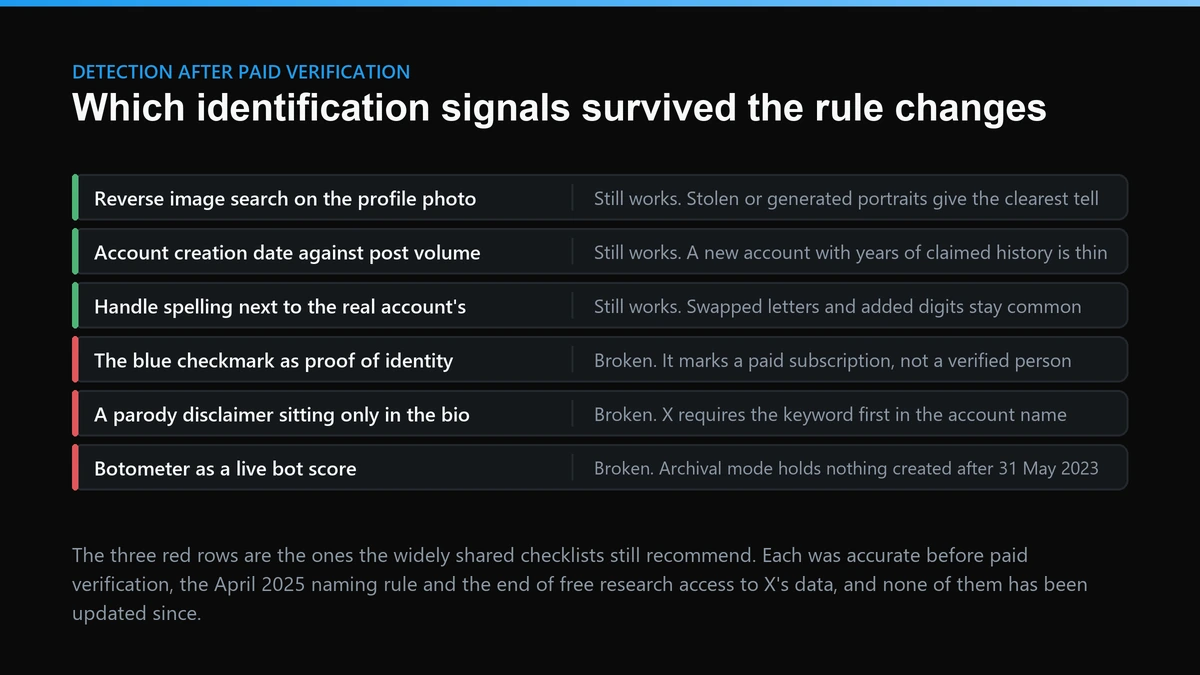
Three of those rows deserve their own sections, because each is advice that was correct when it was written and has expired since without being withdrawn.
Does a fake Twitter account checker do what the name suggests?
Mostly not. Search that phrase and the results are dominated by follower-audit products, which scan the follower list of an account you control and estimate how much of it is inauthentic. That is a useful thing to buy if you are auditing your own audience, and it is not the thing you wanted, which was a verdict on one suspicious profile.
The tool people actually mean is Botometer, built by the Observatory on Social Media at Indiana University, and it no longer works the way the guides recommending it describe. Free research access to X's data ended, and the project rebuilt it as Botometer X in archival mode in February 2024, serving pre-calculated scores from data collected before June 2023. In its own words, no records exist about accounts created after 31 May 2023. An impostor account registered last month is therefore invisible to it, and a "no data" result says nothing about whether the account is real.
Twitter fake account detection, and why the research stalled
Academic work has the same dependency problem. The most cited recent study, by Hickey and colleagues in PLOS ONE on 12 February 2025, found no significant reduction in inauthentic activity across the period it examined, with crypto-promotion accounts rising rather than falling. It also stops at June 2023, for the same reason Botometer does, so treat it as evidence about the problem's shape rather than its current size.
X's own numbers are fresher. X's head of product Nikita Bier wrote in October 2025 that "this week we purged 1.7 million bots engaging in reply spam", which tells you both that the population is large and that X removes it in sweeps rather than one report at a time. For what a genuine reporting workflow looks like once you have decided an account is fake, routing a report to the right violation is the practical companion, and the shadowban checkers people confuse with ban tools covers the other half of the tool question.
The checkmark stopped being evidence of anything
A fake verified Twitter account is not a contradiction in terms. The blue mark signals an X Premium subscription rather than a verified identity, so an impersonator can buy one at the price of a monthly fee.
Elon Musk, a fake verified Twitter account, and the 2022 wave
That mechanism produced the clearest public demonstration anyone has. When paid checkmarks went on general sale in November 2022 at eight dollars a month, an account renamed to @EliLillyandCo posted "We are excited to announce insulin is free now" and collected more than 1,500 reposts before it was pulled. The pharmaceutical company apologised on 10 November 2022, and Forbes reported its share price falling 4.37% in the aftermath. Nothing about that account was verified except the payment.
X does operate real identity verification, and this is the part the guides miss: it is a separate, optional feature. Premium subscribers can confirm a government ID and a selfie through the vendor Au10tix to earn a distinct identity label, and Social Media Today's coverage of the rollout notes it was not available in the EU, the EEA or the UK at launch. Claims circulating in 2026 that ID checks became mandatory for all new subscribers do not hold up. Nothing obliges the person impersonating you to prove who they are.
Two other badges behave differently and are worth knowing. Gold marks a verified organisation on a business subscription, and grey is assigned by X to government and multilateral accounts, which is why neither can simply be purchased by an impostor. Read the badge as a statement about billing, then go back to the profile itself for the actual evidence. Where the impersonation is commercial rather than personal, the counterfeit route has its own failure modes, set out in why a counterfeit report gets ignored. If the impostor also took the handle you wanted, claiming an inactive username explains what X will and will not release.
When does a Twitter parody account cross into impersonation?
At the display name, in almost every case. X tightened this in April 2025, and the announcement from its safety account is unusually specific: from 10 April, all parody, commentary and fan accounts must "include PCF-compliant keywords at the beginning of their account names and avoid using identical avatars to the entities they depict." Two requirements, both testable in about five seconds.
The twitter parody account rules, in X's own words
The qualifying words are parody, fake, fan and commentary, and position is the point. A label at the front survives the truncation that hides the end of a display name in a crowded timeline, which is exactly where a reader is most likely to be fooled. This is where a widely repeated version of the twitter parody account rules goes wrong: a disclaimer sitting in the bio is permitted, but on its own it no longer satisfies the requirement, so an account named "Jane Doe" with "parody" in the bio fails regardless of how clearly the bio is written. Social Media Today's report of 6 April 2025 quotes the announcement in full, and X has said it is still refining a profile label that may eventually replace these requirements, so check the current wording before you rely on it.
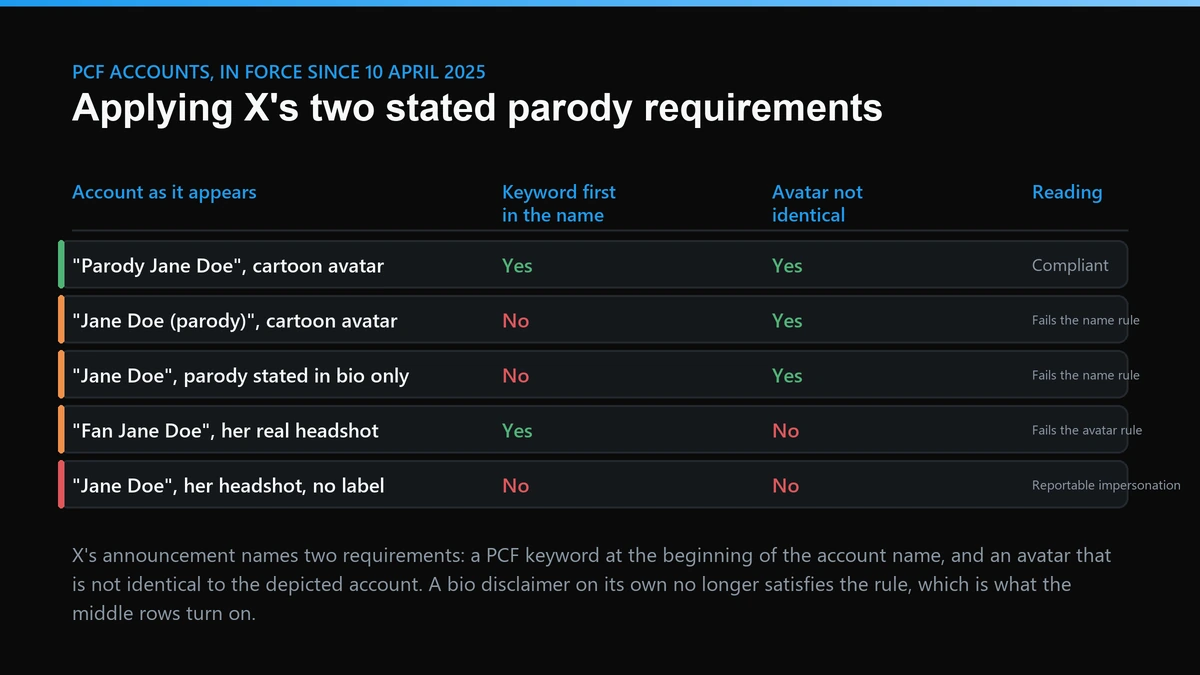
Run the two tests before you file. Twitter Ban Service declines cases at this point more often than at any other, because an x parody account that passes both is protected commentary, and a report against it will be refused on identity grounds no matter how unpleasant you find the posts. An account that fails either test is a deceptive identity and belongs on the impersonation form. If individual posts are defamatory or use your copyrighted photographs, that is a separate claim about content rather than identity, and the DMCA and official-form routes handle it differently. The mechanics of the authenticity form itself are covered in filing a Twitter impersonation report.
How to get a fake Twitter account deleted, step by step
Assuming the account failed the tests above, the route is X's standalone impersonation form rather than the in-app report. That form exists precisely because the person being copied often has no account to report from, and it accepts filings from the individual, an authorised representative, or someone reporting on behalf of another person.
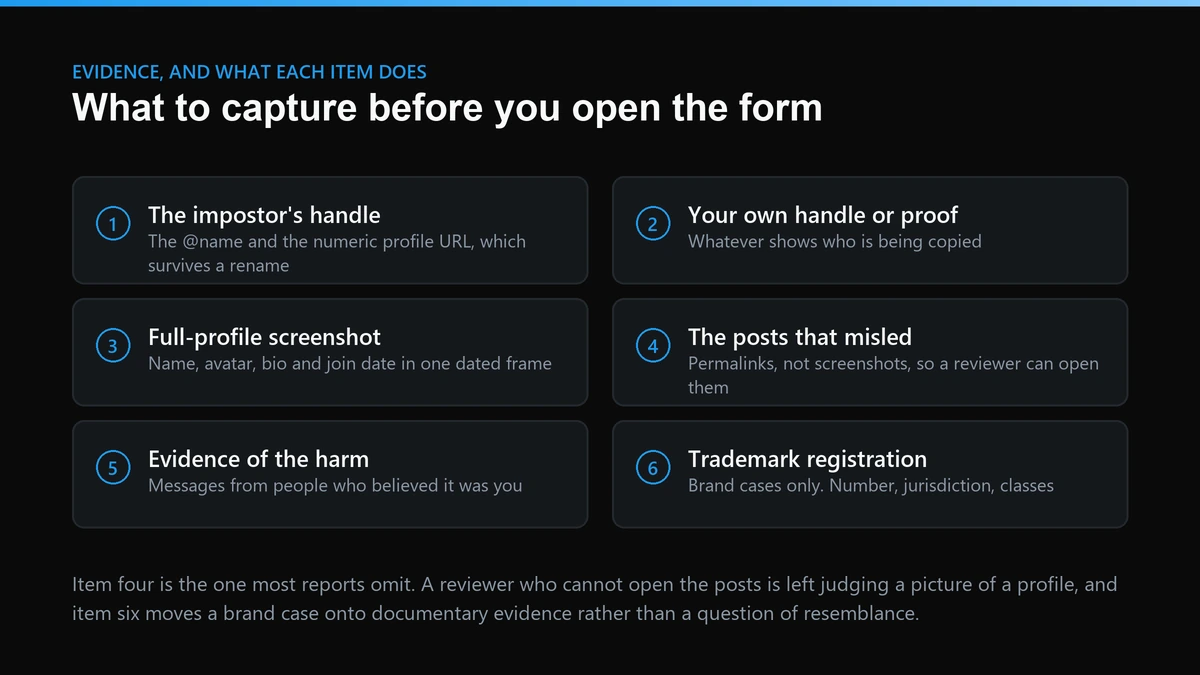
- Capture the profile before you act. Take a dated, full-window screenshot showing the display name, avatar, bio and join date together, and record the numeric profile URL as well as the @name.
- Collect permalinks to the posts that misled people. Links, not screenshots. A reviewer who cannot open the post is judging a picture of a profile.
- Assemble proof of who you are. Your own account, your website, or for a brand, the trademark registration number with its jurisdiction and classes.
- File once, on the correct ground. Choose identity if the account claims to be you, and copyright only if the actual complaint is your photograph being used.
- Keep the record. Note the case reference and any reply, because a refusal that names its reason tells you which element was missing.
- Escalate on evidence, not volume. If nothing happens, strengthen the filing rather than repeating it.
That last step is where most cases go wrong. We asked for numeric profile URLs rather than handles after we saw impostor accounts rename themselves while a report was still open, which leaves a reviewer holding a screenshot that matches nothing live. Twitter Ban Service builds the filing around the elements the policy actually names, and where a first report has already failed, the stated reason usually points at the fix.
Piling on more reports does not help, and it carries its own risk: X treats coordinated reporting as a misuse of the reporting system in its own right. That argument is made in full in what mass reporting a Twitter account really does and the truth about mass report bots. For the broader question of what actually gets an account suspended, see the legitimate route to a suspension, and where the conduct is sustained abuse rather than identity theft, the harassment policy threshold is the rule that governs. Posts attacking a protected characteristic sit under a different rule again, set out in reporting hate speech on X. You can also open a case with us or browse the full X takedown solutions index.
One number is worth carrying into this. X's Global Transparency Report for the second half of 2024 records 722,557 accounts suspended for misleading and deceptive identities, of which 520,424 were flagged automatically and 202,133 came from user reports. That puts 72% of identity suspensions beyond the reach of anyone filing anything. Your report matters most in the cases the automation misses, which are the careful single-target impersonations rather than the obvious bulk ones.
Can you find out who is behind the profile?
Usually not, and the pages promising otherwise are selling investigations rather than answers. X does not disclose the identity behind an account to the person reporting it. The results for how to find out who made a fake twitter account are almost entirely paid open-source intelligence firms, and what they actually sell is inference from public traces rather than access to X's records.
Some inference is genuinely available to you. Writing style, posting hours that suggest a timezone, an avatar reused from another platform, a follower list that fills up with the impostor's real acquaintances in the first days: these narrow the field, and in personal cases they often narrow it to someone the target already suspects. None of it is proof.
Proof requires legal process. Twitter Ban Service does not unmask account holders and no reporting service can, because a court order compelling disclosure is the only reliable route to a name, it runs through the jurisdiction where X's relevant entity sits, and it costs more than most personal cases justify. Where police are involved because the conduct is criminal, they have their own channel and it does not depend on you identifying anyone first. Standing is a separate question again, and who X will actually hear from about someone else's account works through it. If the real problem is one post rather than the whole profile, removing a single post is the narrower ask.
Screenshots of tweets nobody ever posted
Search for fake twitter account posts or fake twitter account tweets and you will not find removal advice. You will find generators: web tools that render a convincing image of a post, complete with avatar, handle, checkmark and engagement counts, for anyone who wants one.
The fake twitter account meme, and where it actually lives
The format those tools produced is now a routine part of how screenshots circulate, and it travels almost entirely off X. A fabricated post reaches people on messaging apps, forums and other networks, where the image is just an image and nobody can click through to check whether the post exists.
This matters when you are the one in the picture. If the fabricated post was never published on X, there is no account and no post for X to act against, and an impersonation report will go nowhere because nothing in X's system matches your complaint. Usually it is living on another platform, and that platform's rules are the ones that apply. Where the fake has been posted to X as an image, the position changes: it is then a post on X, and X's synthetic and manipulated media rules cover deceptive altered media likely to cause harm.
In practice, establish where the image is actually hosted, capture it with its URL and timestamp, and report it to the host carrying it rather than to the platform it imitates. Anyone deciding to clear their own timeline as a result will find the real limits in what deleting all your tweets costs and cannot reach, and the thirty-day mechanics in deleting a Twitter account permanently. Leaving the platform while an impersonator is active is usually the wrong move, because it removes the authentic account a reviewer would compare against.
The same four-way split appears on every large platform, with different names attached. Instagram routes identity cases through its own impersonation flow rather than a standalone form, which changes the evidence it expects, as the Instagram account takedown playbook sets out. That volume myth travels too, and it is answered for that platform in whether mass reporting works on Instagram and what a spam report bot really does. TikTok's version of the same question is covered in does mass reporting work on TikTok. If your case spans two platforms, file each one under that platform's own rule rather than sending the same complaint twice.
Sources
- Misleading and deceptive identities policy · X Help Center
- Report impersonation accounts · X Help Center
- X adds requirements for parody accounts, 6 April 2025 · Social Media Today
- X rolls out ID verification for Premium users · Social Media Today
- Introducing Botometer X, 21 February 2024 · Observatory on Social Media, Indiana University
- X under Musk's leadership: substantial hate and no reduction in inauthentic activity, 12 February 2025 · PLOS ONE
- Enforcement on misleading and deceptive identities, H2 2024 · X Global Transparency Report data
FAQ
Is it illegal to make a fake Twitter account?
Making an account under a name that is not yours is not automatically a crime, and X itself permits pseudonyms. What turns it into a legal matter is what the account does: fraud, harassment, defamation or trademark infringement are actionable in most jurisdictions regardless of the platform's own rules. X's policy question and the legal question are separate, and an account can breach one without breaching the other.
How long does X take to remove a fake Twitter account?
X publishes no deadline for reviewing an impersonation report, so any site quoting a fixed 24 or 48 hour turnaround is guessing. Reported accounts in this category are also a minority of the enforcement X records, because most identity suspensions come from automated detection rather than user reports. Expect variable timing and file once, properly, rather than repeatedly.
Can I report a fake account if I do not have an X account myself?
Yes. X's impersonation form is a standalone web form rather than an in-app flow, so the person being impersonated or an authorised representative can file without holding an account. That matters for people who left the platform years ago and only discovered the clone because someone messaged them about it.
Someone made a fan account that posts as if it were me. What can I do?
Check the two requirements first. If the account name does not begin with a word like fan or parody, or the avatar is identical to yours, it fails X's rules and is reportable as a deceptive identity. If it satisfies both and simply annoys you, X is unlikely to act on identity grounds, and a defamation or harassment claim about specific posts is the stronger route.
Will reporting a fake account tell the impersonator who reported them?
X does not disclose who filed a report about impersonation. The copyright route is different: a DMCA notice requires your name and contact details and those travel to the person you reported, which is worth knowing before choosing that path for a stolen photo rather than filing on identity grounds.
Does deleting my own account stop someone impersonating me?
No, and it usually makes things harder. Leaving removes the authentic account a reviewer would compare the impostor against, and after thirty days it releases your username for someone else to register. If you are being impersonated, keep the real account live at least until the report is resolved.