10 September 2026 · Twitter Ban Service · 11 min read
Hate speech on Twitter starts with a protected characteristic, not with cruelty
Hate speech on Twitter falls under X's Hateful Conduct policy, which bites only when an attack targets one of eleven protected characteristics, including race, religious affiliation, gender identity and disability. Abuse without that hook is judged under other rules, and a breach more often earns a restricted-reach label than deletion.
Has there been a twitter hate speech increase since 2022?
Yes, and the strongest measurement of it survived peer review. Researchers from UC Berkeley, UCLA and the USC Information Sciences Institute tracked the platform from 1 January 2022 to 9 June 2023 and published the result in PLOS ONE on 12 February 2025. Average weekly hate posts rose from 2,179 before the October 2022 acquisition to 3,246 after it, roughly 50% higher. Engagement moved further than volume: weekly likes on those posts went from 4,158 to 7,066, about 70% higher.
The category breakdown is where the averages stop being useful. Transphobic posts rose 260%, racist posts 42%, homophobic posts 30%. A Black user and a trans user were not experiencing the same platform in 2023, and a single blended figure hides that.
Both numbers held into at least May 2023, which matters because the early spike was widely dismissed at the time as trolls testing a new owner. It was not a spike that decayed.
One caution about the numbers you will meet elsewhere. The loudest figures on twitter and hate speech come from advocacy organisations, and they are not the same class of evidence as a journal article, even when they turn out to be broadly right.
| Source type | Example | What it can support | What it cannot |
|---|---|---|---|
| Peer-reviewed study | PLOS ONE, February 2025 | A rate change measured against a stated baseline, with methods others can attack | Anything after its data window closed in June 2023 |
| NGO research report | ADL, "Threads of Hate", May 2023 | Documented samples and a stated method, useful as illustration | Journal-grade generalisation; X has litigated against one such group |
| Platform transparency report | X Global Transparency Report | What X says it actioned, by its own categories | How much went unactioned, since it counts enforcement rather than incidence |
What to do about twitter hate comments on your own posts
Triage before you report, because the reply layer gives you controls the report queue does not. Hate comments on twitter arrive in roughly three shapes, and each has a different correct response.
- One bigoted reply from a throwaway account. Block it, and report only where a protected characteristic is named. Blocking clears your mentions now; the report may take days and can end somewhere you cannot see.
- A sustained campaign from a single account. This is the shape that escalates well, so capture everything and report under hateful conduct while the posts are still live.
- A coordinated wave. Stop reading replies, tighten who is allowed to reply to the thread, and preserve the evidence before the accounts start deleting.
Most people searching this topic want the second answer and get given the first. They are told to block and move on, which handles the feeling and does nothing about the account.
What counts as twitter hate speech under X's rules?
An attack on a person because of a listed characteristic, not an attack on a person you happen to find hateful. X's policy on hateful conduct states that you may not directly attack other people on the basis of race, ethnicity, national origin, caste, sexual orientation, gender, gender identity, religious affiliation, age, disability, or serious disease. Eleven characteristics, and the list is closed.
That single sentence explains most of the frustration around x hate speech reporting. Political affiliation is not on the list. Occupation is not on the list. Neither is being unpleasant, being wrong in public, or having enemies. A post can be sustained, humiliating and obviously intended to wound, and still sit outside this policy because it attacks the person rather than a characteristic the rule protects.
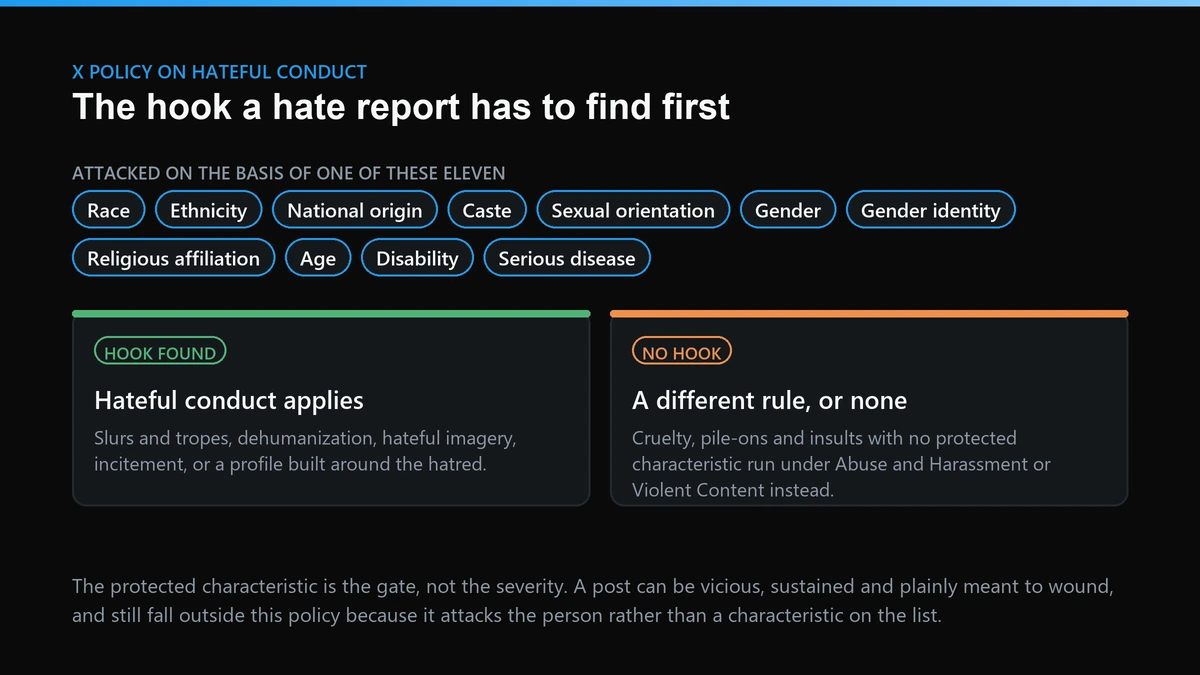
Underneath the headline sentence the policy names the shapes hateful conduct takes: slurs and tropes, dehumanisation, hateful imagery, incitement, and a profile built around the hatred rather than a stray post. The last one carries the heaviest consequence, because a hateful profile puts the account itself in scope rather than a single post.
Where the attack is personal rather than identity-based, the route changes, and the companion page on targeted harassment on Twitter covers the narrower definition that applies there. If you are still deciding which mechanism you need at all, how reporting an X account works sets out what a report does and does not trigger.
Examples of hate speech on twitter that clear the gate, and the near-misses
The useful test is not how bad a post feels but which clause a reviewer can point at. Below are the patterns we see most often when clients send screenshots, sorted by what happens when the report reaches a human.
| What was posted | Clause it engages | Verdict |
|---|---|---|
| A slur aimed at a named user, keyed to their ethnicity | Slurs and tropes | Clears the gate |
| Comparing a religious group to vermin or disease | Dehumanisation | Clears the gate |
| An account whose handle, bio and banner are built around a hate symbol | Hateful profile | Clears the gate, account in scope |
| "Someone should deal with people like her" under a post about a disabled activist | Incitement | Usually clears, and may also be violent speech |
| Sustained mockery of a person's appearance, weight or voice | None here | Fails; route to abuse and harassment |
| Vicious insults about someone's politics or employer | None here | Fails; often breaks no rule at all |
| A coded phrase or numeric symbol with no visible target | Contested | Fails without context you supply |
That last row is the one worth dwelling on, because coded language is where genuine hateful conduct most often escapes. A reviewer looking at a three-word reply has no way of knowing that a number, an emoji sequence or a rewritten spelling carries the meaning everyone in the thread understood. Nothing in the post identifies a protected characteristic, so nothing in the post engages the policy. The fix is not a stronger adjective in the report, it is supplying the missing context: the parent post that establishes who was being addressed, the earlier reply where the same account said the quiet part plainly, and the handful of other posts that show the pattern. Coded hate is a translation problem before it is a moderation problem, and the translation has to arrive with the report, because nobody is going to go looking for it on your behalf.
We learned that ordering the hard way. On early cases we submitted every post in a pile-on as one hateful-conduct report, on the theory that volume demonstrated severity. It does the opposite. When a batch mixes protected-characteristic attacks with ordinary insults, the submission gets read against its weakest examples, and the weak ones set the tone for the whole file. Twitter Ban Service now splits them: the hateful-conduct report carries only posts where the characteristic is visible or evidenced, and the personal abuse travels separately under the rule that actually covers it. The same evidence, filed in two envelopes instead of one.
Coordinated waves need the same discipline, and reporting brigading on X covers how those are packaged. Where the account is impersonating someone to make the hate look self-inflicted, a Twitter impersonation report is the faster instrument, and the signals that separate a scam account from a real one help when the profile is disposable. Throwaway handles opened for a single pile-on sit in a category of their own, and what X actually removes when an account is fake sets out which of them it will act on.
Where twitter terms of service hate speech rules actually live
Not in the terms of service themselves, which is why searching them returns so little. X's Terms of Service incorporate the X Rules by reference, the X Rules carry a Safety section, and hateful conduct sits inside that section as its own policy with its own page. Three documents, one chain.
The practical upshot: quote the policy, not the terms. A report or a legal letter that cites the hateful conduct policy by name lands in the right vocabulary, and the full index of X takedown routes maps the rest of the chain.
Why is the post still up when the report worked?
Because deletion is the exception, not the default. X's stated enforcement philosophy, "Freedom of Speech, Not Reach", applies visibility restrictions in preference to removal, and hateful conduct was the first policy it was applied to. A post that has been actioned this way stays readable on the author's profile while its reach is cut and its engagement features are switched off.
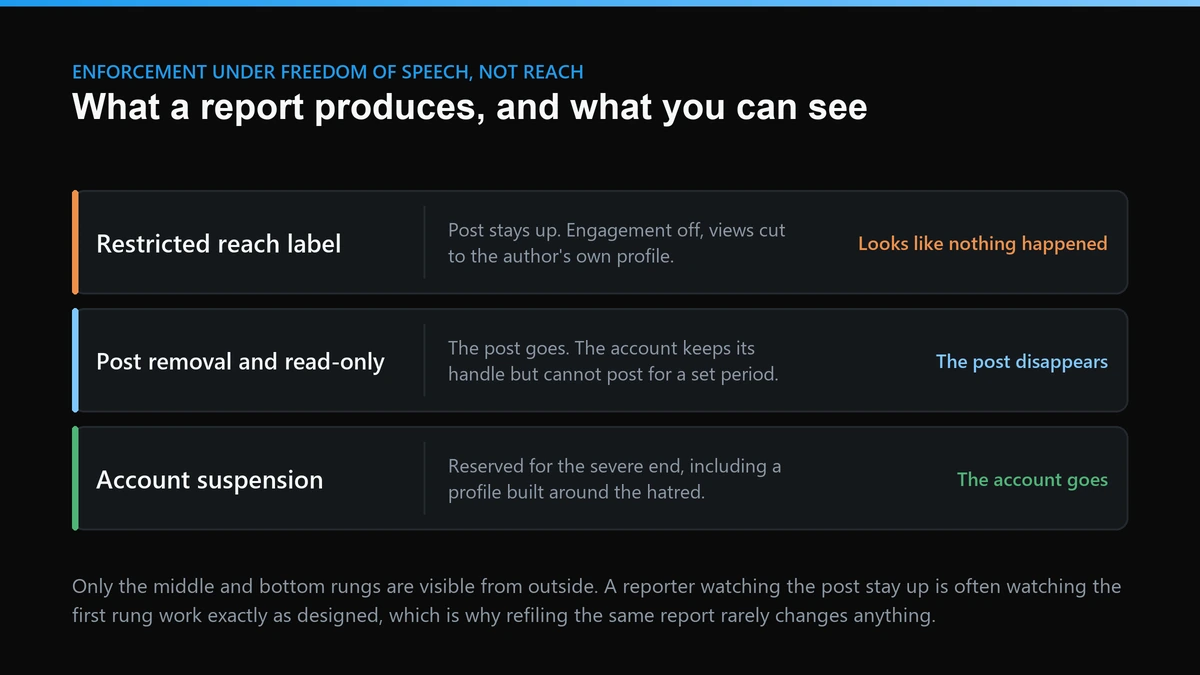
From outside, the first rung is indistinguishable from inaction. You reported a post, the post is still there, and the obvious conclusion is that X ignored you. Often the opposite happened. The tells are second-order: replies stop arriving, the post no longer appears in search or recommendations, and quote posts dry up.
This is the single most expensive misunderstanding in hate reporting, because it drives people to refile the same report repeatedly, which achieves nothing and can attract attention to the reporter instead. Report volume is not one of the factors X weighs, a myth taken apart in mass reporting a Twitter account, and the automated versions sold to exploit that belief are covered in the mass report bot teardown and the per-violation report tool guide. If your own reach has collapsed rather than theirs, shadowban checkers and what they can actually see is the relevant page. When reports genuinely go nowhere over a long period, why X ignores some reports works through the causes.
When do twitter threats stop being a moderation problem?
At the point a reasonable person would fear violence, the question stops belonging to X. Threats are governed by a separate rule, X's Violent Content policy, which covers violent threats, wishes of harm, incitement and glorification of violence. It needs no protected characteristic, so a threat against someone with no identity hook at all is still squarely in scope.
The legal line in the United States is narrower than the platform line and was redrawn recently. In Counterman v. Colorado, decided on 27 June 2023, the Supreme Court held that a true-threats prosecution requires proof of a subjective mental state: the State must show the defendant "consciously disregarded a substantial risk that his communications would be viewed as threatening violence". Recklessness is enough, and pure intent is not required, but a purely objective reading of the words is no longer sufficient on its own.
For twitter death threats, treat the platform and the police as parallel tracks rather than sequential ones. In order:
- Capture first. URL, handle, numeric account ID, full-window screenshots with timestamps, and the thread around the post.
- Call emergency services if the threat is immediate or specific about time and place. In the US that is 911, not an online form.
- File with police for anything non-immediate. A twitter harassment police report is taken more seriously with captured evidence attached, and US complaints can also go to the FBI's IC3 at ic3.gov.
- Report to X under violent speech, separately from any hateful-conduct report you file.
How to file a twitter harassment police report
Go in person or through your force's online reporting portal, and bring the case rather than the story. Officers who take these reports are rarely social media specialists, so the file has to be legible without them opening X at all.
Bring printed screenshots with visible timestamps and the full URL of each post, the account handle and its numeric ID, a one-page timeline in date order, and a short note on why you believe the threat is credible: proximity, whether the person knows where you live or work, whether the account has escalated. Ask for the crime reference number before you leave. In the United States, complaints can also be lodged with the FBI's Internet Crime Complaint Center at ic3.gov, which is a complaint channel rather than an emergency one.
Two things regularly go wrong. People report after blocking, which cuts off their own access to the evidence, and they report the worst single post instead of the pattern that makes it credible.
UK readers have a route the US does not. Section 127(1) of the Communications Act 2003 still covers grossly offensive or menacing messages, and the Online Safety Act 2023 added a threatening-communications offence in force since 31 January 2024, carrying up to five years on indictment. Twitter cyberbullying that never touches a protected characteristic can therefore be criminal in the UK while being neither hateful conduct nor a US offence.
Where the threatening account should be removed outright rather than moderated post by post, taking down a Twitter account and the honest version of getting an account banned cover the instruments available, and removing a specific tweet handles single posts. Twitter Ban Service files and escalates through X's official channels; the platform makes the final decision, and no one who tells you otherwise is describing how the system works.
What can a twitter harassment lawsuit actually reach?
The poster, almost never the platform. Section 230 provides that no provider of an interactive computer service shall be treated as the publisher or speaker of information provided by another information content provider, which disposes of most claims premised on X hosting or declining to remove a user's post. Telling X about the post first does not change the analysis.
What remains is a claim against the account holder, under defamation where a false statement of fact caused harm, or under state harassment and stalking statutes where the conduct qualifies. Anonymity slows this rather than preventing it, since identity is usually pursued through a subpoena once a claim exists. Weigh the remedy honestly before starting: a court order requiring removal is frequently achievable where a damages award is not, and either route is slower and more public than a report.
Copyright is the exception worth knowing, because it has its own fast statutory process, set out in the DMCA route for Twitter posts. Where the underlying goal is erasing your own footprint rather than someone else's, deleting a Twitter account permanently, the cost and limits of deleting every tweet and who can delete someone else's X account cover the standing rules that decide who X will hear from.
Sources
- X's policy on hateful conduct · X Help Center
- Violent content policy · X Help Center
- The X Rules · X Help Center
- Hickey, Fessler, Lerman & Burghardt, "X under Musk's leadership", PLOS ONE, 12 February 2025
- Counterman v. Colorado, decided 27 June 2023 · Cornell Legal Information Institute
- 47 U.S.C. § 230 · Cornell Legal Information Institute
- FBI Internet Crime Complaint Center (IC3)
Other routes on this site: Twitter Ban Service explains the wider service and you can open a case directly. If the account you need gone is on another platform, see Instagram account takedown, whether Instagram mass reporting works, Instagram spam report bots and mass reporting on TikTok. For a dormant handle you have a claim to, there is claiming an inactive X username.
FAQ
Is hate speech on Twitter illegal in the United States?
Almost never on its own. The First Amendment protects speech that is bigoted, offensive or cruel, and there is no general hate speech offence in US law. Criminal liability attaches to conduct layered on top of the speech: true threats, stalking courses of conduct, or a hate crime where the bigotry is an aggravating element of another offence. That is why X's rules are stricter than US law, and why a post can be removable but not chargeable.
What is the difference between hateful conduct and abusive behavior on X?
Hateful conduct is defined by what the attack is based on. Abusive behavior is defined by who it is aimed at. A post insulting one person repeatedly is targeted harassment; the same post becomes hateful conduct once the insult keys on race, religious affiliation, disability or another protected characteristic. Sustained campaigns often break both rules. The category you choose at the report selector decides which policy a reviewer applies, so choose the one you can evidence.
Can I sue X itself over a user's hate speech?
In the United States, generally no. Section 230 says an interactive computer service will not be treated as the publisher or speaker of information provided by someone else, so claims that turn on X hosting or failing to remove a user's post are usually dismissed. Notifying X first does not remove the immunity. The realistic defendant is the account holder, and the realistic remedy is often a court order to remove rather than damages.
Is twitter cyberbullying covered by the hateful conduct policy?
Only when the bullying keys on a protected characteristic. Bullying that is purely personal, however sustained, is handled under X's Abuse and Harassment policy instead. The practical consequence is the report category: file a cruelty campaign as hateful conduct and a reviewer measures it against a protected-characteristic definition it was never going to meet, then closes it.
Can you see when a post has been given a restricted reach label?
X's enforcement philosophy describes a publicly visible label on posts whose reach has been restricted, with engagement features switched off. The reporter rarely sees it. What you notice instead are the second-order signs: replies that stop arriving, a post that no longer surfaces in search or recommendations, and quote posts that dry up. The post itself stays readable on the author's profile, which is why so many successful reports look like failures.
What should I keep before reporting hate posts that might be deleted?
Capture the post URL, the account handle and numeric ID, a full-window screenshot showing the timestamp, and the surrounding thread that establishes who was being addressed. Do it before you report and before you block. Accounts that expect enforcement often delete and repost from a fresh handle, and a police report or a civil claim later needs the version you captured, not a description of it.
Should twitter death threats go to X or to the police first?
The police, and do not wait on X to decide anything first. A platform report changes what is visible; a police report starts a record that can support a protective order or a prosecution later. Go straight to emergency services where the threat names a time, a place or a weapon. File with X in parallel under violent speech rather than afterwards, so the post is captured while it is still live.