21 September 2026 · Twitter Ban Service · 14 min read
5 checks before you buy a mass report Twitter account bot, panel or ban service
A mass report Twitter account bot, a report panel or a paid "ban service" sells volume, and X weighs the rule break, not the count. No listing checked in September 2026 named a broken rule, and "ban proof" is often a screen that appears with nothing removed. One evidenced report under the right X policy does the work.
What does a "buy mass report Twitter" listing actually sell?
Report volume, priced by the unit, from sellers who never name the rule your target broke. Twitter Ban Service opened six listings that rank for these searches on 21 September 2026, and the pattern held whether the search was typed carefully or as "mass report twitter acount".
What we saw was one product sold three ways. An SMM panel's product page offered reports in packs of 10 to 10,000 across "Real", "High Quality" and "Premium" tiers, from $0.03 a report, with an "Instant Start". A second shop advertised "$0.90 for 1,000 Reports". A third priced reports on a single tweet at $8.90 per 100, up to 15,000 and "Up 1000 per day", although ordering was marked temporarily unavailable. Side by side, the same thousand reports cost $0.90 in one place and $89 in another, a spread of roughly 99 to one that only a product nobody can measure could sustain. None of the three named an X rule. All three took crypto alongside cards or PayPal.
| Listing | What it sells | Price shown | Names an X rule? | What you hand over |
|---|---|---|---|---|
| SMM panel product page | Reports in packs of 10 to 10,000, three "quality" tiers | From $0.03 per report | No | Card, PayPal, Apple Pay, Google Pay or crypto |
| SMM panel shop blog | Reports sold by the thousand | $0.90 per 1,000 | No | PayPal, Wise, Skrill, Bitcoin or Tether |
| SMM panel listing | Reports on one tweet, 100 to 15,000 | $8.90 per 100 | No | Visa, Mastercard or Bitcoin |
| GitHub script | Automated reports filed from your own account | Free | No | Your X username and password |
| GitHub script | Automated account reports | Free | n/a | Page returned "not found" |
| Marketplace thread | Unbans, account takedowns, lookups | Not visible | n/a | Page returned "not found" |
Six listings is a snapshot rather than a census, and two of them had already disappeared. Every price in it attaches to reports sent. Nothing attaches to an outcome.
Seller claims, decoded
Each claim on those pages measures something the seller controls, and none measures a decision X makes. Read that way, the sales copy turns into a list of questions, the same ones Twitter Ban Service puts to its own intake.
| What the listing says | What it actually measures | Ask the seller | Verdict |
|---|---|---|---|
| "Instant Start", "Up 1000 per day" | How fast the seller's accounts press Report | Which rule, and which queue? | Speed of the sender |
| "Real", "High Quality", "Premium" | How old or busy the reporting accounts look | Whose accounts are these? | Quality of an account pool |
| "100% safe" | A sentence on a sales page | Safe under which X policy? | Unverifiable |
| A refund "if you're not happy" | A support inbox | Refund on the reports, or on the ban? | Depends how you paid |
| Testimonials of suspensions within 48 hours | A story with no handle attached | Which account, suspended when? | Unverifiable |
| "Proof of delivery logs" and "refill" | Reports sent, then more of them | Does the log show a decision by X? | More volume |
One line from the cheapest-looking page matters more than the rest: "you don't need to log in or share passwords". Reports have to come from somewhere. X's help center says spam reports cannot be created through its web form and must be filed from within X, which puts a logged-in account behind every single report. A seller who needs none of yours is running a pool of its own, and X's Misuse of Reporting Features policy describes that setup almost word for word, listing "operating multiple accounts for the purpose of violating this policy" among its severe cases, beside automated reporting done without X's written consent. So the "Premium" tier is a promise about how long the seller's accounts survive the filter built to catch them. It says nothing at all about your target, and what a Twitter account report can actually remove shows why the count never reaches the outcome.
A sound intake starts from the rule for the same reason. The count never enters it.
What does a mass report Twitter account bot do with your login?
It uses it. A script that files reports needs a logged-in X account, and a copy running on your own computer uses yours.
One repository that still ranks for these searches, carrying 51 stars in September 2026, asks for your X username at launch and your password straight after, then drives a real browser through the report flow at "about 4s per account", in the words of its own README. It is written for Python 2.7, a version that stopped receiving fixes in January 2020. Every report it files goes out from your account, and the Misuse of Reporting Features policy lists "using automation to submit large numbers of reports without the express written consent of X" among the severe cases that can end in permanent suspension. The first account a report bot endangers is the one it logs into. Twitter Ban Service never asks a client for a login for that reason: a case needs links to posts, not access to anybody's account.
The market looks the same on every platform. Instagram has its own spam report bots and mass-report panels selling the identical promise, the TikTok mass report bot adds a malware route through side-loaded apps, and a search for a Twitter ban tool mostly turns up shadowban checkers, which diagnose your own account and act on no one else's.
The four screens that pass for ban proof
Three of the four profile screens a seller can send you turn up when nothing was removed, and the fourth cannot show who caused it. That is the weakness of screenshot proof, and it is why the checking has to happen on your side.
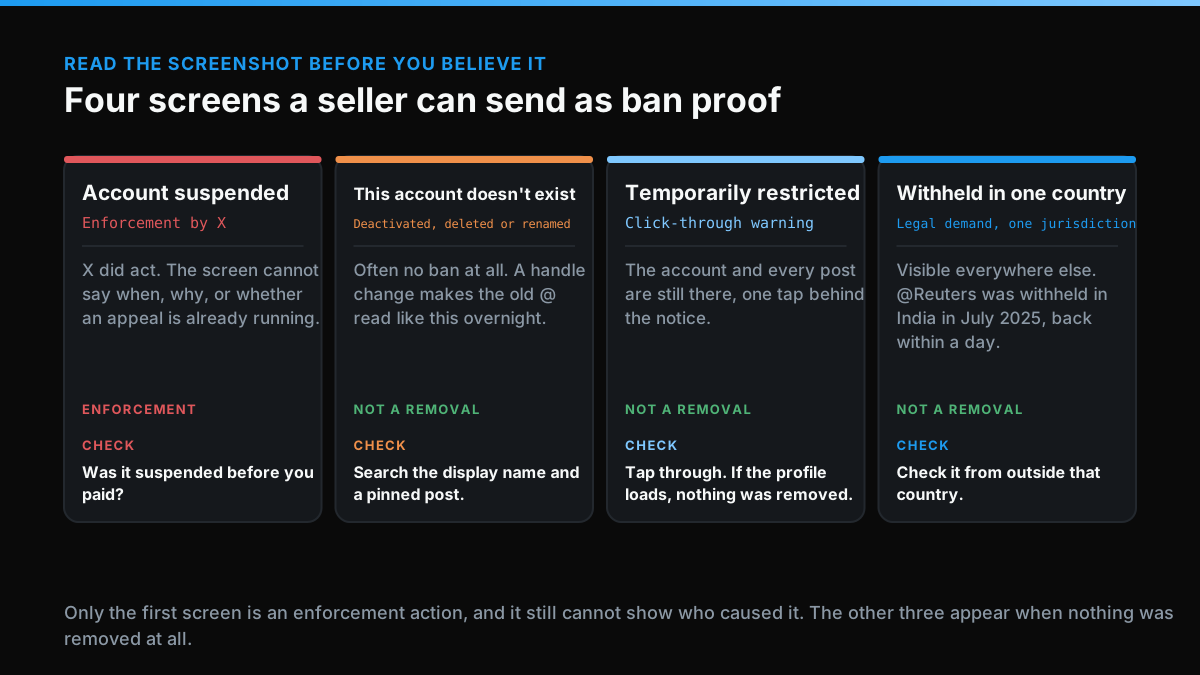
"Account suspended" is X's own enforcement notice, so it is the one screen that means X acted. It carries no date and no reason. An account suspended a week before you paid looks exactly like one suspended the morning after, and because X runs an appeal form, the decision can be reversed after the screenshot is taken. "This account doesn't exist" is far weaker: it appears when the holder deactivates, deletes or simply changes the handle, which takes seconds and leaves the same person posting under a new @, and a deactivation stays reversible for 30 days. The "temporarily restricted" warning is a click-through, with every post one tap behind it. A country block reads like a ban only from inside that country. On 5 July 2025, visitors in India saw "@Reuters has been withheld in IN in response to a legal demand" on the news agency's main account, The Tribune reported, a withholding that by design applies only inside that one country, and the account was back within about a day.
X seldom tells even the person who filed what happened next, and how to tell what a report actually did covers the outcomes that never announce themselves. When a handle has vanished, search the display name; if the account turns up under a new @, its "About this account" panel shows how many times the username has changed. Twitter Ban Service archives the profile and the posts before filing anything, because a record made afterwards proves nothing.
Five checks before any money moves
Each check takes minutes, and an honest service expects to be asked all five. A seller who cannot pass them is selling volume rather than enforcement.
- Screenshot the target's profile yourself, logged out, with the date visible. Without your own baseline, every "after" picture a seller sends is unverifiable.
- Ask which X rule the account breaks and which route the report will take: a named policy, then the in-app report, the impersonation form, a copyright notice or a legal channel. An answer given as a number of reports is the answer of a panel.
- Refuse any request for your X password, cookies or a session token, and do not run a report script that asks for them in its settings.
- Ask what happens when X finds no violation. "We stop and tell you why" is an honest answer, and a promise of a certain ban with your money back is one only X could keep.
- Hold any proof against the four screens above, reload the profile yourself, and look again after 30 days.
Is it illegal to pay for a Twitter ban service?
Most countries have no offence called buying reports, but the purchase breaks X's rules at once and can reach further. The exposure starts with the buyer.
Twitter Ban Service turns down any case built on volume rather than a rule, and X's own policy is the first reason why. Its Misuse of Reporting Features policy covers "coordinating and/or encouraging others to misuse X reporting features" in the hope of getting accounts "limited or removed", and paying a panel is the most literal way of coordinating others there is. EU law adds a second cost. Article 23(2) of the Digital Services Act requires platforms to "suspend, for a reasonable period of time and after having issued a prior warning, the processing of notices" from people who "frequently submit notices or complaints that are manifestly unfounded". Spend reports on an account that broke nothing, and the report you need later, about a real threat, can sit unprocessed.
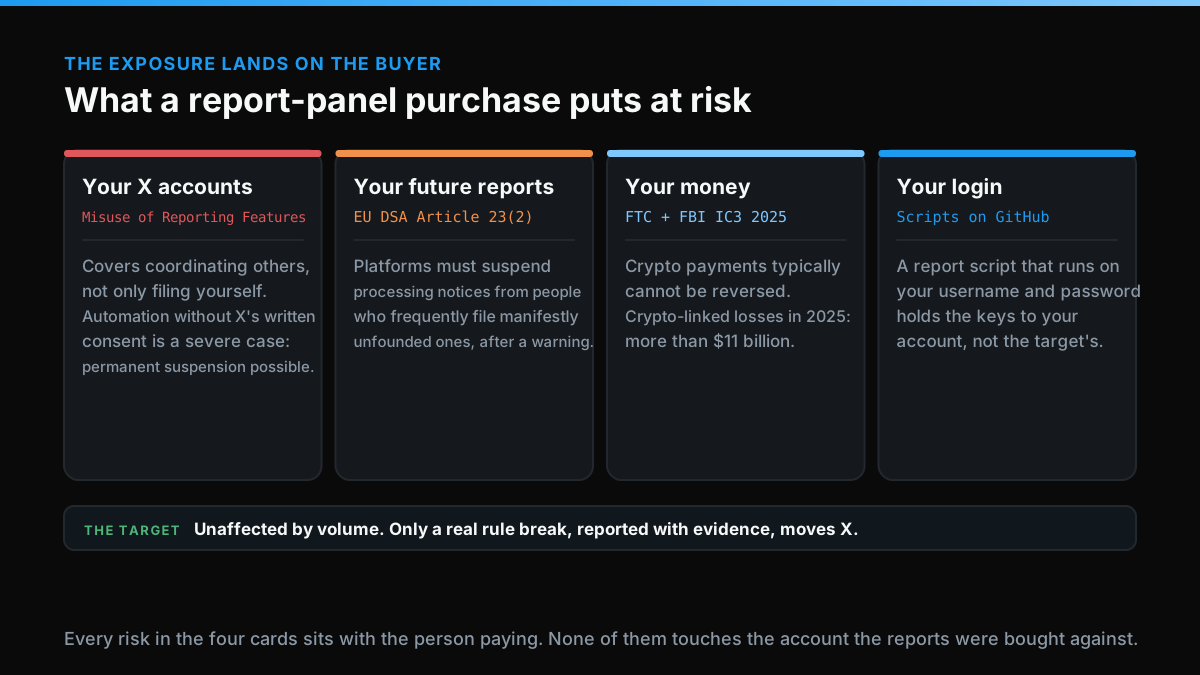
Where the target is a person, a paid campaign can also become part of a harassment or stalking course of conduct, depending on the country, and civil claims can follow the people who organised it; who you actually sue over a post on X explains why courts look at the individuals involved rather than at X. The money is the simplest part. The FTC's consumer guidance says "cryptocurrency payments typically are not reversible", and the FBI's 2025 Internet Crime Report counted more than $11 billion in losses on complaints involving cryptocurrency, out of nearly $20.9 billion in total, according to the ABA Banking Journal. This is general information rather than legal advice, and the rules differ by country.
What does Reddit say about a Twitter ban service?
Very little, and the silence is informative. When Twitter Ban Service searched Reddit for threads on paid Twitter ban services in September 2026, we got no genuine discussion back for any of five phrasings, only unrelated news, much of it about subreddit moderation.
The market talks about itself on BlackHatWorld instead, and the thread titles tell the story without the posts. Several are buyers trying to hire someone to mass report a particular X account. One is an exposé of SMM panels, built on the poster's own deposits and test orders. Another comes from a customer of a well-known Twitter automation tool, asking for an alternative. None of the thread summaries we could see showed a rule-abiding account going down on report volume alone.
How to report bot accounts on Twitter so the report counts
Report each bot you actually run into as spam, one account per report, from inside the X app. That is the only mass report X invites, and it works because every report is true. X's help-center page titled Spam says spam reports cannot be created through that form and have to be filed from within X, so each one comes from a logged-in account.
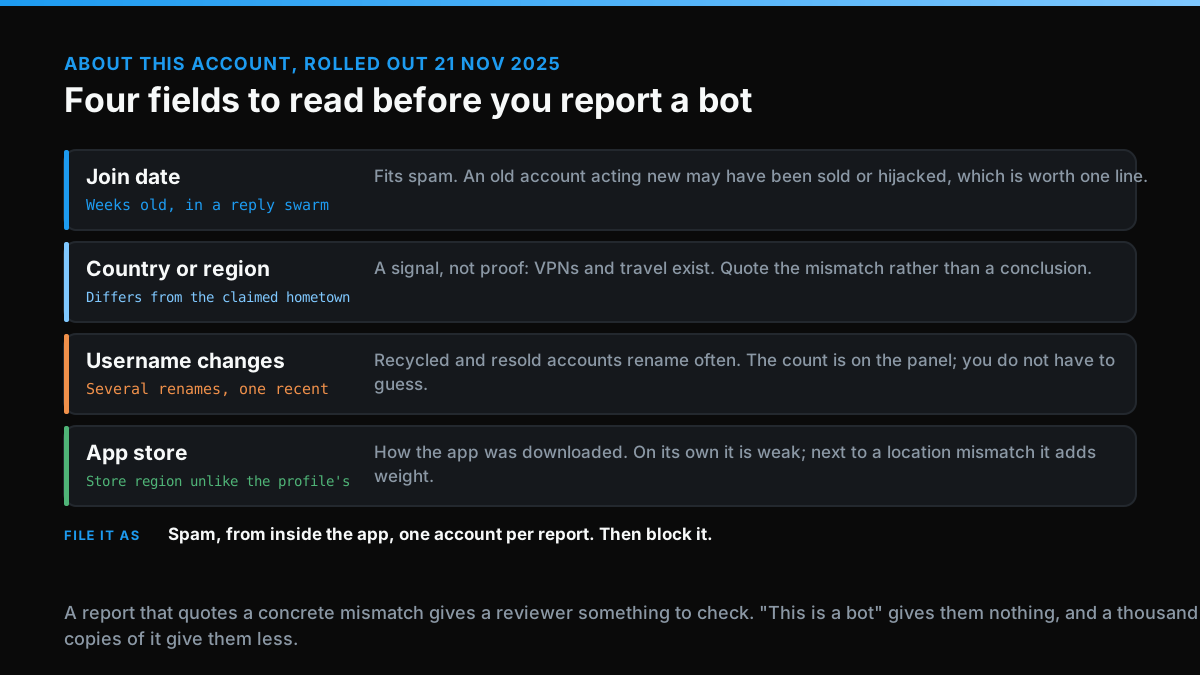
Before you file, open the profile's "About this account" panel, which X began rolling out on 21 November 2025, TechCrunch reported. It lists the join date, the country or region, how many times the username has changed and when, and which app store the account came from. A profile claiming a hometown on one continent while the panel shows another, or a handle renamed four times since spring, gives you something concrete to put in the report instead of "this is a bot". Then block it, because a report does not stop the replies in the meantime.
Keep the scale in view. In April 2026 X's head of product, Nikita Bier, said the company was "identifying and suspending 208 bots per minute" during a week-long sweep, six months after removing 1.7 million reply-spam bots. Sweeps at that rate dwarf anything a report panel could add, which is why mass report spam Twitter packages are selling a job X's own systems already run. Where a genuine network sits behind the replies, Twitter Ban Service reports it under the platform manipulation and spam rule with the linked accounts mapped, which is the evidence-led version of the same job.
Tweet removal and takedown services X will actually hear
A tweet removal service, a tweet takedown service and a Twitter account takedown service sound interchangeable. They are three different jobs.
Removing your own posts needs no service at all. Bulk-deletion tools work from your own archive, and the cost and limits of deleting all your tweets are the real constraint there. A Twitter account removal service aimed at your own profile is selling a settings task with a 30-day queue, laid out in deleting a Twitter account permanently. Taking down someone else's post or profile is the only part where outside help can matter, and only through a route X recognises: a report under the policy the conduct breaks, the impersonation form, a DMCA copyright notice or a court. Standing settles several of these before any evidence does, which is why who can ask X to delete someone else's account comes first.
Twitter Ban Service works that last lane, and a Twitter account report service done properly starts with the rule rather than the handle. If the conduct does not map to a specific X policy or law, the case stops there. Where it does, the file goes to the category that fits it, whether that is a fake account impersonating someone, a scam account working your followers, targeted harassment or hate speech aimed at a protected group, and the same rule-first intake runs an Instagram account takedown. The service files, escalates and follows up; X makes the decision, and nobody outside X can promise it. Credible threats of violence and child sexual abuse material go to the police or the relevant hotline at the same time as any report, never as a replacement for one.
So does a Twitter ban service work?
The kind that sells a ban does not, because nobody outside X has one to sell. The kind that works is paid for evidence: someone checks the account against a named rule, gathers the posts that prove it and files them through the route X built for that rule. Twitter Ban Service keeps the violations it files in the open for that reason.
So skip anything priced per report, keep your login to yourself, and take your own screenshot before anyone takes your money. If the account genuinely breaks a rule, start with the evidence and send the handle and the rule it breaks. If it breaks none, no service can change that, and the honest ones will tell you so.
Where the facts on this page come from
- X Help Center: Misuse of Reporting Features policy
- X Help Center: Spam form page (spam is reported from within X)
- Regulation (EU) 2022/2065, the Digital Services Act, Article 23
- FTC Consumer Advice: What To Know About Cryptocurrency and Scams
- ABA Banking Journal (7 April 2026): FBI 2025 Internet Crime Report figures
- TechCrunch (21 November 2025): X rolls out About this account
- Social Media Today (9 April 2026): X's bot purge at 208 a minute
- The Tribune (7 July 2025): Reuters account withheld in India
- Seller listings and repositories: opened on 21 September 2026 and deliberately not linked.
FAQ
How much do mass reports on Twitter cost from a panel?
On the three live listings checked on 21 September 2026, between $0.90 and $89 for 1,000 reports, with one page starting at $0.03 a report. None priced an outcome, because a seller controls only how many reports it sends and X decides suspensions on the rule break.
Can mass reporting on Twitter get the reporter banned?
Yes. X's Misuse of Reporting Features policy covers duplicate or false reports sent in large numbers, along with coordinating others to send them. It treats automated reporting without X's written consent as a severe case that can end in permanent suspension, so the accounts doing the filing carry the risk.
Can you get your money back from a ban service that did nothing?
If you paid by card, dispute the charge with your card issuer and keep every order screenshot. Crypto is harder: the FTC's consumer guidance says cryptocurrency payments typically are not reversible, so the money comes back only if the seller decides to send it.
What does 'how to mass report someone on Twitter' usually mean?
Two different things. Getting a group to file the same complaint against one account is coordinated misuse under X's rules, and it gets discounted. Each person who genuinely saw a violation filing one accurate report under the right category is ordinary moderation, and it needs no bot or panel.
Is an X ban service the same thing as a shadowban checker?
No. Searches for an X ban service often return shadowban checkers, which test whether your own posts are being hidden. A ban service claims to act against someone else's account. That makes it either evidence work under X's rules or a volume sale dressed up as one.
What is the difference between a tweet removal service and a tweet takedown service?
A tweet removal service usually means bulk-deleting your own posts from your archive, which needs nobody's permission. A tweet takedown service goes after someone else's post, and that comes down only through X's report routes, a copyright notice or a court order.
What does a Twitter account report service actually file?
One report per account, under the X policy the conduct breaks, with the posts and screenshots that prove it, sent through the route X built for that policy. When no rule fits, a service working properly declines the case instead of filing a thin report and billing you for it.
Is it fine to mass report spam accounts on Twitter?
Reporting every spam account you actually meet is what the Spam category exists for. The misuse starts when duplicate reports pile onto one account, or when other people are recruited to file them. Report once, block the account, and skip anyone selling spam reports in bulk.