18 September 2026 · Twitter Ban Service · ~12 min read
How to report a tweet on X, and how to tell what your report actually did
To report a tweet, open the post, tap the ••• menu, choose Report post, then pick the category matching the rule it breaks. X measures the post against that policy and nothing else. Two of its four possible responses are silent, so a report that worked often looks like one that failed.
Between January and June 2024, X suspended roughly 5.3 million accounts, up from 1.6 million in the same months of 2022, and removed or labelled 10.6 million posts. Around 5 million of those were hateful conduct, 2.6 million abuse and harassment, 2.2 million violent content. Its H1 2024 Global Transparency Report puts the overall violation rate at 0.01% of content. Set those totals beside the tens of millions of reports arriving in the same window and the queue stops looking like a void and starts looking like a filter.
How do you report a tweet on Twitter, step by step?
Four taps, from the post itself. Start from the tweet you want reviewed rather than the profile, because a report attaches to one specific post.
- Open the post. On mobile, tap the ••• icon at its top right; on the web, the same icon sits in the same corner.
- Choose Report post.
- Say who the content targets: yourself, someone else or a specific group, or everyone on X. This is the third-party route, and it is where a bystander report belongs.
- Pick the category, then add the detail X asks for. Submit.
X documents the entry points for posts, Lists and Direct Messages on its report a post help page. What the page does not say is that the category you choose in step four decides which policy team sees the case and which rulebook gets applied. Everything else about the report is administration.
That one selection is the whole game, and it is where most failed reports go wrong.
Reporting the profile instead is a different job with a different threshold, covered in our guide to reporting an X account. Report the post when one tweet carries the breach, and the account when the pattern is the breach.
Which report category should you actually choose?
Whichever one you can evidence, rather than the one describing how the post made you feel. A reviewer checks the post against the definition attached to your chosen category and closes the case if it does not fit. Nobody goes looking for the category that would have fitted better.
| What the post is doing | Policy it lands under | Who X needs to hear from | What the action can reach |
|---|---|---|---|
| Publishing a home address, phone number, ID or private media | Private information policy | The person exposed, or an authorised representative, unless the sharing is clearly abusive | The post, and suspension until it is taken down |
| Targeting one person with sustained abuse or slurs | Abuse and harassment, or hateful conduct | The target carries more weight than a bystander | The post, escalating to the account |
| Fake engagement, scripted posting, a coordinated cluster | Authenticity, formerly platform manipulation and spam | Anyone | Usually the whole account |
| Passing as you or your brand | Authenticity and impersonation | The person or brand impersonated | The account, via a standalone form |
| Using your copyrighted work or mark | Copyright or trademark, on a legal track | The rights holder or a designated agent | The post, and your identity is disclosed |
| Saying something false and damaging about you | No X Rules category exists | A court, in practice | Nothing, until an order exists |
That third column is the one almost nothing else on the web prints, and it decides more cases than the first two combined. A second trap sits in the copyright row: that route is not anonymous. And the last row sends more people away disappointed than any other, which the defamation section deals with properly.
One allowance worth using: X lets you attach several posts to one report, so a reviewer sees the pattern rather than a line out of context. On a campaign rather than a single tweet, that is the difference between a closed ticket and an investigated one. Our walkthrough of the official X form for each violation covers the routes that sit outside the in-app flow.
Who files the report changes the outcome
X says so in writing, and it is the least-known rule in the system. Its enforcement philosophy lists, among the factors behind an enforcement decision, whether the report came from the target of the potential abuse or from a bystander, the severity of the violation, and whether the account has a history of breaking the rules. In certain scenarios X requires a report from the actual target, or their authorised representative, before it will act at all.
That single paragraph explains a whole category of failure people usually blame on indifference. A friend reporting harassment aimed at someone else, a follower reporting a leaked phone number that is not theirs, a colleague reporting an impersonation of their employer: each is a bystander report in a category where X is waiting to hear from the person affected.
Nobody decided the content was fine. The wrong person filed, so it closed.
So before filing on someone else's behalf, ask them to file it themselves and send you the confirmation, or get written authority to act as their representative. Where neither is possible, say in the report exactly why the target cannot file, and make the abusive character of the post obvious in the evidence rather than in adjectives.
What X does to the post, and why you probably cannot see it
X has four responses available and announces only two of them. This is the single most useful thing to understand about reporting, and the reason the queue feels like a void.
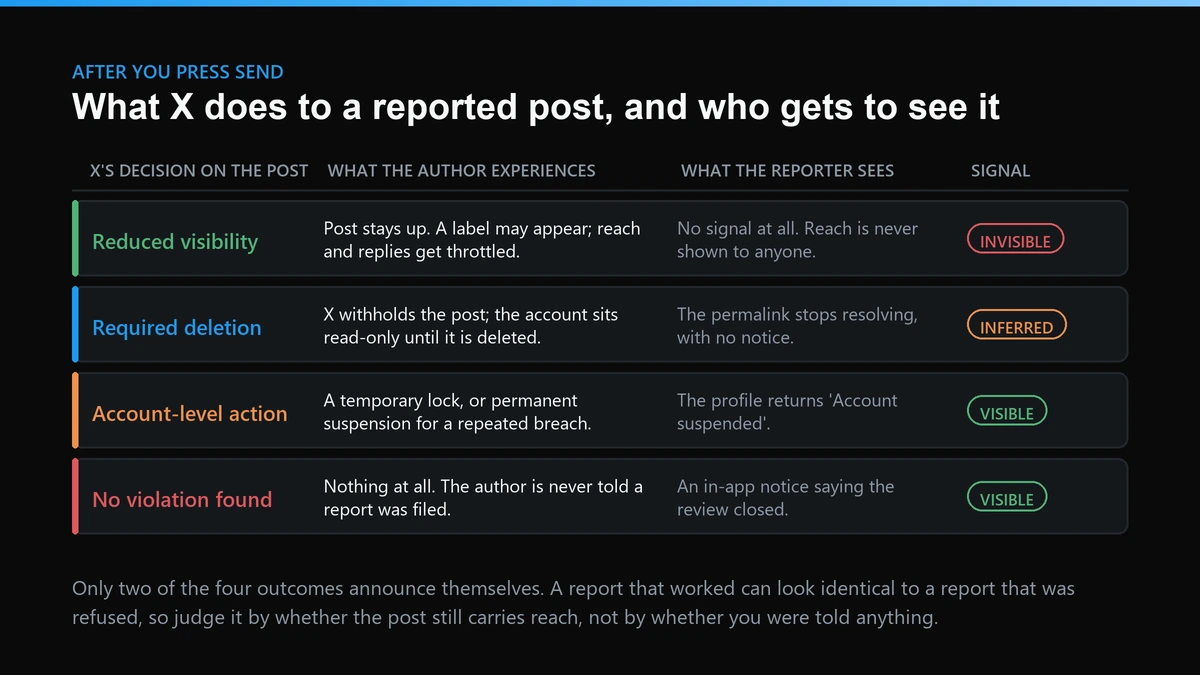
Reduced visibility leaves the post up with its reach cut and its reply, like and repost affordances throttled. From outside it looks untouched, because the restriction applies to distribution rather than to the page you are loading. Required deletion withholds the post and drops the author into a read-only period until they take it down, at which point the permalink stops resolving with no explanation attached.
Only account-level action and an explicit no-violation notice are legible from outside.
So the honest test is not whether you were told anything. It is whether the post still travels. Check whether it surfaces in search, whether quote posts are still arriving, and whether replies stopped. A twitter deleted content report filed after the author has already removed the post has nowhere to attach, which is why the capture step below is not optional.
What to capture before the post disappears
Accounts that expect enforcement delete quickly. Before you file, and before you block, take the post permalink, the account handle and its numeric ID, a full-window screenshot showing the timestamp, and enough of the surrounding thread to show who was being addressed. Blocking first is the common mistake, because it hides the content from you and makes the thread harder to document afterwards.
When Twitter Ban Service takes a case on, that package is the first thing we ask for, and its absence is the most frequent reason a strong complaint has to be rebuilt from archive snapshots. A case we handled in March turned on a single reply the client had screenshotted and the author had since deleted; without it the remaining posts read as an argument rather than a campaign, and a reviewer would have closed it in seconds.
Can someone see if you reported them on Twitter?
No, with one exception that surprises people. X tells the reported account that a post was actioned and which rule it broke. It is not told who flagged it, which is the answer to how to report someone on twitter without them knowing.
Intellectual property is the exception, and it is blunter than most guides admit. Where a copyright complaint results in action, X's copyright policy says the reported user receives a full copy of it, including the reporter's name, email address and street address. Trademark reports carry your details across too, and notices are commonly forwarded to the Lumen database and published. If disclosure is the problem, a designated agent can file on the rights holder's behalf so their details appear instead of yours.
A subtler exception applies to the Help Center forms rather than the in-app button. Filing through a form, X may ask you to agree that parts of your report can be shared with third parties, including the affected account. The in-app flow does not ask that. If staying unidentified matters, it is worth reading which route a given violation actually requires before you start.
And reports are anonymous to the reported user, never to X. The platform knows which account filed what, which is half the reason the next section matters.
How do you report doxxing on X?
Under the private information policy, which is where X files doxxing rather than under a rule of that name. It covers home addresses, phone numbers, email addresses, government identification, financial account details and non-consensual intimate media, and a clean evidence trail matters more here than in almost any other category.
- From the post, choose Report post, then the privacy option.
- Say whose information it is: yours, someone else's, or you are an authorised representative.
- Identify the exposed detail precisely. A reviewer needs to see which string in the post is the private information, not a general complaint that the post is invasive.
- Submit, then report any reposts separately. Each one is its own post and needs its own report.
X's private information policy is the text a reviewer works from, and reading it before you file is worth more than any amount of escalation afterwards.
A twitter doxxing report naming the exact field carried in the post clears review. One describing the harm usually does not.
Two clauses inside that policy decide most cases. One is standing: anyone may report private information shared in a clearly abusive way, but outside that X may need to hear from the person exposed, or from someone authorised to represent them. The other is the published-elsewhere exception. Information the owner already made public themselves, say a phone number listed on their own company's contact page, may not count as private at all. Home addresses are the carve-out inside that carve-out, because the physical-risk calculation differs. Where a violation is confirmed, the usual remedy is a suspension lasting until the post comes down.
Search twitter report doxxing reddit and the recurring complaint in those threads is silence after filing. Some of that is the standing rule quietly closing third-party reports. Most of the rest is a reporting artefact: privacy removals are frequently the invisible kind, reach cut with no notice sent to anyone.
Where the exposure includes intimate imagery, treat it as urgent and parallel. File with X, and separately with the relevant reporting body in your country, rather than waiting on the platform to decide first.
A bot posted it. Report the post or the account?
The account, almost always. The rule now lives under X's Authenticity policy, which absorbed what used to be called platform manipulation and spam, and it is written at account level. A single spam post reported in isolation gives a reviewer nothing to act on. What works is the pattern: matching bios, identical posting intervals, a burst of replies all pushing one link, a follower graph that appeared in the same week.
That is also the honest answer to report a twitter bot as a one-off. One profile barely registers against automated detection running at platform scale; a documented cluster does. Other platforms work the same way, which is why our write-up of the Instagram spam report bot market reaches the same conclusion from the other side.
Is there any legitimate twitter report automation?
Not for you, no. X allows automated report submission in exactly one situation: where a law enforcement agency or an NGO has prior consent and identifies itself through an official email domain or a verified entity account. Everyone else falls under the automation rules, which bar scripted accounts outside the Developer Policy. So every product sold as twitter report automation is either a dashboard that quietly submits nothing, or real bulk submission that trips the misuse rules and actions the accounts running it. Our breakdown of the twitter ban tool category takes those claims apart.
Does reporting a tweet more times make it come down faster?
It does the opposite, and the risk transfers to you. X's Misuse of Reporting Features policy prohibits, in its own words, submitting duplicate or false reports in large numbers, and coordinating or encouraging others to misuse reporting features to harass others under false pretenses or to cause accounts or posts to be limited or removed.
Note where the sanction lands: the organisers of a reporting campaign are the people that policy is written about.
Be careful about the inverse claim, though, because plenty of pages state it as fact: X has never published a line saying report volume is ignored. What it has published is a list of the factors it does weigh, and the count of complaints is not among them. Severity, the account's history, and who filed are.
This is where searches like how to get someone's twitter banned and the apostrophe-free how to get someones twitter banned lead people wrong. What works is one accurate report under the right category with evidence attached, not thirty hollow ones. We have written the volume argument out in full for Instagram mass reporting and tested the same claim against TikTok's enforcement model; the mechanism is the same on all three platforms.
Can you get someone IP banned on X?
No. There is no IP ban to buy or trigger, and searches for how to get someone ip banned on x are chasing a control X does not expose to users. Shared office addresses and recycled mobile ranges would make it useless anyway. The account-level detail behind that myth sits in our account reporting guide.
They came back under a new handle. How do you report that?
As ban evasion, now folded into the same Authenticity policy as spam, and X treats it severely. Creating a new account or repurposing an existing one to replace a suspended one is prohibited outright, and X reserves the right to suspend any other account it believes the same person operates, regardless of when that account was created. Detection leans on device fingerprints and behavioural patterns rather than IP address, which is why a VPN and a fresh email change nothing.
To file it, open the new profile, choose Report, then the option covering someone pretending to be another person, and supply the original suspended handle plus what links the two. That answers both how to report someone on twitter for circumventing ban and how to report someone going around a twitter ban: no separate evasion button exists, so the impersonation route carries it.
Name the old handle explicitly. A reviewer left to work the connection out unaided will close the report.
Can you get a defamatory tweet removed by reporting it?
Not through the report button. Defamation is a legal conclusion about whether a statement is false and damaging, and no X Rules category asks a reviewer to make that finding. Section 230 also keeps X out of the argument, since the platform is not treated as the publisher of what an account posts.
So a request to remove defamatory tweet content, or to report defamatory tweet content as a rule breach, is aimed at the wrong door. What works runs through the author instead. To get a defamatory tweet removed you normally need a judgment against the person who posted it, and X will act on a properly served court order to remove defamatory tweet content once one exists. Reaching that point often means unmasking an anonymous account first, a separate chain set out in our page on who you actually sue over a tweet.
Two things still make the platform report worth filing first. If the post also breaks a real rule, harassment or private information, that route can remove it in days rather than months. And the report creates a dated record that the content was flagged, which matters later.
What X owes you after you file, and where that changes
More than most guides claim, and less than you want. X does publish a timeline, which competitors routinely replace with invented ones: it says it acknowledges properly submitted reports within twenty-four hours, that reports are typically resolved within a few days, and that resolution can take up to thirty days where the case depends on user input or the account appeals. If you have read that reports are decided in 48 to 72 hours, that number came from a blog, not from X.
What X does not owe you outside the European Union is reasoning. The in-app notice is the entire answer, there is no obligation to explain the decision, and there is no appeal against the outcome of a report you filed about someone else. Appeals belong to the account that was actioned.
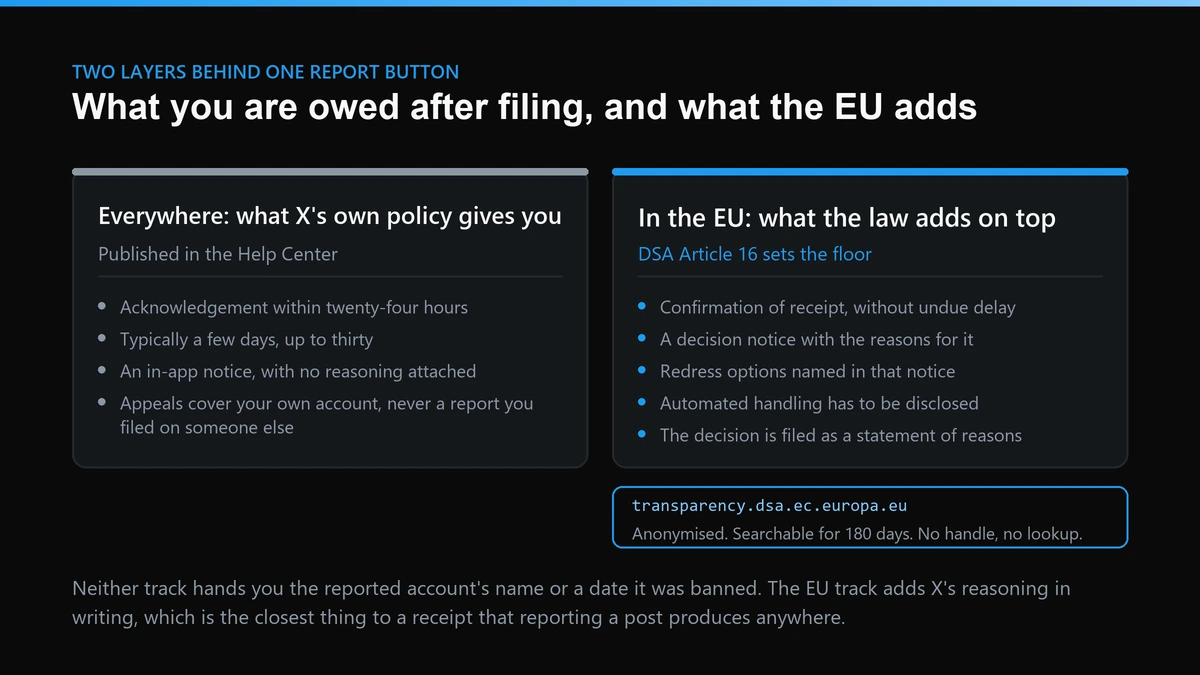
Inside the EU, the floor is statutory, and it covers a lot of people: X reported around 102 million average monthly active recipients across the bloc for the second quarter of 2025. Article 16 of the Digital Services Act requires that where a notice carries the notifier's electronic contact details, the provider confirms receipt without undue delay, then notifies that person of its decision on the reported content along with the redress available against it. Automated decision-making has to be disclosed. Notices must be handled in a timely, diligent, non-arbitrary and objective manner.
In practice this changes how you file. Reporting while signed in from an EU member state, with contact details attached to the notice, converts a silent submission into one that owes you a written reason. It is the only mechanism anywhere that reliably tells a reporter what happened to a post they flagged.
The decisions themselves are published. Under Article 24(5), platforms submit a statement of reasons for every moderation action to the Commission's DSA Transparency Database, which anyone can search. Set expectations correctly, though: personal data is stripped before publication, the search interface retains records for 180 days, and there is no handle to look up. It shows you what X decides and on what grounds, at scale.
It will not tell you anything about your specific post.
Checking whether anything actually happened
There is no public ledger of X enforcement against individual accounts, so how to check when someone was banned from twitter has no clean answer. The profile returns an account suspended page and gives no date. Your closest approximation is the Internet Archive: find the last capture showing a live profile and the first showing the suspension notice, and the ban falls between them.
For a post rather than an account, check reach instead of status. A post under a visibility restriction stops appearing in search results and recommendations while remaining readable on the author's profile, so searching a distinctive phrase from it is a better test than loading the permalink. Our page on why X appears to ignore reports works through the refusal patterns in more depth.
When the report button is the wrong tool entirely
Report the post when a rule was broken and you can point at the clause. Everything else needs a different instrument, and reaching for the report button first usually costs weeks.
- A credible threat naming a time, place or weapon goes to the police first, and to X in parallel under violent speech.
- Content you own goes through the copyright form, not the in-app report, because only the legal track compels removal.
- Your own posts are yours to remove; see deleting tweets in bulk and permanent account deletion.
- Someone else's account or tweet is not yours to delete, whatever a service claims; the standing question is unpacked in who can delete an X account.
- A sustained campaign against one person is targeted harassment, and attacks keyed to a protected characteristic are hateful conduct; the categories are not interchangeable.
- A fraudulent account needs the scam signals documented before you file, which our guides to spotting a Twitter scammer and fake account patterns set out.
- Whole-account removal on X or elsewhere is a campaign rather than a report, covered in taking down a Twitter account and, for the neighbouring platform, Instagram account takedown.
If the post breaks a rule, file it today under the narrowest category that fits, and keep the capture. If it has already been refused once, do not send the same report again. Change the category to one your evidence actually supports, or hand the file to someone who will build it that way. Twitter Ban Service works that second case through X's official reporting channels and pursues a suspension only where the X Rules or the law are genuinely broken; you can put a case in front of us or read the rest of the X enforcement guides.
Sources
- X Help Center — Report a Post, List, or Direct Message
- X — How to report violations of the X Rules (acknowledgement and resolution times)
- X — Enforcement philosophy and approach to policy development
- X — Private information policy and doxxing
- X — Misuse of Reporting Features policy
- X — Authenticity policy, covering spam, manipulation and ban evasion
- X — Copyright policy, including what the reported user receives
- X — Global Transparency Report, H1 2024 (PDF)
- Regulation (EU) 2022/2065 — Digital Services Act, Articles 16 and 24
- European Commission — DSA Transparency Database
FAQ
Can someone see if you reported them on Twitter?
No, not for an in-app report: the author learns that a post was actioned and which rule it broke, never who flagged it. Copyright is the exception, because a successful claim sends the reported user a full copy of the complaint with your name and address on it.
How many reports does it take to remove a tweet?
X has never published a number. Its enforcement philosophy lists severity, the account's history and whether the target or a bystander filed, and report volume appears nowhere on that list. One accurate report on genuinely violating content is enough. Filing the same complaint repeatedly, or organising others to, breaches the Misuse of Reporting Features policy and puts your own account at risk instead.
Can you report a tweet after it has been deleted?
Not through the in-app flow, because the report attaches to a live post. Once the author deletes it, the permalink is gone and so is the button. Capture the URL, the numeric post ID and a timestamped screenshot before you file, because that package is all you will be left holding.
What does a Twitter report doxxing Reddit thread usually get wrong?
Mostly two things: that doxxing is a named rule, when X actually files it under the private information policy, and that silence means refusal. A post stripped of reach looks untouched from outside, so re-reporting until something visible happens walks straight into the misuse policy.
How do you find out when someone was banned from Twitter?
You approximate it. X publishes no lookup and no date, and the profile just returns an account suspended page. The Internet Archive is the usual workaround. Find the last capture showing a live profile and the first showing the suspension notice, and the ban sits between them. Crawl frequency decides how tight that bracket gets, so a busy account narrows it to days and a quiet one to months.
Does reporting a tweet work on behalf of someone else?
Sometimes, and this is where third-party reports quietly fail. The flow asks whether the content targets you, someone else or a specific group, or everyone on X, so bystander reports are certainly accepted. But X weighs who filed, and for private information it may need the person exposed, or an authorised representative, before it acts at all.
Will a report get a defamatory tweet taken down?
Rarely on its own, because defamation is a legal finding rather than an X Rules category, and Section 230 keeps the platform out of the question of whether a statement is false. Removal normally follows a court order against the author.
Can a tool or bot file reports for you?
Nothing you can buy. X permits automated report submission only where a law enforcement agency or an NGO has prior consent and identifies itself through an official domain or a verified entity account. Everything else falls under the automation rules. The products sold for this either submit nothing at all or get the accounts running them suspended.