10 September 2026 · Twitter Ban Service · 12 min read
Twitter lawsuit over something posted on X: who you actually sue, and what X will hand over
A twitter lawsuit over something posted on X almost never names X Corp. as the defendant. Section 230 blocks that route, so the claim runs against the account holder, and X's role narrows to a witness holding records that only a court order or a subpoena can reach.
X Corp. is the witness in a twitter lawsuit, not the defendant
Section 230(c)(1) of the Communications Decency Act is the wall. It says an interactive computer service will not be treated as the publisher or speaker of information provided by another information content provider, and courts read that to dispose of claims which depend on X hosting, promoting or declining to remove someone else's post. Notifying the platform first does not dissolve the immunity. The wall is still standing in 2026: the Supreme Court turned away two Section 230 petitions in October 2025, and a cert petition in Doe v. Twitter was still pending as of 20 April 2026 on the narrow question of whether the immunity covers knowing possession and distribution of child sexual abuse material.
Which leaves the account holder. Every viable claim over a post on X, whether it is defamation, harassment, or a business tort, runs against the person who typed it, and the platform's part is documentary: it holds the signup email, the phone number, the login logs, and the deleted drafts of nothing at all. That reframing is worth sitting with, because it changes what you are shopping for: you are not looking for a way to make X liable. You are looking for a way to make X produce.
There is a second reason searches around this phrase mislead. Type it in and the results fill with corporate litigation: an x lawsuit filed by X Corp. against advertisers, the securities cases, the severance claims from the 2022 layoffs. Those pages are about X as a litigant. The question most people actually arrive with, twitter legal action over a post about them, is a different problem with a different answer, and almost nothing on that first results page addresses it.
The practical order matters. Before any of the legal machinery is worth paying for, work out whether the post breaks the X Rules, because that route is free and it produces the record everything else builds on. Reporting an X account and the four instruments that take an account down cover that ground in detail, and removing a single post about you deals with the narrower case where the account itself is fine and one tweet is not. Twitter Ban Service exists for that first lane.
What happens if you sue X Corp. anyway?
You litigate in North Texas. Version 21 of X's Terms of Service, in force since 15 January 2026, applies the law of the State of Texas. It requires that disputes be brought and proceed exclusively in the federal or state courts located in Tarrant County — not the state generally, the county. That clause is not old. It replaced a California venue in the terms that took effect on 15 November 2024, and the change was read at the time as relocating every user dispute to the Fifth Circuit's territory.
A further revision is already published and scheduled. The version that takes effect on 9 October 2026 widens the permitted venues to Wichita County or Tarrant County, and adds something the current terms lack: if the forum-selection clause is held unenforceable, the dispute goes to binding arbitration before a retired federal judge, conducted on an individual basis only and not as a class, collective or representative action. It also introduces a one-year limitation period. Both versions carry a class-action waiver.
Read together, those provisions describe a deliberate narrowing. The realistic cost of suing X over anything is a filing in a court you probably do not live near, local counsel admitted there, and a claim you must bring alone and quickly.
One narrow exception worth knowing. Section 230 protects X from liability for what other people publish. It does not protect X from claims about its own conduct toward you as a customer, which is a separate and much smaller category. If the account you want quiet is your own, litigation is the wrong tool entirely: deleting an X account permanently and the cost and limits of deleting every tweet are the routes that actually work, and neither needs a lawyer.
There is no twitter legal department you can email
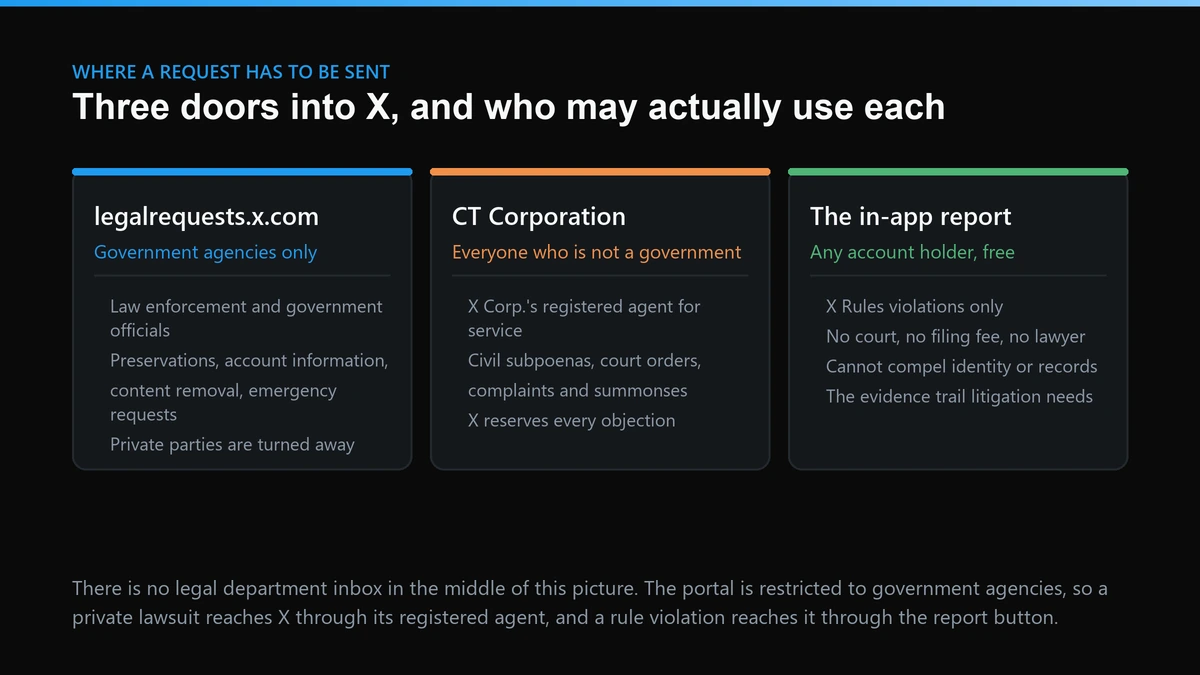
The address people search for does not exist. X publishes a Legal Request Submissions site at legalrequests.x.com, and the temptation is to treat it as the twitter legal department contact everyone is hunting for, but the site's own terms of access close that door. X states that only government agencies, including law enforcement agents and government officials, may use the Legal Request Submission Site, and that legal requests from non-government entities, including private entities, may be served on X Corp.'s registered agent, CT Corporation.
So the honest answer to a search for the twitter legal department, the x legal department or the twitter legal team is that there is a portal and a registered agent, and a private person gets the registered agent. A process server can tell you the rest. X adds, in the same guidance, that it does not and will not waive any objections, including the lack of jurisdiction or proper service, which is a polite way of saying that serving the wrong entity wastes your filing fee.
We have had people arrive at this desk holding a signed order, asking which address at X's legal team it should go to. Explaining that no such address is published usually took longer than reading the order did. Twitter Ban Service cannot serve process on anyone's behalf either, and says so before the conversation goes any further.
What the twitter legal request portal is actually for
Governments. A twitter legal request submitted through that site covers preservations, requests for account information both routine and emergency, and content removal demands, and the same address serves as X's single point of contact for EU authorities under Article 11 of the Digital Services Act. A twitter law enforcement request and an x law enforcement request are the same object arriving through the same channel from an agency with jurisdiction.
What a twitter law enforcement request unlocks that yours does not
Two features of that channel have no civilian equivalent. Emergency disclosure lets an agency ask for information without waiting for process where X forms a good faith belief that there is an exigent emergency involving a danger of death or serious physical injury. Preservation is the other: on a valid twitter law enforcement request X will preserve, but not disclose, a temporary snapshot of the relevant account records for 90 days pending service of valid legal process, with extensions available if asked before the clock runs out. A private litigant cannot freeze anything. That asymmetry is the single strongest argument for filing a police report in parallel where the conduct is criminal.
For everything short of that, the free channels are the ones to exhaust first. The solutions index maps them by violation, the right report route for each violation saves the guesswork, and a Twitter DMCA notice is the one legal instrument with a self-serve form and a defined process, at the price of your name travelling to the person you filed against. If you would rather talk it through first, the contact page is the way in.
What does a twitter subpoena actually get you?
Identifying data, and only if the account created any worth having. The Stored Communications Act sorts disclosure into tiers, and X applies them literally. Basic subscriber records, meaning the name given at signup, the email address, the phone number, session times and connection records, come out under a subpoena issued to a government agency under 18 U.S.C. 2703(c)(2). Other transactional records need a court order under 2703(d). Contents, which X defines to include posts, photos and direct messages, require a valid search warrant.
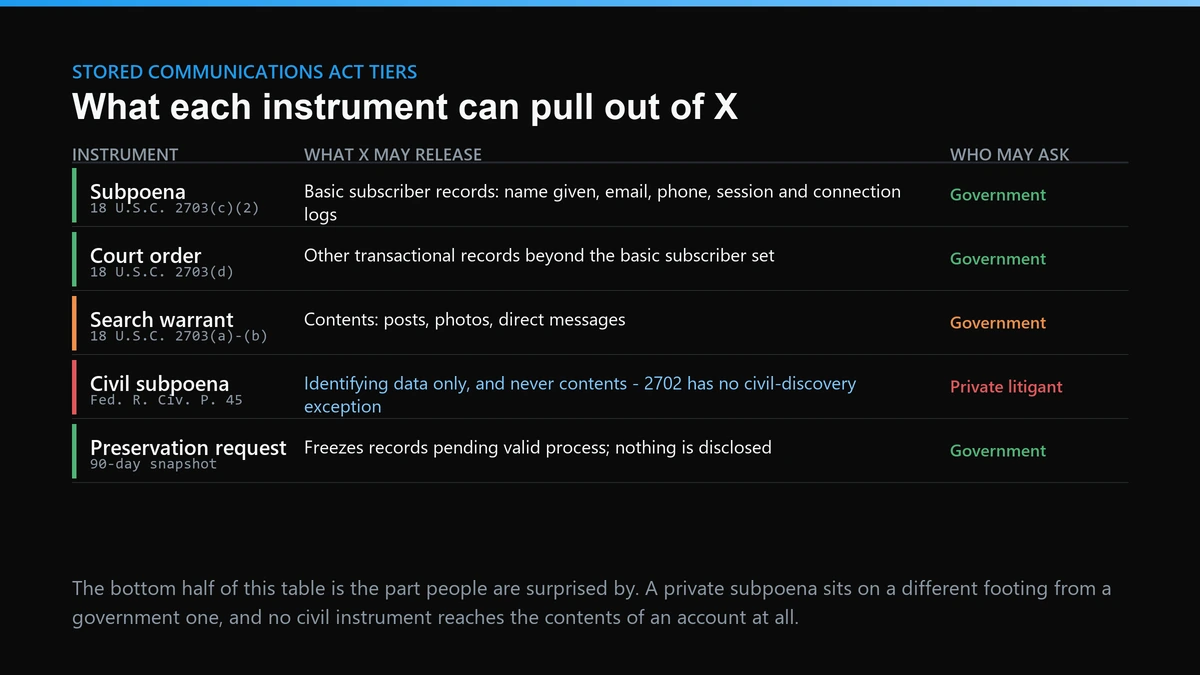
Now the part the process-server pages leave out. A civil subpoena is not one of those tiers. Section 2702 prohibits a provider from divulging the contents of a communication, and it contains no exception for civil discovery, so a Rule 45 subpoena is simply not on the list of things that unlocks content. Courts have been consistent about it, and the provider's standard response is to object, cite the statute, and point the litigant back at the account holder, from whom the same messages can be demanded in ordinary discovery. Identifying information sits on a different footing and can be sought, which is why unmasking works and message-fishing does not.
Budget for two smaller frictions. X may seek reimbursement for costs associated with information produced pursuant to legal process, as permitted under 18 U.S.C. 2706. And where the request comes from outside the United States, X generally refers the requester to the procedures available under a mutual legal assistance treaty or letter rogatory, which adds months. Standing matters here as much as paperwork does, and who is actually allowed to ask X to remove an account works through the situations where the person asking has none.
How to find out who is behind a twitter account, lawfully
File first, ask second. There is no lawful shortcut that produces a verified identity from outside a court, which is why the search results for this question split into two populations that never reference each other: people-search sites selling reverse lookups, and law-firm pages that discuss defamation without ever explaining the mechanics. The mechanics are a John Doe suit followed by a third-party subpoena, and they run in a fixed order.
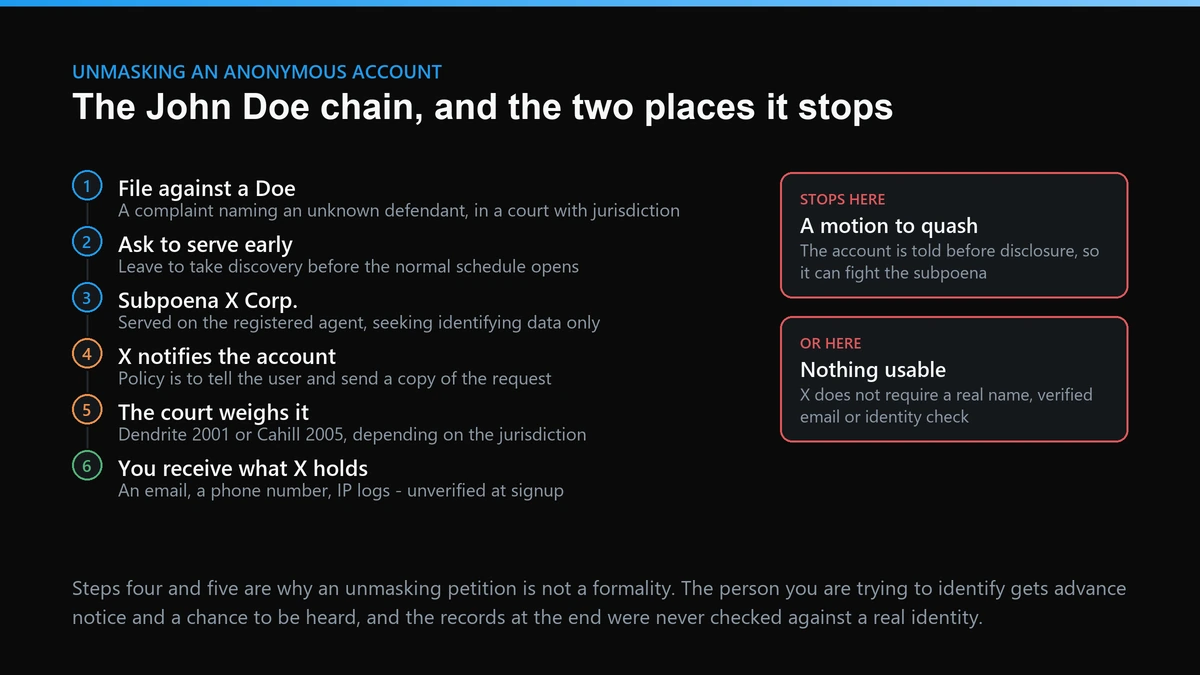
Step four is where most people's expectations break. X's stated policy is to tell the person you are trying to identify that you are trying to identify them. In its guidelines for law enforcement, X puts it this way: "For purposes of transparency and due process, X's policy is to notify users (e.g., prior to disclosure of account information) of requests for their X or Periscope account information, including a copy of the request, unless we are prohibited from doing so." The prohibition contemplated there is a non-disclosure order under 18 U.S.C. 2705(b), which a private litigant has no way to obtain. Content removal follows the same rule, with X promising to notify affected users about legal requests to withhold content, including a copy of the original request.
Your subpoena, in other words, arrives with your name on it, at the account you are suing, before anything is disclosed. The recipient then has the opportunity to move to quash, and anonymous-speech protections give them real material to work with. New Jersey's Dendrite International v. Doe No. 3 (2001) requires the plaintiff to notify the speaker, identify the exact statements complained of, make out a prima facie case, and then satisfy the court that the need for disclosure outweighs the First Amendment interest. Delaware's Doe v. Cahill (2005) sets the bar at the summary-judgment standard. Which test applies depends on the jurisdiction, no national standard exists, and the difference is often what decides the motion.
Step five is the quieter disappointment. X does not require real name use, email verification or identity authentication, so the records at the end of this chain were never checked against a human being. A burner email and a VPN produce exactly what you would expect. That is the honest reason a twitter subpoena sometimes costs four figures and returns a Gmail address created eleven minutes before the first post.
Which is not an argument against ever doing it. It is an argument for spending an hour on identification before spending money on it, because the cheap signals often settle the question. The four different things people mean by a fake account and the eight signals that separate a scammer from a real account both exist because a surprising share of anonymous accounts identify themselves through reused handles, recycled images and posting patterns. Where the account is wearing your name rather than hiding its own, the impersonation report route reaches the outcome faster than any court would, and if you have already filed and been refused, a counterfeit report that X keeps ignoring usually failed on category rather than merit. Coordinated accounts are a different animal again, and brigading and job-scam rings leave the kind of overlapping evidence that a single-defendant lawsuit handles badly.
Which is faster, a twitter takedown request or a lawsuit?
The report, by a distance, when the post genuinely breaks a rule. It costs nothing, needs no court, and X acknowledges it within about a day. The lawsuit reaches content the rules do not cover, and it is the only route that produces damages or an identity. The two are not alternatives so much as sequence, and the table below is really about one variable: who finds out it was you.
| Route | Does X tell the other side | Does your name travel | What it costs |
|---|---|---|---|
| In-app report | Only that action was taken, not by whom | Not published by X either way | Nothing |
| DMCA notice | Yes, with a copy of the notice | Yes, in full | Nothing, plus perjury exposure |
| Civil subpoena via CT Corporation | Yes, before disclosure | Yes, on the caption | Filing, service, counsel |
| Court order to withhold | Yes, with a copy of the request | Yes | Litigation to obtain it |
| Law enforcement request | Usually, unless sealed or exigent | No, the agency is the requester | A police report |
Two of those five rows put your name in front of the person you are complaining about. Only one of them is optional.
Does twitter notify when you report someone?
Not with your name, and not with a promise either. This is worth being precise about, because the confident claims circulating on both sides are secondary sources. X does not publish an affirmative statement that reports are anonymous. What it does publish, in its guidance on reporting violations, is a caveat pointing the other way: when reporting potential violations through the Help Center you may be asked to allow X to share parts of your report with third parties, such as the affected account. Read plainly, that is a request for consent rather than a default disclosure, and it is the only on-point language X offers.
Set that against the legal side and the asymmetry is stark. Reporting carries no published commitment to hide you and no routine notification of the other side. Legal process carries an explicit commitment to notify them and hand over a copy. Anyone weighing a twitter takedown request against litigation because they want to stay out of it should read those two positions carefully, in that order.
What exists instead of a twitter deletion request form
A set of narrow forms, none of which is a general deletion channel. There is no public twitter deletion request form and no court-order upload page for private parties; X's forms index routes legal matters to the law-enforcement channel and everything else to the reporting flows. What a court order buys is geography rather than erasure. X describes withholding access to the identified content in the location in which it is alleged to be in violation of local law, and states that it is the location of the viewer that matters, rather than the location of the reported user. The post survives; it stops loading in one country.
What the x transparency report shows about legal demands
The numbers give a sense of scale. In its second Global Transparency Report, covering July to December 2024, X reported 20,925 government requests for account information and disclosed some or all of the data in 10,581 of them, a rate of about 50.6%. United States requests fared better at 3,788 filed and 2,975 met, close to 78.5%. Removal demands ran on a different order of magnitude: 97,006 requests, 79,438 actioned, near 82%. Those figures come from the x transparency report published through X's Transparency Center, which serves the underlying data slowly and is best read as the twitter transparency report's successor rather than a live dashboard.
Two readings follow, and they point the same way. Even a government asking X for account data walks away empty-handed about half the time. And removal, which is what most people actually want, succeeds far more often than disclosure does.
The order that works
- Capture before you touch anything. Post URLs, the handle and the numeric account ID, full-window screenshots showing timestamps, and the surrounding thread. Accounts that expect enforcement delete and repost from a fresh handle.
- Report under the rule the post actually breaks, not the one that feels worst. Category is what a reviewer measures against, and a mis-filed report closes as no violation on the merits of a policy you never invoked.
- Keep the outcome. An action, or a refusal, is evidence either way. A documented refusal is what tells you the rules do not reach this content and the law might have to.
- Send a police report in parallel where there are threats, stalking or intimate images. Only an agency can trigger a 90-day preservation, and only an agency can reach content.
- Then price the litigation, with the evidence pack already built and the limitation period checked.
Twitter Ban Service runs the first three of those steps and stops there. We read the posts against the clause they breach, file through X's own channels, and say plainly when a case is a grievance rather than a violation. What Twitter Ban Service does not do is unmask people, obtain records, or advise on a claim, and any service offering to identify an anonymous account without a court is either selling guesses or breaking the law.
The same asymmetry holds elsewhere, which is worth knowing if the campaign against you spans platforms. Meta and TikTok run the same two-lane structure, free rules enforcement on one side and legal process on the other, and the details differ enough to matter: an Instagram account takedown, whether Instagram mass reporting achieves anything, what an Instagram spam report bot really does and the same question on TikTok cover those. On X itself, what X requires before it acts on targeted harassment and the protected-characteristic gate on hate speech are the two policies most legal-route searches should have started with. Getting an account banned the legitimate way sets out what the free lane can and cannot do, while mass reporting a Twitter account and the mass report bots sold around it explain why volume is the one lever that does not work. If the reach of your own account dropped after a dispute, the shadowban checkers are a separate question, and where the impersonator is squatting a handle you have a claim to, claiming an inactive username is occasionally the cleaner end of it.
If you take one instruction from this page: report it properly first, keep the refusal, and let that document decide whether a lawyer is worth calling. Almost nobody does it in that order, and it is the order that keeps the option open.
Sources
- Guidelines for law enforcement · X Help Center
- Legal request FAQs · X Help Center
- Report violations · X Help Center
- 18 U.S.C. 2703, Stored Communications Act · Cornell LII
- 47 U.S.C. 230 · Cornell LII
- X's North Texas venue clause, 15 November 2024 · KERA News
- X has a new forum selection clause · Transnational Litigation Blog
- The SCA and civil discovery · EFF Internet Law Treatise
- X's transparency reporting on government requests, 25 September 2024 · SiliconANGLE
FAQ
Can I sue X Corp. for something another account posted?
Almost never in the United States. Section 230(c)(1) says an interactive computer service will not be treated as the publisher or speaker of information provided by another content provider, and courts apply it to claims that turn on hosting or failing to remove a user's post. Telling X about the post first does not change that. The account holder who wrote it is the defendant, and X becomes a records custodian you may have to subpoena.
Where would I have to file a lawsuit against X?
Texas. Version 21 of X's Terms of Service, effective 15 January 2026, applies Texas law and requires disputes to proceed exclusively in the federal or state courts located in Tarrant County. The version taking effect on 9 October 2026 widens that to Wichita County or Tarrant County and adds an arbitration fallback on an individual basis only, plus a one-year limitation period. Both versions carry a class-action waiver.
How long do I have to sue over a tweet?
Defamation limitation periods are short, commonly one to two years depending on the state, and under the single publication rule the clock usually starts when the post first went up rather than when you found it. Retweets and quote posts generally do not restart it. Because the deadline can pass while you are still deciding, capture the evidence and get the filing record started before you commit to counsel.
Will X remove a post if I send a court order?
Usually by withholding it rather than deleting it. X describes withholding access to identified content in the location where it is alleged to break local law, and states that it is the location of the viewer that matters rather than the location of the reported user. So a court order from one country typically produces a country-level block, not a global erasure, and the post stays visible elsewhere.
Do I need the person's real name before I can file?
No. You can file against a John or Jane Doe and ask the court for permission to take discovery early, then subpoena X for whatever identifying data it holds. The court decides whether the unmasking is justified, applying a state standard such as Dendrite or Cahill. Expect the account to be notified and given a chance to move to quash before anything is disclosed.
Can X be forced to hand over direct messages?
Not by a private litigant. X requires a valid search warrant for the contents of communications, which includes posts, photos and direct messages, and only a government agency can obtain one. The Stored Communications Act contains no exception permitting disclosure of contents in civil discovery, so a Rule 45 subpoena aimed at message content is objected to and refused.