18 September 2026 · Twitter Ban Service · 14 min read
What a Twitter account report can actually remove, and what survives it
A report against a Twitter account produces one of five outcomes: a label, restricted reach, a forced post deletion, a temporary read-only lock, or permanent suspension. Only two of those remove anything. X decides which one applies, the category you file under decides what gets reviewed, and volume changes neither.
What does a report on a Twitter account actually remove?
Usually nothing, and that is not the same as being ignored. X publishes a range of enforcement options rather than a single ban switch, and three of the five rungs on that range leave the content exactly where it is. The gap between what people expect from the report button and what the button is wired to do explains most of the frustration around this topic.
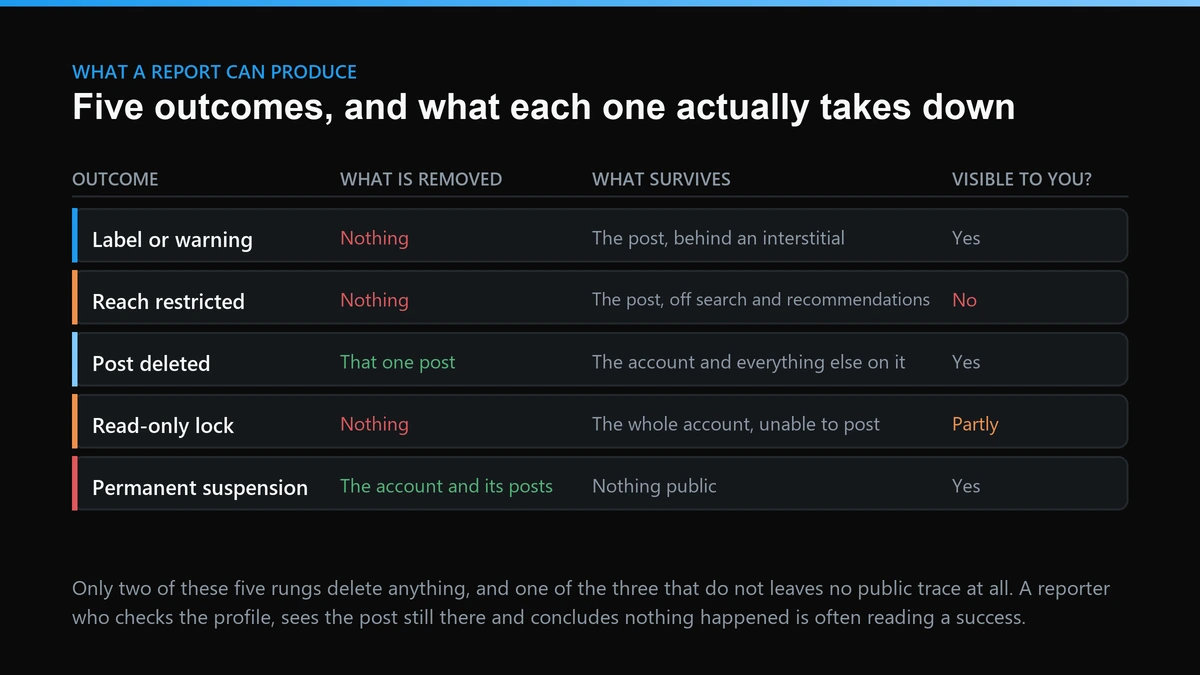
| Outcome | What is removed | What survives | Can you tell? |
|---|---|---|---|
| Label or warning notice | Nothing | The post, behind an interstitial | Yes |
| Reach restricted | Nothing | The post, pulled from search and recommendations | No |
| Post deleted | That one post | The account and everything else on it | Yes |
| Read-only mode, temporary | Nothing | The whole account, able to read but not post | Partly |
| Permanent suspension | The account and its posts, from public view | Quote posts, screenshots, off-platform copies | Yes |
The second row is the one that costs people the most. X describes the policy in its own transparency reporting as Freedom of Speech, not Freedom of Reach
, an approach under which it restricts the reach of posts to make them less discoverable as an alternative to removal
. A post handled that way stays readable on the author's profile while its distribution is cut, which from the outside is indistinguishable from inaction. The companion page on hate speech on Twitter works through the second-order tells, because hateful conduct was the first policy the approach was applied to.
Scale gives the same answer from another direction. X's global transparency report for July to December 2024 records 181,701,993 user reports, 4,191,171 account suspensions and 10,131,247 posts removed or labelled. Divide those out and roughly one report in thirteen produced any action at all, with about one in forty-three ending in a suspension. Read that as direction and scale rather than as your personal odds: reports are counted per report, not per account, so a single account can draw thousands and one decision can close thousands. If the whole account is the goal, the four routes to take down a Twitter account sorts the problem by ownership instead.
One caveat on freshness that nobody selling this work will mention. That report covers the second half of 2024 and was published in March 2025. No global safety report has appeared since, so the most recent published picture of X enforcement is around twenty-one months old as of September 2026, and anyone quoting a current success rate is quoting something they cannot have.
Whether you are told the result at all is now a regulatory question rather than a matter of etiquette. X's guidance states that depending on the type of issue you're reporting, you may or may not hear back from us with an outcome
. On 12 November 2025 Ireland's Coimisiún na Meán opened an investigation into X covering exactly that: whether people can appeal a decision not to remove content they reported, whether they are properly informed of the outcome, and whether the complaints mechanism is easy to use. Its Digital Services Commissioner, John Evans, put the principle in one line: The right to appeal a decision is an essential right and a cornerstone of the DSA.
Until that closes, silence after filing is the documented norm, not a sign your report was defective.
The report button and the standalone forms are two different machines
Most guides treat reporting as one funnel with different reasons attached. It is not. The in-app flow and the forms at help.x.com run on different entry requirements, different evidence, and in one case a different body of law, and picking the wrong machine is a quiet way to lose a case that should have won.
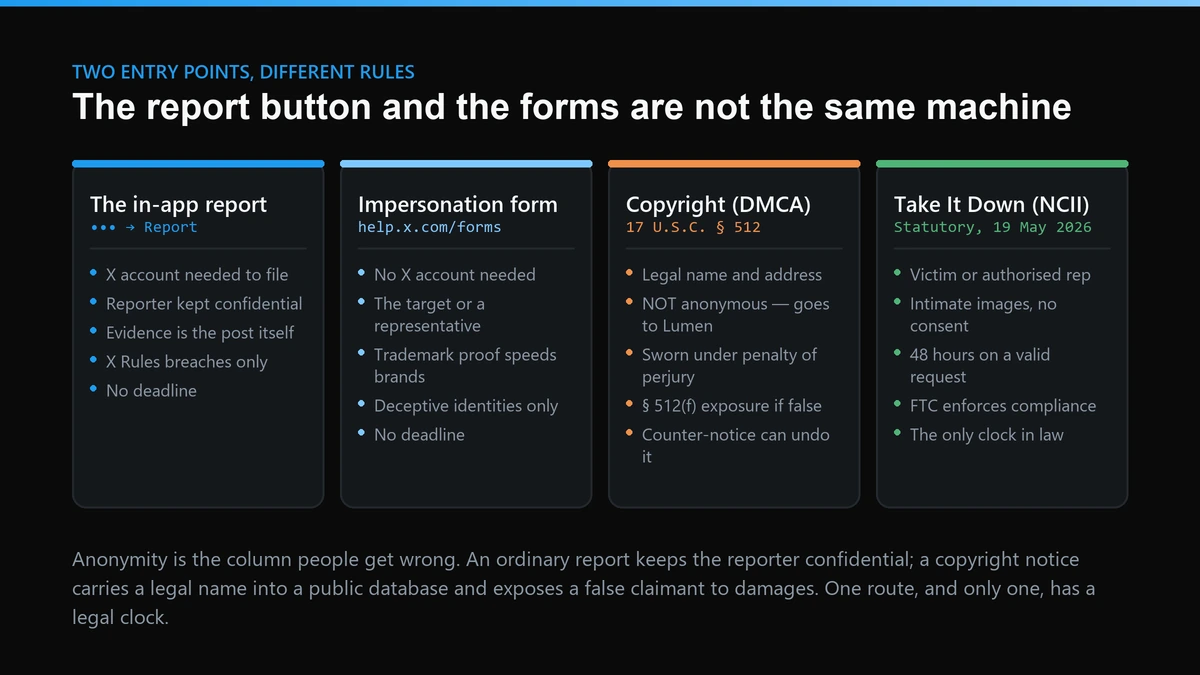
Work through the fork in this order before you file anything:
- Name the harm, not the feeling. A reviewer assesses the specific post you flagged against the single policy category you chose. Not the account's history, not the thread, not the pattern you can see and they cannot.
- Check whether a dedicated form exists. Impersonation, copyright, trademark, legal demands and non-consensual intimate imagery all have their own routes, and those routes reach places the in-app menu does not. The last of them is the only one carrying a legal deadline rather than a policy: under the TAKE IT DOWN Act, signed in May 2025 and enforceable by the FTC from May 2026, a platform has 48 hours to remove non-consensual intimate imagery on a valid request.
- Check who is allowed to file. The impersonation form accepts submissions from the impersonated person or their representative and does not require an X account at all, which matters when the target of the fake never joined the platform.
- Check what filing costs you. Copyright is the trap. A DMCA notice carries your legal name, and X's copyright policy states that where material is removed the reported user receives a full copy of the complaint including the reporter's name, email and street address.
That last point is worth slowing down on, because a widely shared claim gets it backwards. Ordinary abuse reports keep the reporter confidential. Copyright notices do the opposite: they carry a sworn statement made under penalty of perjury, they travel onward to the public Lumen database, and if the other side files a counter-notice X forwards a copy of it along with the contact details attached. A copyright takedown is also reversible in a way a rule report is not, since the statute gives the provider 10 to 14 business days to restore the material unless the original filer has gone to court. In practice few try: X actioned about 64% of the 230,392 copyright notices it received in the second half of 2024, while only 10% of counter-notices succeeded. If you need to report an X account without your name reaching the other side, the category decides that, not a privacy setting. A brand comparing quotes for a twitter impersonation takedown service is really buying evidence assembly and the right form, because the form itself is free and open to the rights holder.
One practitioner note on sequencing. On an early case in March we filed a strong impersonation report and, out of caution, blocked the account the same afternoon. The block is visible to the other side, the report is not, and a fake that had been posting weekly went quiet within the hour and started a fresh handle. Twitter Ban Service now files first and leaves the block until the case closes, because the block is the tell that a complaint has been made. Where a clone account is the problem, what X actually removes when an account is fake covers which of them it will act on.
Which violations does X still remove, and which has it stopped removing?
The removable set narrowed sharply after 2022, and no competitor page states the split plainly. Copyright and trademark, doxxing and private information, non-consensual intimate imagery, credible threats, child safety, impersonation and coordinated bot networks all still produce action. Negative opinion, most misinformation, general unpleasantness and a large share of what people experience as harassment mostly do not.
X's own per-policy figures for the second half of 2024 show how uneven the outcomes are. The same report button, filed under different policies, behaves like a different product.
| Policy reported under | Reports received | Accounts suspended | Posts removed or labelled |
|---|---|---|---|
| Hateful conduct | 56,644,189 | 2,326 | 6,068,219 |
| Abuse and harassment | 69,006,045 | 937,892 | 1,489,317 |
| Violent content | 23,961,009 | 89,866 | 1,835,973 |
| Child sexual exploitation | 11,189,741 | 1,790,852 | 2,781 |
| Private content | 8,979,107 | 2,188 | 32,543 |
| Non-consensual nudity | 76,392 | 51,449 | 143,813 |
Sit with the top row for a moment, because it is the most misunderstood number in this whole subject. Hateful conduct drew over fifty-six million reports and produced 2,326 suspensions, which is roughly one suspension for every twenty-four thousand reports, while the same policy generated six million post-level actions. X is not ignoring hateful conduct. It is labelling and restricting the posts and leaving the accounts standing, exactly as its stated philosophy says it will. Someone who files under that policy expecting the profile to disappear has misread the product, not been unlucky. Compare the bottom row: non-consensual nudity drew the smallest report volume in the table and the second-highest suspension count, because that category carries immediate permanent suspension. Severity sets the outcome. Volume does not.
Defamation sits outside the set entirely, and it is the most common wasted filing Twitter Ban Service sees. X has no defamation category because it does not adjudicate truth. Minc Law puts it bluntly: X will not play referee to determine whether or not content published on its platform is defamatory.
A defamatory tweet removal therefore runs through a court order or a jurisdiction-specific legal demand, never through the report menu, and the same applies to twitter defamation removal sold as a platform service. The page on who you actually sue over a tweet covers why X ends up as the witness rather than the defendant.
Two categories still move fast and are worth knowing by name. Doxxing and private-information breaches are handled as safety issues, and targeted harassment on Twitter explains the narrower definition that applies when the abuse is personal rather than identity-based. Financial fraud is the other, where the evidence is unusually legible to a reviewer, and the signals that separate a scam account from a real one sets out what to capture before the profile disappears.
Does mass reporting a Twitter account change the outcome?
No, and for once there is a primary document that settles it rather than an opinion. X publishes the factors it weighs when deciding whether to enforce: whether the behaviour is directed at an individual, a group or a protected category; whether the report has been filed by the target of the abuse or a bystander
; whether the user has a history of violating the policies; the severity of the violation; and whether the content may be a topic of legitimate public interest. Five factors — and the number of reports is not among them. The only report-related input is who filed, not how many did.
Coordinated filing is separately a breach of the Misuse of Reporting Features policy, which prohibits submitting duplicate or false reports in large numbers and coordinating others to do the same. So twitter mass reporting violation terms of service is not really a question about the target. It describes what the reporters are doing, and the stated consequence runs to limiting how that account's future reports are processed, or suspending it outright. A twitter mass report group organising a pile-on generates a detectable pattern, and the pattern is what gets discounted.
X has also documented the tactic being used against people, in its own words. A footnote in the same transparency report states that it observed a rise in reports of child sexual exploitation and non-consensual nudity, driven by an increase in inauthentic and malicious user reporting activity
. That is the platform recording a mass-reporting wave as an attack it detected, in the two categories with the fastest suspensions, which is precisely where a bad actor would aim. The wave moved the report counts. It did not move the outcomes.
Is a twitter mass report tool or a twitter spam report bot ever real?
What is mass reporting on Twitter in practice is a market as much as a tactic. A twitter mass report service and a twitter mass report tool sell the same premise at different prices, a twitter report bot and a twitter spam report bot automate it, and a free twitter mass report bot pulled from a public repository is usually a credential harvester wearing a script. Twitter Ban Service takes the security side apart in the teardown of Twitter ban tools, and the same market on other platforms behaves identically: see Instagram mass report, the Instagram spam report bot market and whether mass reporting works on TikTok.
There is a real mechanic underneath the myth, and it is the opposite of what the panels claim. One writer documented reporting the same account across roughly four months and found that Twitter Safety ignored all the other reports against this account, only clearing them out when they took action on a recent report.
A backlog of open reports does not accumulate into pressure. It sits there and gets closed in bulk the moment one report finally lands on the right desk, which means twenty filings and one filing reach the same reviewer with the same weight. Against that, a single correctly categorised report can move quickly: one Hacker News account describes filing under targeted harassment and watching the account go inside twenty minutes. Coordinated waves need a different treatment again, and reporting brigading on X covers how those are packaged.
The inverse case deserves a line, since a good share of people searching this are on the receiving end. An account that has been twitter mass reported and suspended appeals through the account-access route rather than the report queue, and the appeal is about your own account, never about the people who filed. Being the target of a campaign is a different problem with a different door, and the Instagram account takedown guide shows the same asymmetry on another platform.
What does the takedown market charge for each outcome?
Prices in this category span five orders of magnitude for work that ends at the same two or three forms — so it is worth seeing the tiers against what each one can actually move.
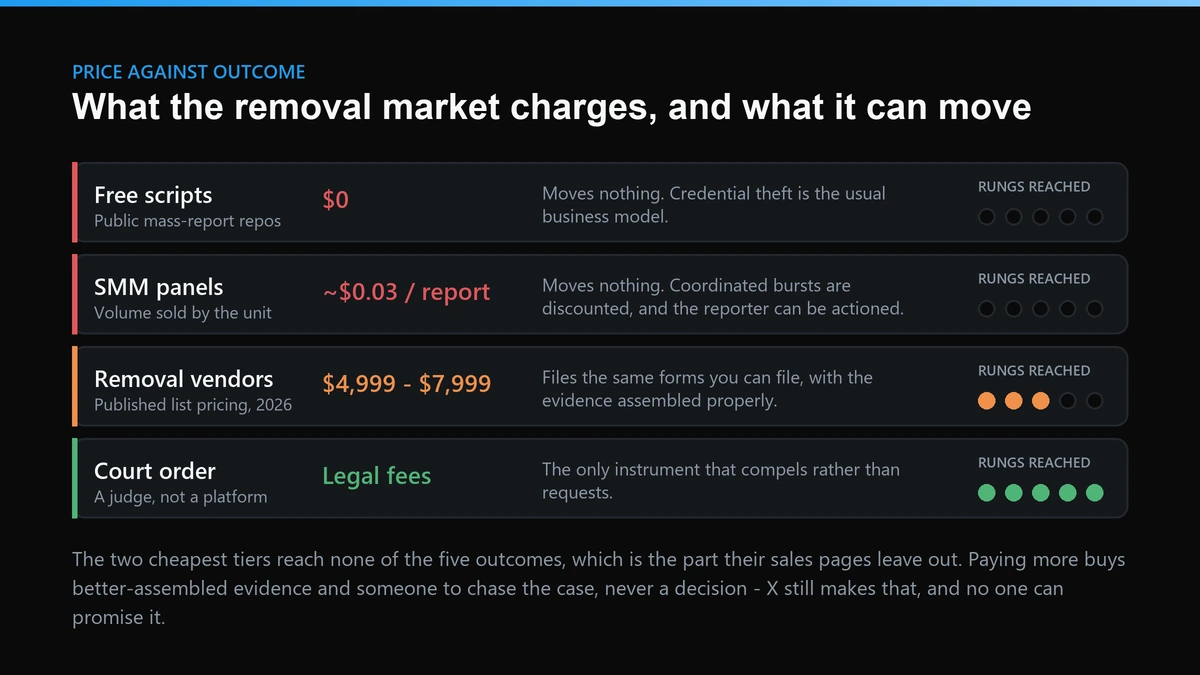
| Tier | Typical price | What it can reach |
|---|---|---|
| Public mass-report scripts | Free | Nothing. The repositories mostly harvest logins |
| Panels selling report volume | Around $0.03 per report | Nothing, plus exposure for the buyer |
| Removal and reputation firms | $4,999 to $7,999 on published 2026 list pricing | The same forms you can file, assembled properly |
| Court order | Legal fees | The only instrument that compels, though it withholds by country rather than deleting |
What does an x account takedown service actually sell?
Anyone marketing an x account ban service, an x account takedown service or an x tweet removal service is operating in the third tier, and the honest version of that offer is evidence work plus persistence. Searches for an agency to take down malicious tweets quickly return brand-protection vendors rather than anything faster than the forms, because speed here is a property of the case, not of the buyer.
Which brings us to the phrase that should end a conversation. A guaranteed twitter takedown cannot exist, because X holds the decision and no vendor sits inside that process. Where a guarantee does appear it is usually attached to volume, which is the one input the platform actively discounts.
The cautionary case here is worth knowing by name, since it is what a guarantee looks like when someone actually tries to honour it. Richart Ruddie, operating a reputation-management outfit, obtained de-indexing orders by filing lawsuits with fabricated plaintiffs and defendants and forged judicial signatures, as documented by Eugene Volokh in March 2017; he paid $71,000 to settle and entered a plea bargain in a related criminal case. Regulators have since reached further into this market. The FTC's Consumer Reviews and Testimonials Rule, effective 21 October 2024, bans suppressing content through unfounded legal threats and states explicitly that reputation-management companies are not immune from liability, with the first warning letters going out in December 2025 and civil penalties running past $50,000 per violation. Twitter Ban Service quotes on the work of building and filing a case, and the platform's decision stays outside anybody's control, ours included.
What survives a removal, and when a court is the only route
A suspension ends distribution on X. It does not erase anything. The profile stops resolving and the posts drop out of search, while quote posts carrying the original text, screenshots already taken and archived copies elsewhere continue to exist. People who have waited months for a suspension are often surprised by how little of the problem it solves, and planning for that in advance is the difference between a win and an anticlimax.
The legal route has its own version of the same disappointment, and it is the detail most takedown pages get wrong. A court order does not usually make X delete a post. X's mechanism for valid legal demands is country withheld content, which blocks the material in the jurisdiction that ordered it while leaving it visible elsewhere, and X restores access if the content later becomes lawful there. Nor is the process covert: X's stated policy is to notify the user about requests to remove their content, including with a copy of the request, unless prohibited by law. Against that, its compliance rate is high, with about 82% of the 97,006 government and legal removal requests in the second half of 2024 actioned.
How to get a tweet taken down when the account stays up
The post-level questions collapse into one constraint. You cannot delete a tweet for someone, and you cannot delete someones tweet, whichever way the search is phrased, because no account holds that power over another. What you can do is cause X to remove it or cause the author to. Everything filed under get a tweet taken down, how to get a tweet taken down, or takedown tweet resolves to those two paths, and who can delete someone else's X account sets out the narrow standing that exists. Note the contaminated corner here: twitter account takedown and twitter account takedown on x mostly return guides to deleting your own profile, which is a separate job covered in deleting a Twitter account permanently and the cost and limits of deleting all your tweets.
So here is the recommendation, stated plainly. File once, in the correct category, with the permalink and a dated screenshot captured before you do anything visible. Do not block until the case closes. If the content is defamatory rather than rule-breaking, stop filing reports and go to a lawyer, because a twitter takedown through the report menu was never available for that harm and repeat filings only train the queue to close your case. Where you want an x account takedown or want to get a twitter account taken down on genuine grounds, the strength of the single filing decides it. Our full index of X enforcement routes maps the rest, and you can send us the handle and the posts if you would rather have the case built for you.
Sources
- X Global Transparency Report, July to December 2024 (PDF, published March 2025). Source of the enforcement factors, the per-policy report and suspension figures, the copyright and legal-request totals, the quoted enforcement philosophy, and the footnote on malicious reporting activity.
- Coimisiún na Meán investigation into X, 12 November 2025, on appeals against decisions not to remove reported content, and the quoted statement from Digital Services Commissioner John Evans.
- X copyright policy, on forwarding counter-notices and contact details to the original filer.
- 17 U.S.C. § 512, for the 10-to-14 business day restoration window and § 512(f) liability for knowing misrepresentation.
- X on content withheld by country, the mechanism a valid legal demand actually triggers.
- FTC Consumer Reviews and Testimonials Rule guidance, on unfounded legal threats and the liability of reputation-management firms.
- Eugene Volokh on fabricated libel suits used for de-indexing, 14 March 2017, the Richart Ruddie case.
- Minc Law on reporting slander on X, source of the quoted position on defamation adjudication.
FAQ
What is mass reporting on Twitter?
Mass reporting is a group filing the same complaint against one account to force a suspension. X's Misuse of Reporting Features policy prohibits submitting duplicate or false reports in large numbers, and coordinating others to do it, and the stated consequences fall on the reporters rather than the target: X may limit how their reports are processed, or suspend them outright. The deeper reason the tactic fails is that report volume is not among the five factors X says it weighs when deciding whether to enforce.
Does X tell you what happened to your report?
Often not. X's own guidance on reporting a post says that depending on the type of issue you are reporting, you may or may not hear back with an outcome. A confirmation that the report was received can take up to a day to appear. There is no case number to quote, no queue position, and no way to ask a human for a status update on a standard in-app report.
Can you delete someone else's tweet?
No, and no tool changes that. X gives no account power over another account's posts, so the only routes are X removing the post or the author being made to. Searches for delete someones tweet return bulk-deletion apps built for your own timeline.
How long does a Twitter report take?
There is no published service level and the honest range is enormous. One Hacker News account describes filing under targeted harassment and watching the account disappear inside twenty minutes. A Substack writer documented reporting the same account across roughly four months before anything moved, and found that X closed the earlier reports in bulk only once a later one landed. Severity is the main variable. Whether the account already carries prior enforcement is the second, since violation history is one of the five factors X says it weighs. Elapsed time since you filed is not a factor at all.
Is reporting a Twitter account anonymous?
For ordinary rule reports, yes. For copyright, no. A DMCA notice carries a legal name and a statement made under penalty of perjury, notices are forwarded to the public Lumen database, and X's copyright policy states that on receiving a valid counter-notice it forwards a copy, including the contact information submitted in it, to the person who filed the original complaint. Anyone who needs distance from a copyright claim should have an agent file it rather than sending it personally.
Does a suspension delete the account's old posts?
It removes them from public view rather than erasing them. The profile stops resolving, posts drop out of search, and the follower list disappears. Quote posts, screenshots and archived copies elsewhere survive intact, so treat a suspension as the end of distribution on X rather than deletion of the content.
Can anyone guarantee a Twitter takedown?
No, and a guarantee is the clearest signal to walk away. X makes every enforcement decision, so no outside party controls the outcome. Even the reputation firms competing for this work refuse the promise, with one stating plainly that X is the decision-maker. A vendor selling certainty is either selling report volume, which X discounts, or counting on the account breaking a rule anyway.