21 September 2026 · Twitter Ban Service · 12 min read
Filing a Twitter DMCA notice when your work is stolen, and when repeat notices suspend the account
A Twitter DMCA notice is a copyright complaint filed through X's Intellectual Property Issues form from a signed-in X account. It needs a direct link to each infringing post, a link to your original work, your contact details and a statement made under penalty of perjury. Valid notices get the post withheld, and repeated ones can get the account suspended.
How many copyright notices does X handle, and how often do they stick?
X processed 188,661 copyright notices and 70,980 trademark notices in the first half of 2024, and only 11.71% of copyright counter-notices ended with the content restored, according to X's Global Transparency Report as reported by The Drum on 26 September 2024. That last figure is the one to hold on to. Of the posters who fought a removal through the formal counter-notice route, roughly nine in ten did not get their content back.
A notice still has to earn that outcome. Twitter's copyright transparency report, published in July 2022, lists what X refuses to act on: notices that are incomplete, that are not really about copyright, or that X judges fraudulent, along with uses that look like fair use, news or political speech. In that same report, Twitter described a network that sent unauthorized notices while claiming to act for a K-pop group. More than 45 of the abusive accounts were suspended and 20 targeted accounts were restored. That is the practical difference from what a standard report can remove: a notice is judged on its completeness and honesty, and a dishonest one can get the sender suspended.
How X handles notices has also been argued in court. Seventeen music publishers coordinated by the NMPA sued in June 2023 over roughly 1,700 works and more than $250 million in claimed damages, and a March 2024 ruling kept alive the claim that X treated paying verified users more leniently. Both sides filed joint stipulations of dismissal with prejudice on 16 July 2026, with no terms disclosed, Music Business Worldwide reported. No court ever decided whether that claim was true.
Which X form fits what was taken from you?
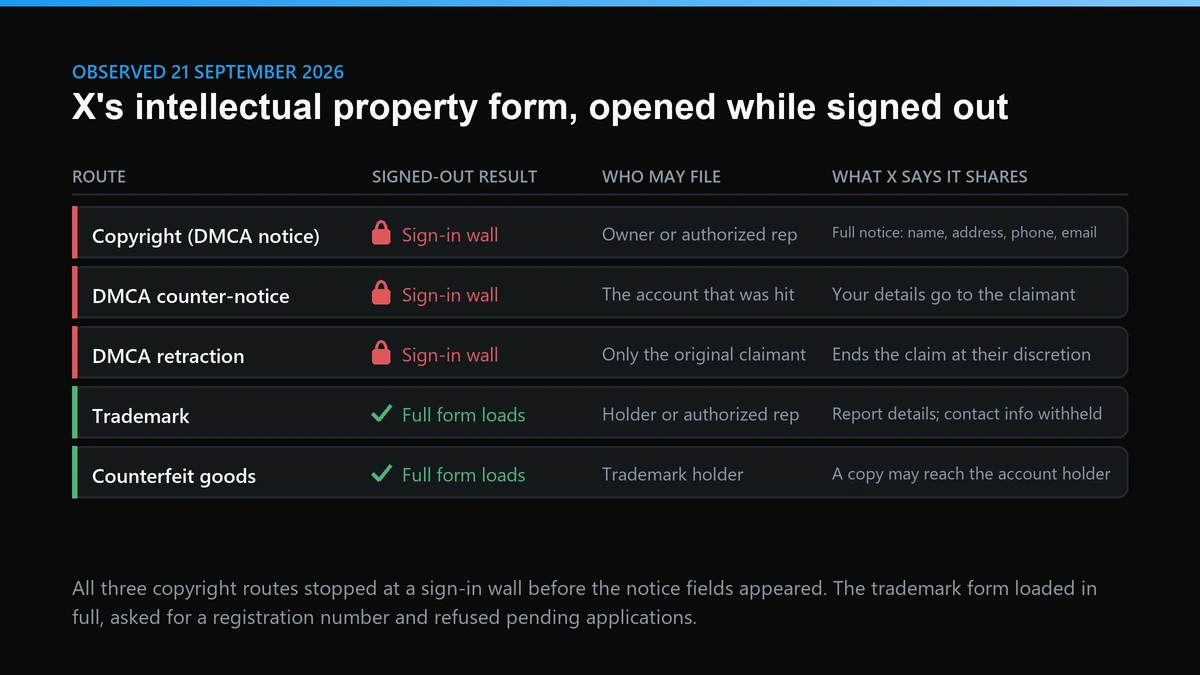
Copyright covers work you created, trademark covers a registered name or logo, and counterfeit covers fakes sold under that mark. All three sit on one page, X's Intellectual Property Issues form, and each route asks who you are before it shows anything else. Unless you are signed in, the Twitter copyright form goes no further, while the Twitter trademark report form and the counterfeit form load for anyone. On X, a Twitter copyright infringement report and a DMCA notice are the same filing, because X handles every copyright complaint under section 512 of the DMCA.
| What was taken | Route to pick | Who X accepts it from | Have this ready |
|---|---|---|---|
| Your photos, video, art or writing, reposted | Copyright, the Twitter DMCA form | The copyright owner or an authorized representative | One direct link per infringing post, plus a link to your original |
| Your registered brand name or logo in a handle, bio or posts | Trademark | The trademark holder or an authorized representative | Registration number, class and registration office |
| Fakes of your product, or paid access to your content resold | Counterfeit | The trademark holder | The registered mark and the posts making the offer |
| An account posing as you or your company | Impersonation, a separate form outside the IP page | You or someone acting for you | Proof of identity and the profile link |
| A photo of you that someone else took | Usually none under copyright | The photographer, not the subject | A privacy or harassment report may fit instead |
The counterfeit row catches creators off guard. X's counterfeit policy covers "the offer, promotion, sale, or facilitation of unauthorized access to content, including digital goods", so a paid photo set or course being resold on X can come down under it, provided the seller trades on your registered mark. Without a mark, the same leak is a copyright case.
No form hands you a delete button. X makes each decision, the same rule that governs who can delete another account.
How to file a DMCA takedown on Twitter, one post at a time
Sign in, open the copyright route of X's intellectual property form, and list every infringing post by its own URL. A Twitter DMCA takedown request is only as strong as those links, and X's copyright policy says, in capital letters, that a link to a profile page is not enough to identify the infringing material. Anyone working out how to report copyright infringement on Twitter ends up here, because the ordinary in-app report handles X Rules breaches and the policy points rights holders to the Help Center form.
- Confirm the work is yours to claim. X's policy notes that the photographer, not the person in the photo, generally holds the rights. Screen for fair use as well: since Lenz v. Universal in 2015, a sender is expected to weigh it, and a knowingly false notice creates liability under 17 U.S.C. §512(f).
- Collect one direct link per infringing post. Each post has its own address ending in /status/ and a number. If the copy is the account's avatar or header image, say so in the description instead.
- Sign in to an X account with a current email address. X requires it on every copyright route and sends the ticket confirmation to that address. Filing for a client means signing in as yourself and choosing the representative option.
- Open the Twitter DMCA takedown form. At help.x.com/en/forms/ipi, choose "I need to report possible copyright infringement", then "I am the copyright owner" or "I am an authorized representative of the copyright owner". Picking the third choice, "None of the above", ends the process.
- Complete the statutory elements. Identify your original, list the infringing posts, give your address, phone number and email, add the good-faith statement and the statement under penalty of perjury, then type your full name as the signature.
- Submit once, then watch for the ticket email. No confirmation means X never received the notice and should get it again. Sending the same notice twice only slows it down.
- Log the ticket. Keep the ticket number, the date and every URL it covered, because that record is what a repeat-infringement case is built from.
When Twitter Ban Service opened the form signed out on 21 September 2026, we got the same sign-in wall on four routes: owner, representative, counter-notice and retraction. Both the trademark and counterfeit forms loaded in full. A rights holder with no X account can still be represented by someone who has one.
What proof should be ready before a Twitter DMCA notice goes in?
Proof you made the work first: the original file, its earliest public post with a date, and anything tying the copy back to you. X's copyright policy does not ask for documents with the notice. That file matters later, when a counter-notice or a lawsuit puts your ownership in question.
| What was stolen | Proof that holds up | The trap |
|---|---|---|
| A photograph | The original file with its camera data, and your earliest post of it | Appearing in a photo does not make it yours; the photographer usually owns it |
| A video clip | Your project or export file, and the timestamp of the first upload | A clip cut from a broadcast or a game is mostly someone else's work |
| Artwork | Layered or process files, and your first posted version | A shared style is not protected; copied expression is |
| A written thread or article | The post's URL and date, plus drafts | Names, titles and short phrases get no copyright protection |
| Paid content resold | Your sales page and the leaked file | Sold under your registered brand, it may fit the counterfeit route better |
Twitter Ban Service assembles this file before anything is sent: proof of ownership for each work, a numbered list of infringing URLs, a fair-use check and a signed authorization, so the notice can go in under our name as your representative. X's policy says a representative files with its own valid contact details and names the owner it acts for. Your name still appears on the notice, but the contact details on it are the representative's.
Registration is not required for the notice itself; it matters later, if a counter-notice pushes the dispute toward court. One more privacy point: many guides still say notices land in the public Lumen database, but Lumen reported in April 2023 that Twitter had stopped sending it copies, and X's copyright policy, read on 21 September 2026, no longer mentions Lumen at all.
When do repeat notices get a Twitter account suspended?
When one account draws multiple valid copyright complaints, or shows another sign of a pattern, X may suspend it under its Repeat Infringer Policy. X keeps that policy because the law makes it the price of protection: section 512(i) of the Copyright Act conditions a platform's safe harbor on terminating repeat infringers "in appropriate circumstances", and leaves the count to the platform.
X keeps its count private. No number appears in its copyright policy, so the "six strikes" figure repeated on vendor sites has no source in X's own rules. The policy does say that valid retractions and counter-notices are taken into account, which means a notice the poster successfully counters, or one you withdraw, should not be expected to weigh against the account.
In practice the record is built one work at a time. If an account has reposted a dozen of your photographs, the stronger file names twelve works and links every post that copies each one, instead of one vague complaint about a profile that X's own policy calls insufficient. X does not say whether a single notice listing several posts counts once or several times, so we give every original work its own notice and put every copy of that work inside it. The ledger then shows each ticket, its date, the posts it covered and whether a counter-notice followed, and that ledger is what lets a later notice say, accurately, that this account keeps doing it.
Some behavior skips the slow build. X's policy names re-posting material that was already removed, pointing people to where the copyrighted material sits on other websites, and running an account that is "intended solely or primarily to infringe" as conduct that may end in permanent suspension.
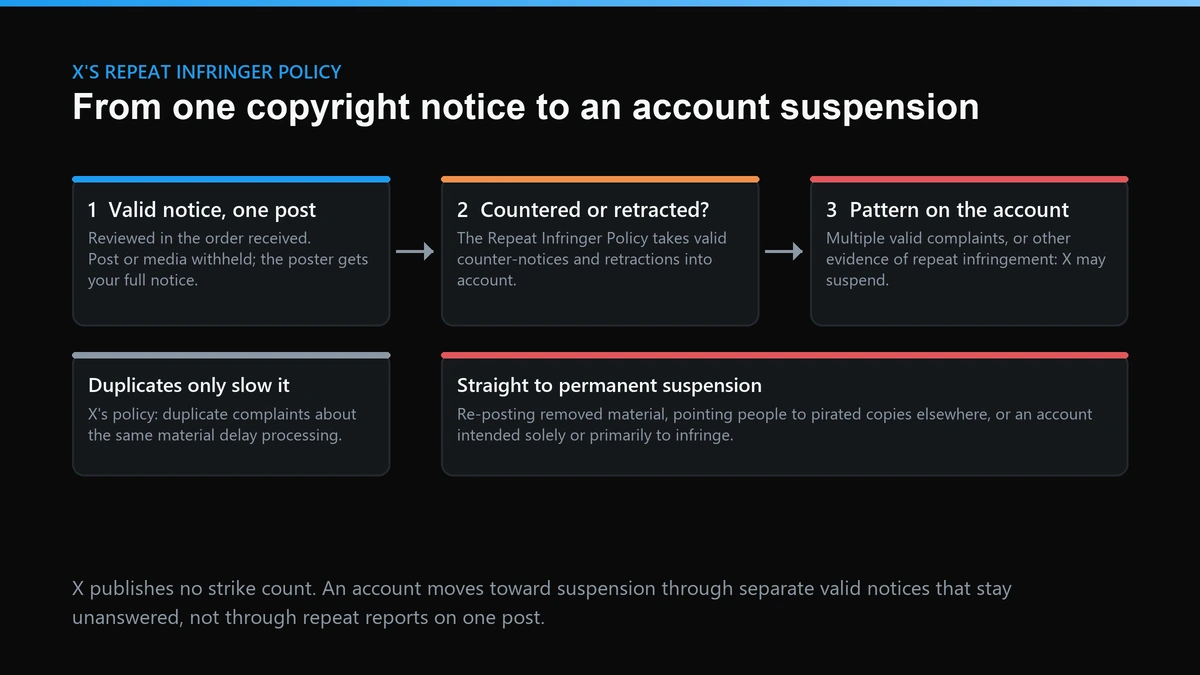
Volume does not replace any of this. X handles complaints in the order they arrive and warns that duplicates delay processing, the copyright version of what mass reporting on TikTok and Instagram mass reports teach: repetition slows the queue without adding evidence. Twitter Ban Service keeps one ledger per account it pursues and stops filing when the evidence stops. An account that deactivates to dodge a notice can come back inside X's 30-day deactivation window, so the ticket numbers stay on file at least that long.
Can a trademark infringement report take a Twitter username?
It can get the account suspended or pushed to stop the confusing use, but X's trademark policy says nothing about handing the username to you. Dated April 2023, the policy lets X give an account "an opportunity to comply" or suspend it permanently on first review, depending on the violation, and it accepts reports only from the trademark holder or an authorized representative.
What the trademark violation report asks for
Knowing how to report trademark infringement on Twitter starts with the registration certificate. The Twitter trademark report form asks for the exact registered mark, a federal or international registration number, the goods and services class from 1 to 45, and the registration office, such as the USPTO. It states that pending applications are not sufficient. It also wants a company email address and your job title, plus a government photo ID where applicable, and the handle you are reporting goes in its own required username field.
Two limits settle many of these cases before X reads the details. Using a mark outside the territory or the class of goods in its registration is not a violation under X's policy, and neither is nominative use, such as a fan account naming the brand it talks about. A Twitter trademark infringement report also travels further than people expect: the form promises your contact information will not be disclosed, while the policy warns that X may give the account holder your name and other details from the report.
If the handle is pretending to be you rather than trading on your brand, the impersonation and fake-account route fits better and needs no registration.
What happens after X withholds the post?
Viewers see the post marked as withheld, the poster receives your full notice, and a deadline starts only if they counter it. The label is public, which makes it different from the quiet reach limits a shadowban checker tries to detect. A Twitter copyright removal stays provisional while a counter-notice is possible: the poster can swear the removal was a mistake, accept the jurisdiction of a U.S. federal court, and ask X to restore the material.
X then forwards the counter-notice to you, contact details included. Its policy says that if X hears nothing within 10 business days about you seeking a court order, it may restore the post. The statute, 17 U.S.C. §512(g)(2)(C), puts restoration at not less than 10 and not more than 14 business days after the counter-notice arrives.
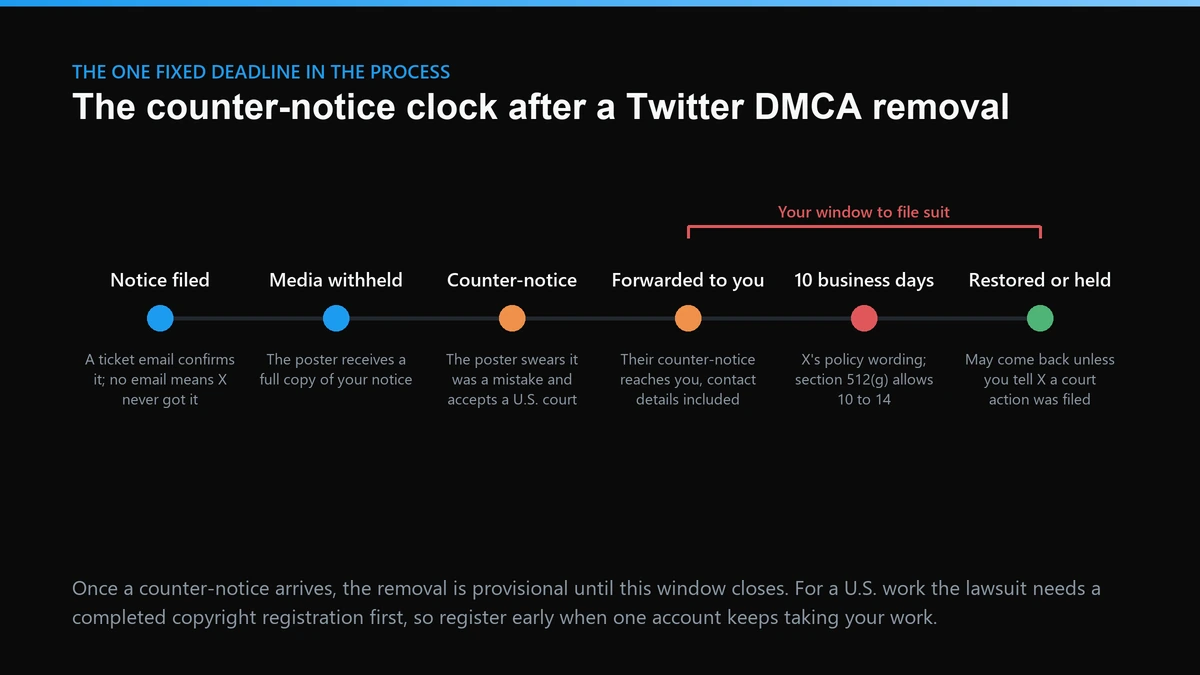
Filing suit is the only step that stops the restoration once a valid counter-notice arrives, and the defendant is the poster, which is who you would actually sue. For a U.S. work the Supreme Court held unanimously in Fourth Estate v. Wall-Street.com, on 4 March 2019, that the Copyright Office must act on a registration before a suit can begin. Money depends on timing too. Statutory damages run from $750 to $30,000 per work, and up to $150,000 for willful infringement, under 17 U.S.C. §504(c), but §412 rules them out for infringement that began before registration unless the work was registered within three months of first publication.
Smaller losses have a cheaper forum. The Copyright Claims Board at the U.S. Copyright Office hears claims worth up to $30,000 in total, limits statutory damages to $15,000 per work and accepts a pending registration application, its FAQ explains. If you change your mind instead, only you can retract: X's policy offers a retraction form, or an email to copyright@twitter.com that identifies the material and says you are withdrawing the notice.
Is there a Twitter DMCA email, and when is a removal service worth it?
Yes, X's Terms list copyright@x.com for its copyright agent, but the web form is the route its policy describes and the one that issues tickets. The Twitter DMCA email that older guides still quote, copyright@twitter.com, now appears in X's copyright policy only as the address a reporter uses to retract a notice. A notice sent through the Twitter DMCA form comes back with a confirmation email, the simplest proof it landed.
Email also runs the other way, and that is where the risk sits. Malwarebytes reported on 17 November 2025 that scammers were sending fake X messages opening "We've received a DMCA notice regarding your account", threatening reduced visibility within 24 hours and linking to a counterfeit login page. A genuine notice about your own posts carries the complaint itself, including the reporter's contact details, which is one of the checks Malwarebytes suggests.
| Who files | Contact details the poster sees | Who answers a counter-notice | Fits when |
|---|---|---|---|
| You, through the form | Yours | You | One or two posts, and you are fine with being named |
| A filing service as your representative | The service's | The service, then your lawyer if it heads to court | One account keeps coming back, or you want distance |
| A copyright lawyer | The firm's | The firm | A counter-notice is likely, or you want damages |
| A monitoring subscription | The vendor's | Usually the vendor | A large catalogue copied on many platforms |
A Twitter DMCA removal service earns its fee when one account keeps coming back or when you would rather your address stayed off the notice. Twitter Ban Service files and tracks the notices; X decides every one of them, and nobody can promise that a particular account will be suspended. Be wary of anything priced per report, like the report bots sold for Instagram, because copyright enforcement runs on one valid notice per stolen work. To open a case, send the handle and your originals through the contact page.
Stolen content that belongs in a different report
A Twitter copyright report only reaches the work itself, so some thefts need another route.
- An account using your photos to run a scam: the fraud matters more than the copy, and the warning signs are covered in how to spot a scam account.
- Reposts with abuse aimed at you: X's targeted harassment rules apply to the campaign, whatever the images.
- Your photo recaptioned with slurs about who you are: that belongs under X's hateful conduct rules.
- The same thief working on Instagram: Meta runs its own forms, so follow the Instagram account takedown route there.
- Your own old post, copied before you deleted it: deleting your own posts never pulls the copies down, so keep the original as evidence.
When the theft is copyright, start with the newest post, give each work its own notice and keep the ledger. The rest of the X takedown guides cover the routes this page leaves out.
FAQ
Can you file a Twitter DMCA notice without an X account?
Not through the copyright form. Tested on 21 September 2026, the notice, counter-notice and retraction routes all stopped signed-out visitors at a login requirement. A representative with their own X account can file for you, and the trademark and counterfeit forms still loaded without signing in.
Can a fan or a friend file a DMCA notice for the creator?
Only with the creator's authorization. X's copyright form offers three choices: owner, authorized representative, or None of the above. Picking the last one ends with X stating that it only handles requests from the owner or their representative, however obvious the theft looks.
Do you need a registered copyright to send the notice?
No. A notice needs ownership, not a certificate. Registration matters later, because a U.S. work has to be registered before you can sue, and a lawsuit is the only thing that stops a restoration after a counter-notice. Trademarks work the opposite way: X's form refuses a trademark report without a registration number.
Can you copyright a Twitter handle?
No. The U.S. Copyright Office's Circular 33 states that words and short phrases such as names, titles and slogans are not protected by copyright. A handle is a name, so the only intellectual property route for one is trademark, and that needs a registered mark covering the way the handle is being used.
How long does X take to act on a takedown request?
X publishes no timeline. Its policy says copyright complaints are handled in the order received and confirmed by a ticket email, and that duplicates slow things down. Only one clock is fixed, and it comes later: once a counter-notice arrives, you have 10 business days under X's wording to report a court action.
What should you do if the same account re-uploads your work after a removal?
File a fresh notice for each new upload and skip re-reporting the post X already withheld. Keep the earlier ticket numbers in your log, because re-posting removed material is exactly the behavior X's policy says may end in permanent suspension, and a clean record is what lets X see the pattern.