23 September 2026 · Twitter Ban Service · 18 min read
Best Twitter impersonations, and how to delete a fake Twitter account copying you
To delete a fake Twitter account that copies you, file X's impersonation form under the branch that fits: you, someone you represent, or your company. Each of its form branches now starts with a government ID and selfie check. X then suspends the copy or forces a profile change, and only X decides.
What does X's impersonation form ask for in 2026?
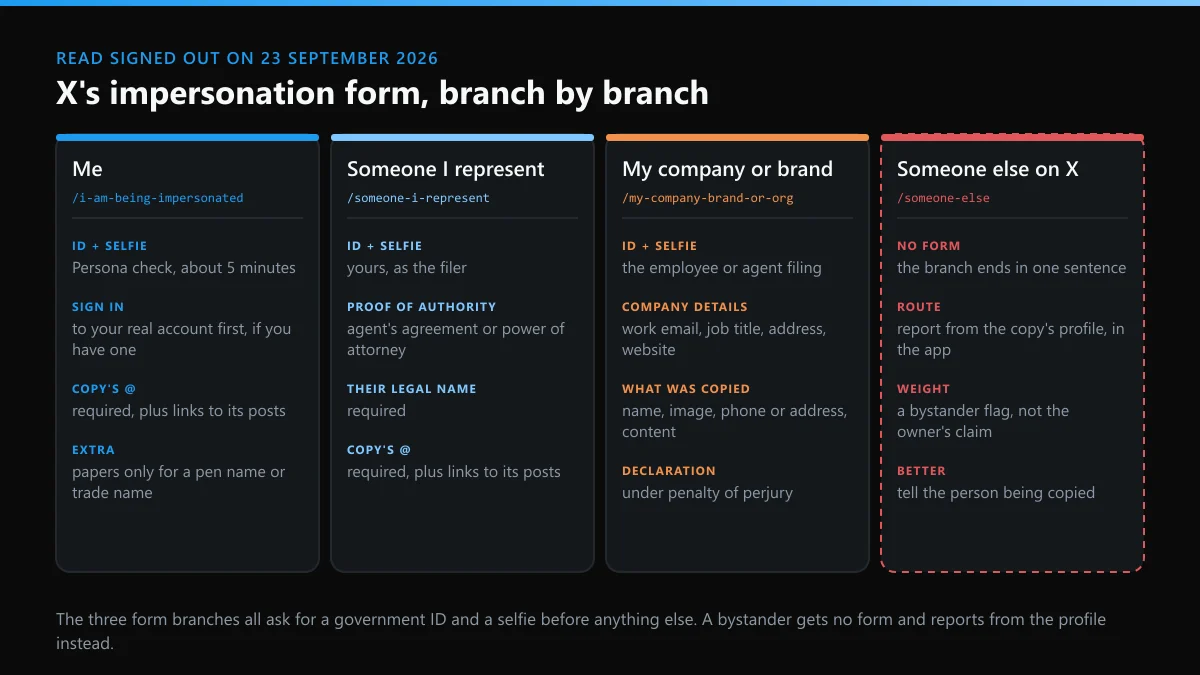
A government ID and a selfie, before it asks a single question about the copy. X's form at help.x.com splits on one required question, "Who is being impersonated?", and three of its four answers lead into a form that starts with an identity check run by the verification company Persona.
When Twitter Ban Service opened each branch signed out on 23 September 2026, we saw the same block at the top of all three. Persona's check "usually takes about 5 minutes", needs a camera that works, and asks the filer to let X and Persona use photos of the ID and a selfie, extracted biometric data included. Persona may keep that data for up to 30 days, according to the consent line. Pick the fourth answer, "Someone else on X", and nothing opens at all. It ends in one sentence that sends bystanders back to the copy's profile to report it inside the app, although plenty of guides still describe a short form any onlooker can fill in.
| Branch you pick | Who it is for | What X asks for after the ID check | Easy to miss |
|---|---|---|---|
| Me or someone I am authorized to represent, then "I am being impersonated" | The person being copied | Your email, the copy's @, links to posts where it claims to be you, a 280-character note | Sign in to your real account first if you have one; a pen name missing from your ID needs its own proof |
| Same, then "Someone I represent" | An agent, lawyer or manager acting for one person | Whether that person has an X account, their legal name, the copy's @ and post links | Proof of authority is required, such as an agent's agreement or a power of attorney |
| My company, brand, or organization | An employee, or a law, marketing or PR firm acting for the company | Work email, job title, company address and website, what was copied, whether you want the handle | A declaration under penalty of perjury; no trademark number is asked for |
| Someone else on X | A bystander | Nothing: the branch has no form | Report from the copy's profile in the app instead |
Two lines on X's help pages seem to pull in opposite directions, and both hold. X's help article on reporting impersonation says you do not need an X account to report it. Its form adds that if your own X account is the one being copied, you must sign in to it before going further. Put together, a person who never joined files signed out, while a person whose account is being cloned files from inside it, which tells X at once which of the two profiles is the original.
Money explains the identity step. People told the US Federal Trade Commission they lost $3.5 billion to imposter scams in 2025, close to one fraud report in three, and nearly $1 billion of that went to people posing as businesses, up from $866 million a year earlier, with about $920 million more lost to people posing as government agencies, according to the FTC's release of 15 June 2026. Those figures cover every channel, from texts to search results, not X alone. A form that can get accounts suspended is also a way to attack real ones, which is the plainest reason to check who is asking.
Someone is impersonating me on Twitter: what goes into the filing?
Post links, the copy's exact handle and one precise sentence. X sends the person being copied to its Help Center form rather than the in-app report, and the self branch is the shortest of the three. That is why thin filings fail there: the reviewer has little to go on beyond two profiles and whatever you typed.
- Collect the post links before you open the form. X's "Links to posts" box takes one URL per line, and a reviewer can open a link, where a screenshot only shows what a page looked like once. Take every post that uses your name, your photos or your job, plus any reply where the copy talks to your followers as you.
- Sign in to your real account in the same browser. X requires it when your account is the one being copied. If you have never had an account, skip this step and file signed out.
- Pass the identity check. Have a passport, driving licence or national ID card ready; Persona photographs the document and takes a selfie, and X's own notice puts the whole thing at about five minutes.
- Type the copy's @ into "Username of the account you are reporting". It is the only required field about the copy, so check it character by character against the live profile. Impostors often pick handles one letter away from yours.
- Spend the 280 characters on what the reviewer cannot see. "Created 3 September, uses my LinkedIn photo, messaging my clients about unpaid invoices" does more than "this is a fake account of me".
- Upload proof for any name that is not on your ID. A stage name, pen name or trading name needs a document tying it to you, such as a registration certificate; otherwise the reviewer is comparing a passport with a name it does not contain.
That is how to take down a fake Twitter account pretending to be me, in the form's own vocabulary. Volume is missing from the list on purpose. A second report sent from another email address adds nothing the first one lacked, and friends who flag the copy from its profile are sending bystander reports about an identity only you can prove. Report someone impersonating you on X once, properly, and spend the time you save watching what the copy does next. The same count-over-evidence belief keeps Instagram mass-report panels and TikTok report bots in business, and it fails on those platforms for the same reason.
How do you report brand impersonation on Twitter?
Through the "My company, brand, or organization" branch, filed by someone able to show they speak for the company. It asks for the filer's full name, a company email address and a job title, then the company's street address, country and website, and whether the company runs an X account of its own. The filer can be an employee or an outside representative, which the form describes as someone who works "at a law firm, marketing or PR company".
Next it asks what the copy took, with four options: the company's name; its photo or image; its phone number or address; and its content, "like Posts, bio, or website", passed off as the copy's own. Tick every one that applies and give an example link for each, because every box is a separate claim. The branch then offers a choice headed "Username use", asking whether the company would like to use the copy's handle on X or has no interest in it.
Two declarations close it. One accepts that X may pass details of the report to third parties, the reported user included, while keeping your contact information out of what they see. The other is made under penalty of perjury. Nothing in the branch asks for a trademark registration, and that is deliberate: X's help article sends companies whose trademarked brand is being misused to a separate trademark complaint, and X's trademark and copyright forms want a registered mark and a signed notice. Report brand impersonation on Twitter through this branch when the account pretends to be the company. Use the trademark door when it trades on your mark without claiming to be you.
Twitter brand impersonation next to a gold checkmark
A gold checkmark marks an official organisation account on Premium Business, and affiliation badges carry the parent organisation's picture onto every account linked to it, which X's page on profile labels describes. A company with both hands its customers a two-second test the copy cannot pass, and that is worth a pinned post of its own. Tick "Our company would like to use this username on X" if you want the copy's handle; it is the only place the form records the wish.
When customers have already paid the copy, their losses belong with the FTC as well as with X. The Impersonation Rule, in force since 1 April 2024, lets the agency seek civil penalties of up to $53,088 per violation from anyone posing as a business, and by June 2026 it had brought a dozen enforcement actions under it and won more than $70 million in redress. Send customers to ReportFraud.ftc.gov and keep their report numbers with your X filing.
Which were the best Twitter impersonations, and why did they all come down?
Nearly all the famous ones date from November 2022, when anyone could buy a blue checkmark for $8 a month, and many lasted only hours. That week is what search results still mean by the best Twitter impersonations, and each case left a rule behind that still shapes how a copy of you is judged today.
| The copy | What it did | What followed |
|---|---|---|
| Kathy Griffin, renamed "Elon Musk" with his profile photo | Posted as the new owner of the platform | Suspended on Sunday 6 November, the day the rule below was announced |
| @KINGJamez, a paid-verified LeBron James | Announced he was requesting a trade from the Lakers | Removed, with the screenshots already travelling |
| A paid-verified Nintendo of America | Posted Mario making an obscene gesture | Taken down; the image outlived it |
| A fake Tony Blair and a fake George W. Bush | The Blair copy reposted the Bush copy | Part of the wave that closed paid sign-ups that week |
| @appletvpius, posing as Apple TV | Used a capital I where the real handle has a lower-case l | The trick to check a handle for first, then and now |
Musk's rule came first. "Going forward, any Twitter handles engaging in impersonation without clearly specifying 'parody' will be permanently suspended," Elon Musk posted on 6 November 2022, adding that there would be no warning and that any name change at all would cost a verified account its checkmark for a while, as CBS News reported the next day. By Friday 11 November the paid tier was unavailable, after copies of Nintendo, Lockheed Martin, Tesla, SpaceX and Eli Lilly had spread, according to the Associated Press. It returned on 12 December 2022 at $8 a month on the web and $11 on iPhone, with a review before any checkmark appeared. Fortune's roundup of 10 November catalogues the fake LeBron and the one-letter Apple handle.
Twitter impersonation memes outlive the accounts
Nobody could remove the screenshots. Know Your Meme files the whole episode under "Twitter Blue Verified Impersonations", and twitter impersonation memes built from it keep resurfacing long after every account in them was suspended. That is the useful lesson for anyone copied now: an X filing removes the account, while images of it that spread elsewhere have to be chased on the sites carrying them.
Twitter Blue impersonation after the rename rule
X wrote the fix for the 2022 trick into its blue checkmark page. Any change to the profile photo, display name or @handle means "a temporary loss of the blue checkmark" until the account is validated again, and no further changes are allowed while that review runs, so a paid account cannot quietly rename itself into you and keep the badge through the swap. What the check still does not do is confirm identity. X says Premium accounts are not reviewed against the old active, notable and authentic criteria, and ID verification is a separate step a subscriber can choose. In the EEA, X stopped calling these accounts "verified" after the European Commission's decision of 5 December 2025 found the checkmark misleading under the Digital Services Act, a decision X says it is appealing. Treat a blue check on a copy of you as a billing fact. If customers were fooled by it, say so in the note.
The Twitter impersonation policy as rewritten in April 2025
X's old "misleading and deceptive identities" page now redirects to a single Authenticity policy dated April 2025, and impersonation is one clause inside it: you may not impersonate individuals, groups or organisations "to deceive others". It allows pseudonyms, since nobody has to show a real identity, and names "Fake personas" separately, covering stock, stolen or AI-generated profile photos and copied bios. That second clause matters when the copy is a composite of your photo and someone else's name. Compliant parody, commentary and fan accounts stay allowed, and the label is now a setting the account holder switches on under Settings and privacy, then Your account, then Account information. Enforcement depends on how severe the breach is and on the account's history. For impersonation on Twitter, that is the whole rulebook, and everything else is evidence.
What happens after you report impersonation on X?
If X agrees with you, the copy is suspended or told to change the account so it stops passing as you. Those are the two outcomes X's help article names, and it gives no timeline for either. For what X's own transparency figures say about decision times, see how long X takes to act on a report.
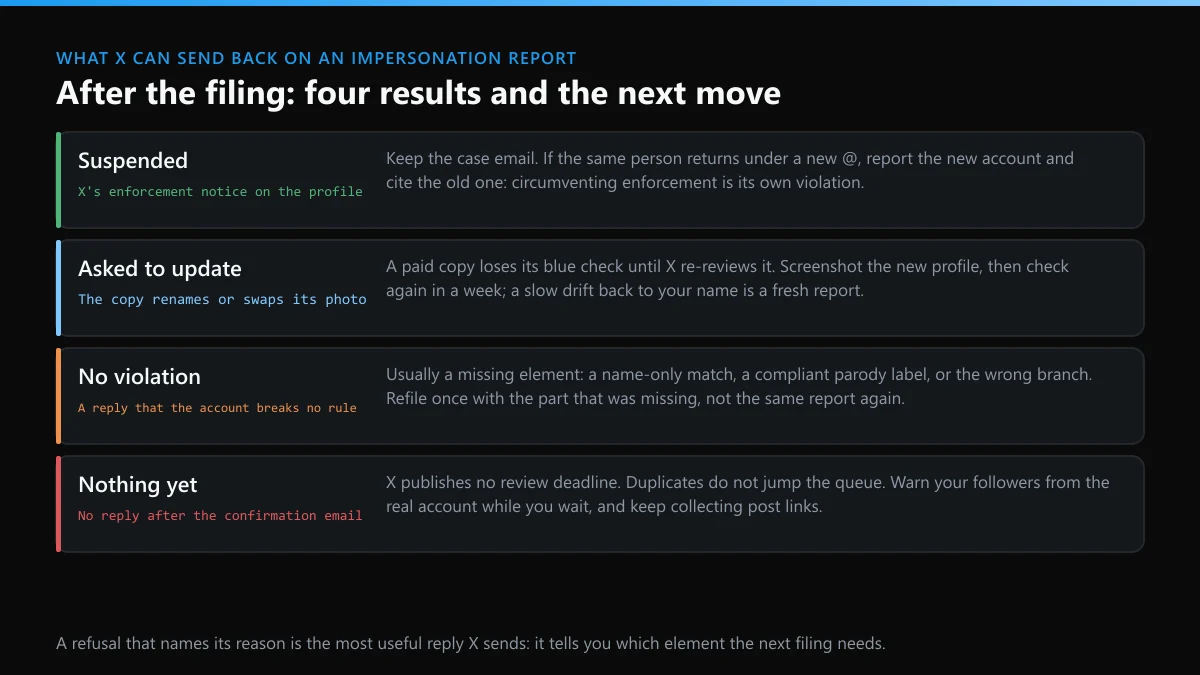
A suspension is the clean result, and the one to document. Keep X's email, screenshot the suspension notice with the date showing, and write the copy's handle down somewhere you will find it again, because impostors come back. X's Authenticity policy lists ban evasion among its inauthentic-account violations, so a new account run by the same person can be reported on that ground as well as for impersonation; name the suspended handle in your note when you do. Do not expect the old username to come to you. X says it generally does not accept individual requests for inactive or suspended usernames, and the individual branches tell anyone after a handle transfer to subscribe to Premium Business, whose Priority Support handles handle inquiries.
A forced update needs watching too. A copy told to change can simply rename itself or swap its photo and stay online, and a paid one loses its blue check while X re-reviews it. If the name drifts back toward yours over the following weeks, that is a fresh violation rather than a closed case, and screenshots taken a week apart are the evidence for it.
"No violation" usually means an element was missing. A copy that shares only your name, with nothing else of yours, is thin; one carrying a compliant parody, commentary or fan label is allowed to exist, and the two tests a parody account has to pass decide which side of that line it sits on. Refile once with the part that was missing, not the same report again. What a report on X can actually remove sets out the ceiling, and reading what your report actually did covers the outcomes X never announces.
Some copies exist to do something besides pretend. If the copy messages your followers asking for money, the scam rule gives X a second ground, and the signals of a scam account are the ones to quote in the note. A copy used to pile on you falls under X's targeted harassment rule as well, and one posting slurs in your name under the hateful conduct policy. Where the person being copied has died or cannot act for themselves, who X will hear from about someone else's account matters before anything is filed. Meanwhile, pin a short post on the real account naming the copy's handle. Followers who see it have a reason to stop answering the copy, and most copies need those answers.
Delete a fake Twitter account from your followers, or one you made yourself
Most people who search delete fake Twitter account are not chasing an impostor. Results for that phrase, and for remove fake Twitter account, are dominated by follower-cleanup tools that strip bot followers out of an account you own, which is a different job with a simpler fix.
X lets you drop any follower without blocking them. On the web, open your followers list or the account's profile, choose the more menu, then "Remove this follower". X's following FAQ says the option works on the web only and does not stop the account following you again if your posts are public, so block the ones that come back. Follower-audit apps can find fakes in bulk, but they need access to your account through X's sign-in; revoke it in your settings when the cleanup is done.
A third meaning is an account you made yourself: an old alt, a parody you ran for a month, a throwaway you forgot. Log in and deactivate it, and it is deleted after 30 days, as deleting a Twitter account permanently sets out step by step. To keep the account but empty it, the cost and limits of deleting all your tweets are the real constraint. Fake Twitter account removal of the impostor kind is the rest of this page, and a search for remove fake X account typed under the platform's new name usually means exactly that.
Is impersonating someone on Twitter a crime?
Sometimes, and mostly when the copy is used to harm or defraud rather than to joke. There is no single rule. Three US states show the range most clearly.
- California, Penal Code § 528.5. Knowingly and without consent "credibly" impersonating a real person online, which expressly includes opening a social-network profile in their name, to harm, intimidate, threaten or defraud. A fine of up to $1,000, up to a year in county jail, or both.
- Texas, Penal Code § 33.07(a). Using another person's name or persona to create a page on a commercial social networking site, or to post messages through one, without consent and with intent to harm, defraud, intimidate or threaten. A third-degree felony.
- New York, Penal Law § 190.25. Criminal impersonation in the second degree covers knowingly impersonating someone by internet website or electronic means to obtain a benefit or to injure or defraud. A class A misdemeanor.
California's version, in force since 1 January 2011, is the one worth reading in full on the state legislature's site. An impersonation is "credible" if someone would reasonably believe the defendant was the person copied, and subsection (e) lets anyone harmed bring a civil claim for damages and an injunction. Elsewhere the conduct is usually charged as whatever the copy did: fraud, harassment, stalking or extortion. England and Wales have no offence aimed at online impersonation as such, so a copy there is pursued under fraud or harassment law, or as a civil claim.
When the copy is taking money from people, report it to the police, and in the US to ReportFraud.ftc.gov as well, then put the reference number in your X note. A crime report does not remove the account; the form does. Suing whoever runs the copy is a slower road, and who you actually sue over an X account explains why X ends up as the witness and why naming the person behind a profile takes a court order. This is general information rather than legal advice, and the answer depends on where you and the impersonator each are.
What does a Twitter impersonation removal service actually file?
The same form you would. Twitter Ban Service has no private channel into X, and no honest Twitter impersonation removal service does; the routes are the three branches above, X's trademark and copyright forms, and the courts.
How outside help works is set by the form itself. A representative filing for one person uploads proof of authority and passes the ID check as themselves, so for personal cases Twitter Ban Service usually prepares the filing for the client to submit: the post links sorted, the 280 characters drafted, any pen-name documents in order. A client's own identity check then takes about five minutes, and the report is theirs. A company can authorise an outside firm to file for it, and the brand branch lists law, marketing and PR firms as the usual examples. What any Twitter account removal service for brand impersonation should tell you up front is that the form takes one reported username at a time, so five copies are five filings, each with its own example links.
Before anything is filed, the account is checked against the rule. A copy that carries a compliant parody label, or shares nothing with you except a common name, gets declined at intake with the reason, because a filing X is bound to refuse only delays the one that could work. X makes the decision on every case; the service prepares, files and follows up, and cannot promise the outcome. Sellers offering report volume instead are selling something else entirely, as the checks on mass-report sellers show. Copies rarely stay on one platform, and an Instagram account takedown runs through a different set of forms.
So file the branch that matches you this week, with post links rather than screenshots alone, and leave the report pile-on out of it. If you would rather hand the evidence work to someone, send both handles and you will hear which branch the case belongs in, or that it belongs in none. Other X cases Twitter Ban Service handles are listed on the solutions page.
Where the facts on this page come from
- X Help Center: impersonation form, all four branches, read signed out on 23 September 2026
- X Help Center: Report impersonation accounts
- X Help Center: Authenticity policy (April 2025)
- X Help Center: About profile labels and checkmarks
- X Help Center: About X Blue Checkmark
- X Help Center: Following FAQ, "Remove this follower"
- CBS News (7 November 2022): Musk says impersonators will be banned
- Fortune (10 November 2022): the paid-checkmark impersonators
- Associated Press via PBS NewsHour (11 November 2022): Twitter Blue unavailable after flood of fake accounts
- CNN (12 December 2022): Twitter relaunches paid blue checks
- California Penal Code § 528.5
- Texas Penal Code § 33.07
- New York Penal Law § 190.25
- FTC (15 June 2026): people reported losing $3.5 billion to imposter scams in 2025
- FTC: Impersonation of Government and Businesses Rule
FAQ
Do I have to upload my ID to report impersonation on X?
Yes, on every form branch as they read on 23 September 2026. The filer photographs a government-issued ID and takes a selfie through Persona, a check X says usually takes about five minutes, and Persona may keep the images for up to 30 days. Bystanders skip it only because their branch has no form.
Can a friend report the Twitter impersonator for me?
Only as a bystander. The "Someone else on X" branch sends onlookers to the report option on the copy's profile, inside the app. That flag can draw X's attention, but the filing that carries identity proof has to come from you, or from a representative holding written authority to act for you.
Will X give me the impostor's username once it is suspended?
Rarely, since X says it generally does not accept individual requests for inactive or suspended usernames; the individual branches send anyone seeking a handle transfer to Premium Business and its Priority Support. A company filing can at least record that it wants the handle, through the form's "Username use" choice.
The fake account has a blue checkmark. Is it harder to remove?
No. The blue check shows a paid Premium subscription, and X says those accounts are not reviewed against the old active, notable and authentic test. It also drops away for a time whenever the copy changes its photo, display name or handle, so it proves nothing about who runs the account.
What if X says the copy breaks no rule and won't take it down?
Read the reason, then refile once with what was missing: post links instead of screenshots, proof of a pen name, or evidence that the copy takes more than your name. If the account carries a compliant parody label, another report will get the same answer, and posts that defame you need a separate route.
How do I report a fake X account pretending to be my company?
Use the "My company, brand, or organization" branch with a company email address. Tick each thing the copy took (the name, an image, the phone number or address, your content), give an example link for each, and sign the perjury declaration. A copy trading on a registered mark without claiming to be you goes to X's trademark policy instead.
What should I tell my followers while the copy is still up?
Pin one post on your real account naming the copy's exact handle and saying you will never ask anyone for money or logins by direct message. Then stop replying to the copy. Its posts belong in your report as links, and every public argument with it hands the copy more reach.