2 October 2026 · Twitter Ban Service · 14 min read
Twitter blackmail and doxxing: X counts the threat, not just the leak
Twitter blackmail is a demand for money, more images or anything else in exchange for not posting someone's private information or intimate media, and X's private information policy names it and bans it, so the threat alone can be reported. Doxxing on Twitter is posting someone's private details, such as a home address or phone number, without consent.
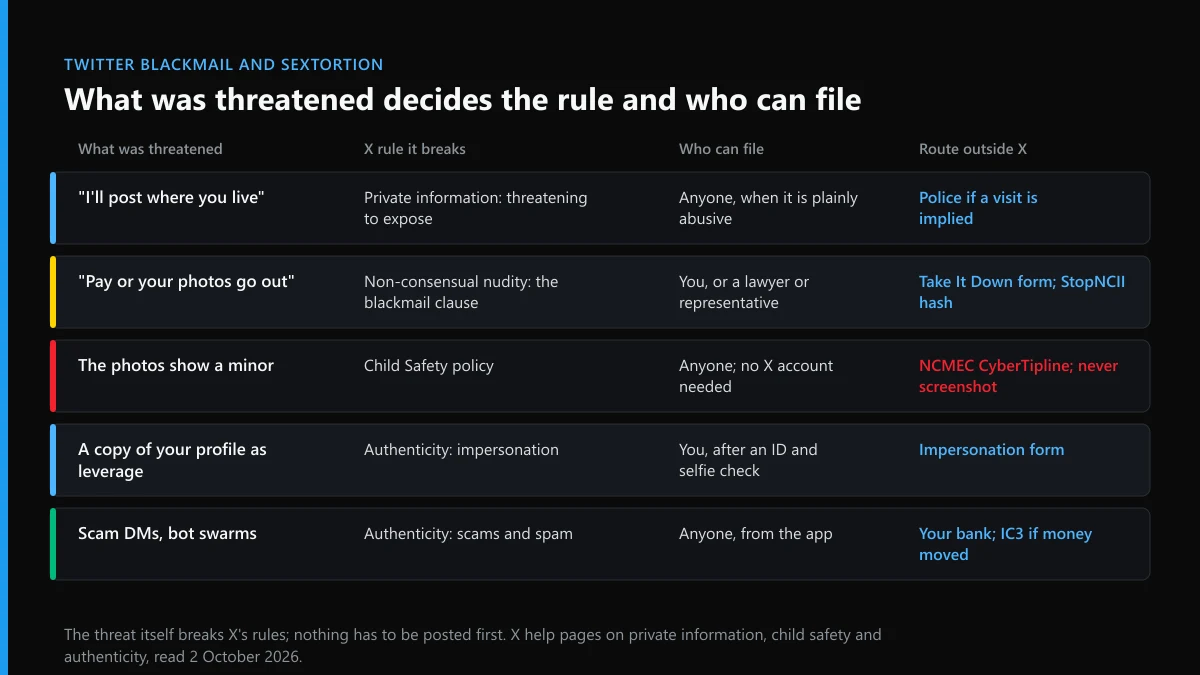
Is "pay me or I post it" against X's rules before anything is posted?
Yes. The overview of X's private information policy, last revised in March 2024, says users may not threaten to expose other people's private information. Further down, the list of banned behaviour includes asking for a reward in exchange for not posting someone's details, which the policy itself labels blackmail. The same pair of rules is repeated in the section on sexual and intimate media.
That changes the timing. Plenty of people wait for the leak, on the assumption that X can only act once something is public. The demand sitting in your DMs is already the breach, and it arrives in a form a reviewer can check: a message, from a named account, with a timestamp. Accounts that blackmail Twitter users tend to run one script against many targets, so an early report can end more than your case.
The policy also says what X can do once it agrees. It can require a post's removal and hold the account in read-only mode for a while, suspend it after repeat violations, and suspend outright any account whose sole purpose is posting other people's private information or media. A burner opened only to extort fits that last description exactly.
Bounties are covered as well. An account offering money for someone's address, or asking its followers to work out who is behind an anonymous profile, breaks the same rule without posting a single detail itself.
What is doxxing on Twitter, by X's own list?
On X, doxxing means sharing someone's private information without their permission, and the policy spells out which details qualify. The list is shorter than most people expect, and the gaps explain many of the "no violation" replies people get.
| Detail shared without consent | Private under X's policy? | The catch |
|---|---|---|
| Home address, GPS coordinates, other private locations | Yes | Can be removed even if the address is public elsewhere, because of the physical risk |
| Non-public phone number, email address or password | Yes | A number you published yourself, on your own site for example, may not count |
| Government ID, social security or national ID number | Yes | Not in regions where X does not treat those numbers as private |
| Bank account or card details | Yes | Posting login details that open someone's accounts is banned too |
| Medical records, biometric data | Yes | Health details rank alongside identity documents |
| The person behind an anonymous account | Yes | A name or a photo that unmasks them counts |
| Name, age or birthday | No | Can still feed a harassment report if it is used to pile on |
| School or employer | No | Same: harassment, not privacy |
| Gossip, rumours, allegations | No | Defamation is a legal question, not a privacy report |
| Screenshots of messages from other apps | No | Unless the screenshot shows a private detail such as a phone number |
Before acting, X weighs four questions: how dangerous the detail is, with location and phone numbers at the top; who posted it and whether they had consent; whether it was already public; and why it was shared. A number posted to help someone stranded by a flood can stay up. The same number posted with abusive intent comes down.
Who files matters as much. When a detail has been posted in a clearly abusive way, anyone can report it. Otherwise X may need to hear from the owner of the information or their lawyer, so if a friend has been doxxed, get them to file too.
The location rule has a history. On 14 December 2022 Twitter banned sharing anyone's live location and suspended @ElonJet, which tracked Elon Musk's private jet from public flight data; reporters who wrote about it were suspended the following day. Today's policy no longer singles out live location, but physical location still sits in its highest-risk tier.
How do people get doxxed on Twitter?
Rarely by hacking. Most doxxing is assembly: small public pieces joined together until one of them carries a legal name or an address. The chain usually has five links.
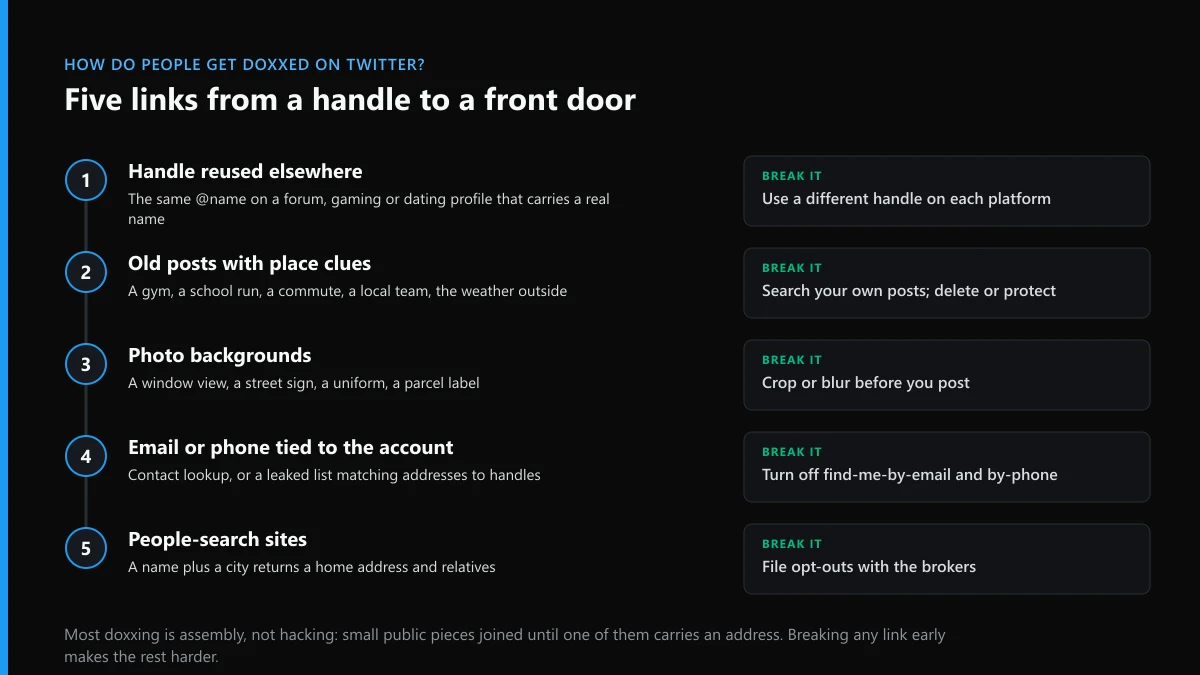
The first is the handle. A username reused on a gaming profile, a dating app or an old forum often sits next to a real name somewhere. The second is your own archive: years of posts about a gym, a school run or a local team narrow a city down to a few streets. Photos finish the job, and people miss a window view or a parcel label far more often than hidden metadata. Twitter stopped letting most posts carry a precise geotag in June 2019, so the giveaway these days is usually visual.
The fourth link is one the platform supplied itself. In August 2022 Twitter confirmed that a bug introduced in June 2021 let anyone holding an email address or phone number find the account tied to it, and a list of 5.4 million matched accounts was put up for sale, as TechCrunch reported at the time. In January 2023 a file of more than 200 million email addresses tied to accounts appeared on a hacking forum, although Twitter said it found no sign the data came from its own systems. Anyone holding lists like these can turn an email into a handle, or a handle into an email.
The fifth link is the people-search industry, where a name and a city return a street address, relatives and old phone numbers.
Breaking one link early beats cleaning up later. Under Privacy and safety, the Discoverability and contacts screen has two switches that let people find you by email or by phone; turn both off. Then search your own posts for place names and either protect the account or prune the archive. Before you wipe years of posts, read what bulk-deleting old tweets costs and where the limits sit, because the free routes stop well short of a full archive.
Twitter sextortion: what changes when the threat is an intimate image?
The rules get stricter and the list of people who can report gets shorter. X bans posting sexual or intimate media without the consent of the person shown, threatening to post it, and demanding payment not to. The policy names images that put someone's face on another person's body, which covers the AI fakes now used as leverage when no real photo exists.
Because X allows consensual adult content, it often needs to hear from the person depicted or their representative before acting. Anyone can report a few patterns, though: posts offering a reward for intimate media, intimate images posted with revenge language or wishes of harm, and images posted alongside the person's contact details.
Most financial sextortion Twitter cases follow one script: a friendly account, a quick move into DMs, an exchange of photos, then a deadline and a screenshot of your followers list. The scale is large. In June 2026 NCMEC said it had received more than 50,000 financial sextortion reports in 2025, about 137 a day, up from more than 36,000 in 2024.
In the US there is now a deadline on the platform's side. The TAKE IT DOWN Act, signed on 19 May 2025, requires platforms to remove a reported intimate image, real or AI-made, within 48 hours of a valid request, and that duty has applied since 19 May 2026, with the FTC enforcing it. When we opened X's safety form on 2 October 2026, the last of its twelve issue options read "I'd like to submit a US Take It Down Act Report."
Two free tools sit outside X. StopNCII.org makes a hash, a digital fingerprint, of an adult's image on their own device, and participating platforms use it to block uploads without the image ever leaving the phone. For anyone under 18, NCMEC's Take It Down service does the same job. If you took the photo yourself you also own its copyright, so a DMCA notice filed against the post runs in parallel, and X's copyright removal process sets out what that notice has to contain.
What if the person in the images is under 18?
Then a different policy applies, and the evidence rule flips. X's child safety policy, dated May 2024, bans trying to obtain sexual images from a child through blackmail and threatening to share sexual images of minors. Anyone can report, with or without an X account, and X says it passes accounts sharing such material to NCMEC.
Do not screenshot, save, forward or reply to the images. X's own policy page warns that engaging with this material can be illegal. Report the account and the conversation, file with NCMEC's CyberTipline, and give the police the handle and the times of the messages rather than copies. The FBI counted more than 13,000 reports of financial sextortion of minors between October 2021 and March 2023, and its write-up of the threat ties at least 14 suicides to it.
What should you do in the first hour after a blackmail DM?
Six steps, in this order. The order is the point: evidence before blocking, reporting before deleting anything.
- Stop replying and do not pay. Payment tells the sender you will pay again. In sextortion cases it usually brings a second, larger demand.
- Capture the evidence before you block. Screenshot the whole thread with the sender's handle visible, copy the profile link and note the date and time. Handles change; the link and the screenshot are what tie the messages to an account later.
- Report the conversation and the account. In the DM, open the info icon and choose Report @username; on the profile, use the three-dot menu. Pick the private information or nudity option rather than generic spam, so the report reaches the right review queue.
- Block, then lock down. Protect your posts for now, switch off find-by-email and find-by-phone, and check which third-party apps still have access to the account.
- Warn the few people who matter. Blackmailers often screenshot your followers list. A short message to family or an employer before a stranger contacts them takes away most of the leverage.
- File outside X the same day. The police or the FBI's IC3 for the extortion, StopNCII or Take It Down for the images, NCMEC for anyone under 18.
One thing to avoid: deleting your own account in a panic. As our guide to deleting an X account for good explains, deactivation starts a 30-day clock, and it takes the conversation that proves the threat with it.
Which report reaches which part of X?
Doxxing and blackmail rarely come as one post. Match each piece to the report that fits it.
A single post with your address. Report the post itself; reporting one tweet, step by step covers the menus. X can make the poster delete it and sit out a read-only spell, but what one report can take down is usually that post, not the account. If you only need the post gone, our post removal work starts there.
An account built to dox or extort. Report it from its profile, adding posts as examples when X asks; reporting an X account from its profile walks through that screen. The policy reserves outright suspension for accounts whose sole purpose is posting other people's private information, which is the case taking down a whole account rests on.
The pile-on that follows. Replies telling strangers to visit or call you are harassment, covered by X's rules on targeted harassment. If the abuse goes after your race, religion or another protected trait, the hateful conduct policy applies on top.
Expect days rather than hours; how long X takes to go from report to ban sets out the published medians. A screen-by-screen view of X's built-in report tool helps you pick the right branch the first time, and if a well-documented report still comes back with no action, what to do when X seems to ignore a report applies here as much as to counterfeits.
Someone impersonating me on Twitter is part of the threat: how do I report it?
Some blackmailers build a copy of your profile with your photo, name and bio, then message your followers from it or post the material there. Under X's authenticity policy of April 2025 that is impersonation, defined by intent to deceive, and it has its own form.
To report Twitter account impersonation of yourself, the form begins with an ID and selfie check run by Persona, which X says usually takes about five minutes. The person being impersonated files, or someone holding written authority for them. A friend who wants to report a fake Twitter account on your behalf gets no form at all, only the Report option on the profile, which still counts as a signal. The impersonation form, branch by branch shows each screen.
Run two reports side by side. Report fake Twitter profiles for impersonation, and report the posts on them for private information or nudity; the second can get the content down while the identity check is still pending. Getting an impersonator's tweets removed covers that second track, and how X treats fake accounts in general covers profiles that copy no one in particular. The form will not hand you a handle, by the way; claiming an inactive X username runs on separate rules.
How to report a scammer on X, and when X stays out of it
Report the account from its profile and choose the scam or spam option, and report scam DMs from inside the conversation. X's authenticity policy bans scam tactics aimed at money, property or private information, and it names relationship and trust-building schemes, money-flipping, fake discounts and phishing. Sextortion often opens exactly like the first of those. The warning signs of a scam account are worth reading before you reply to anyone new.
There is a limit. X says it does not step into financial disputes between users, such as goods that never arrived, refunds or poor quality. Plenty of people who type "twitter report scammer" into a search bar are in exactly that position, and for them the card issuer or payment app is faster than X, which acts only when an account runs a scam pattern rather than one bad sale. Fake recruiters and paid pile-ons fall on the other side of that line; reporting job scams and brigading on X covers both.
How do you report Twitter bots that pile in under your posts?
To report Twitter bots, use the same spam option, one account at a time. Swarms of fresh accounts are common around blackmail, replying under your posts with the threat or the images. On 24 July 2026 Nikita Bier, then X's head of product, said 42,000 accounts automating replies with chatbots had been removed.
What not to do is ask your followers to mass-report. X's authenticity policy counts coordinated or duplicate reports as engagement spam, and they get discounted. That is why a mass-report bot is the wrong answer to a blackmailer, why mass-reporting an account tends to backfire, and why sellers who promise a ban for a fee and so-called Twitter ban tools deserve no money. What actually gets an account banned from X is evidence of a real violation.
Does the same threat follow you onto Instagram or TikTok?
Often. Sextortion crews work across apps: first contact on one, the demand on a second, the threat to post on a third. Reports do not travel between platforms, so each copy has to be reported under that platform's own rules. On Instagram, how an Instagram account actually gets taken down is the route for the account itself. The shortcuts fail there too: mass reports on Instagram and Instagram spam-report bots run into the same anti-abuse rules as on X, and whether mass reporting works on TikTok gets the same answer.
When does Twitter blackmail become a crime?
Usually from the first demand. Threatening exposure to get money is extortion under the law of every US state and in the UK, and the FBI's IC3 logged 54,936 sextortion complaints in 2024 alone. Federal law adds two more tools. The cyberstalking statute, 18 U.S.C. 2261A, covers a course of conduct through an interactive computer service that causes substantial emotional distress. The TAKE IT DOWN Act made it a federal crime to publish intimate images without consent, and to threaten to, when the aim is to coerce or extort. Doxxing alone is harder to prosecute: 18 U.S.C. 119 protects only covered people such as federal officers, jurors and witnesses.
In England and Wales, threatening to share an intimate image has been a criminal offence since 31 January 2024, added to the Sexual Offences Act 2003 by the Online Safety Act. A civil claim is a separate question, and who you would actually sue is the blackmailer rather than X. Only X can remove an account, as who can delete someone else's X account explains, and a court order is what makes it name the person behind one.
What can a reporting service do here, and what can't it?
Be suspicious of anyone who promises more than X allows. We cannot unmask an anonymous blackmailer; X releases account information only to valid legal process. We cannot delete an account or set X's pace. We do not handle images of anyone under 18 at all; those cases go straight to NCMEC and the police.
What Twitter Ban Service can do is the slow, tidy part: sort each message and post into the X rule it breaks, file each one in the right category with the evidence attached, and follow up when a report stalls. The rest of our X reporting guides cover the neighbouring problems. If an account is threatening you now, send us the handle and your screenshots and we will tell you which reports fit before anything is filed.
FAQ
Should I pay someone who is blackmailing me on Twitter?
No. Payment proves you will pay, and in sextortion cases it usually brings a second, larger demand rather than deleted files. Stop replying, keep the evidence, report the account to X and file with the police or the FBI's IC3. If the images show someone under 18, go to NCMEC as well.
Can X remove my home address if it was already public somewhere else?
Often, yes. Most details that were public before they reached X are not treated as private, but the policy makes an exception for home addresses because of the risk of physical harm. Report the post under private information and say why the address puts you at risk.
Is it doxxing on Twitter if someone posts my name and where I work?
Not under X's private information policy. Names, ages, birthdays, schools and employers are on its list of details it does not consider private. If the post is part of a campaign against you, report it as harassment instead, and include the other posts that show the pattern.
Will the blackmailer find out that I reported them?
An ordinary in-app report does not show your name to the account you report. Some formal routes differ: the impersonation form warns that X may pass details to the reported account, though not your contact information. X releases account information about the other side only to valid legal process.
What if the intimate images are fake or made with AI?
They are still covered. X's non-consensual nudity rules include images that put a person's face on someone else's body, and the US TAKE IT DOWN Act covers digital forgeries as well as real images. Report them the same way and say they are fabricated.
Should I delete my X account to make the blackmail stop?
Not while the case is open. Deactivation starts a 30-day clock to deletion, and you lose the conversation that proves the threat. The blackmailer keeps whatever they have either way. Protect your posts and close your DMs to strangers instead, and decide about the account once the reports are filed.