21 October 2026 · Twitter Ban Service · 11 min read
Reported on Twitter: what happens to your account and who can see it
When you are reported on Twitter, X checks the flagged post or account against its rules. If nothing breaks a rule, nothing changes and you hear nothing. If something does, you see a notice naming the rule and the post, never the reporter. X does not tell you who reported you, and a single report is a review request, not a verdict.
What happens if you get reported on Twitter?
A review starts, and that is all a report does by itself. What happens if someone reports you on Twitter depends on what the reviewer finds, not on who sent it or how angry they were. The post or the account is checked against the X Rules. When nothing breaks them, the case closes quietly. You are not told a report existed, and nothing is stored against you that you can see.
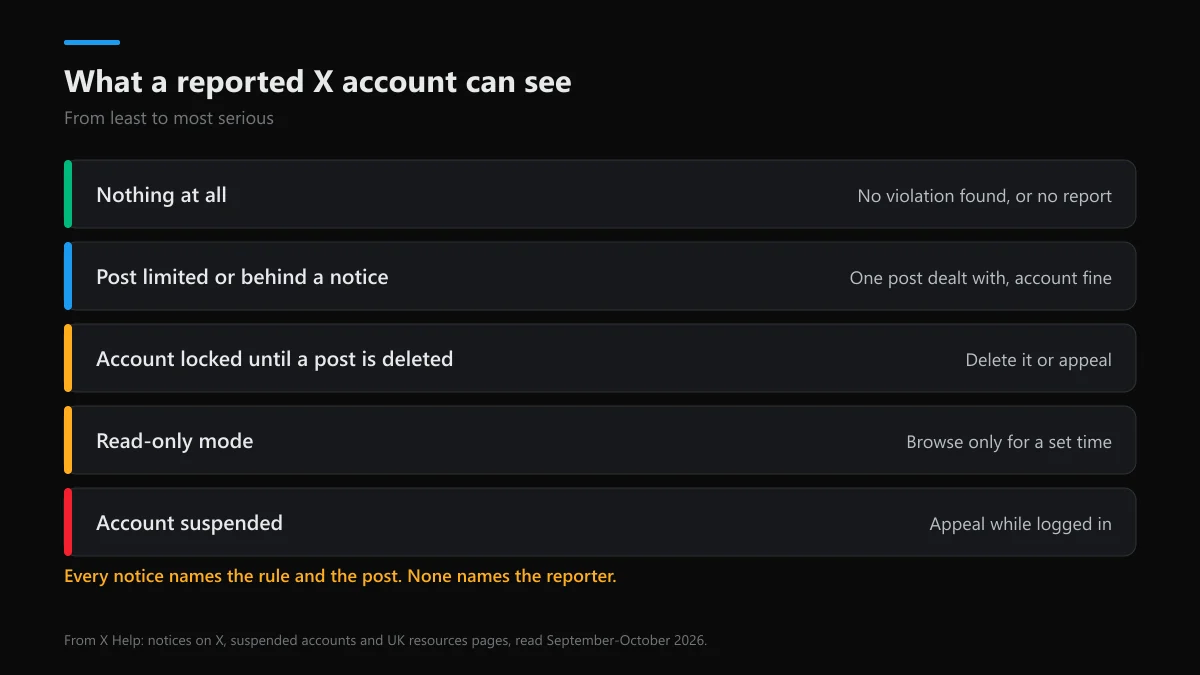
When something does break a rule, X picks from a ladder of actions. Most cases end at the bottom of it: a post hidden or a reply limited. Removal with a lock comes next, then a read-only period, and suspension sits at the top. X's abuse policy reserves suspension for accounts that exist to harass, and its suspended accounts page says most suspensions are for spam or fake accounts, which machines catch with no report at all. So what happens when you get reported on Twitter is usually one of two things: nothing, or a single post dealt with.
What a reported Twitter account actually sees
A twitter account reported for a real violation gets a notice inside the app. There's no email that lists reports, and no strike counter on your profile. This is how to read what shows up, based on X's notices page:
| What you see | What it means | What you can do |
|---|---|---|
| Nothing at all | No report, or the report found no violation | Nothing; you'll never know either way |
| A post shows a notice or reduced reach | That one post was limited, the account is fine | Edit nothing; you can still appeal from the notice |
| "Your account is locked" with a post to delete | A post broke a rule and must go before you can use X | Delete it, or appeal; the lock stays until one of the two |
| Read-only mode | You can browse but not post, like or repost for a set time | Wait it out; DMs go to followers only |
| Asked to change your name or photo | An impersonation or fake persona report held up | Change the profile, or show you're the real person |
| "Your account is suspended" | Severe or repeated violations, or spam | Appeal while logged in to that account |
The notice names "which policy or policies" and which content were involved. That's the only information about a report X gives the person who was reported. X also notes on its reporting page that the action you see "may or may not be related" to any one report, because its own systems act on far more accounts than users do.
Can you see who reported you on Twitter?
No. X never shows the reported person who filed the report: not in the notice, not in the appeal, and not in the data download. Its UK resources page puts it plainly: "X does not disclose information about the person who submitted the complaint." Does Twitter say who reported you, or does Twitter show who reported you anywhere else in the app? No, and the same answer covers whether Twitter users can see who reported them.
There are two narrow exceptions. A copyright complaint is a legal notice, and a copy of it, often with the claimant's name, is passed to the person whose post was removed. A court order can also make X hand over account data. Neither one is an ordinary report. The DMCA logic works much the same on Instagram, where the rules on who can file a DMCA takedown decide whose name appears, and a trademark complaint follows the steps in trademark report eligibility on Instagram and X.
How to find out who reported you on Twitter, and why you can't
People ask how to find out who reported you on Twitter because a lock feels personal. But you can't find out who reported you on Twitter from X, and the clues people rely on are weak. Timing is the usual guess: a fight in the replies, then a notice an hour later. Yet X's median handling time for most EU notices was two to three hours in its DSA transparency report for April to June 2025, and automated systems lock accounts every minute with no report behind them.
Can someone see who reported them on Twitter by asking support? No; support answers about the rule, not the reporter. Guessing has a cost too. Calling out the person you suspect, or reporting them back in revenge, can turn into targeted harassment or report misuse on your side of the ledger. Block or mute them and keep the record instead.
If you report someone on Twitter, do they know it was you?
If you report someone on Twitter, will they know? They can learn that a post was actioned, because they get the notice. They won't learn that you sent the report. So if you report someone on Twitter, do they know your name? No, and when you report someone on Twitter, do they know how many people reported? Also no. Does Twitter tell someone if you report them? It tells them a rule was broken, and leaves the reporter out.
On your side, X's report flow replaces the reported post with a short note on your screen only, and sends a confirmation in your notifications. If I report someone on Twitter, will they know from that note? No; it's visible to the reporter alone. The only way they connect it to you is if you were the only person in the conversation, which is a risk to weigh, not something X reveals.
Is reporting on Twitter anonymous?
Yes, toward the person you report, and no, toward X. Is Twitter reporting anonymous in the sense that X can't tell who you are? No: reports are filed from a signed-in account, and X keeps that link. Are reports on Twitter anonymous to the other user? Yes. Is reporting someone on Twitter anonymous even in a heated thread? It is, though, as above, context can give you away.
EU law backs the same line. The Digital Services Act, Article 17, makes a platform tell the affected user whether a decision followed a notice, and lets it name the notifier only "where strictly necessary". That is why copyright claims are the exception and abuse reports are not. If you report a Twitter account, is it anonymous? Yes. If you report an account on Twitter, is it anonymous in the EU too? Same answer. If I report an account on Twitter, is it anonymous when the account is a scammer? Yes, the reason for the report doesn't change that.
Other apps draw the line the same way. What happens when you report someone on WhatsApp differs only because WhatsApp also gets the last few messages. Reporting someone on TikTok and on X and reporting someone on Snapchat and X both keep the reporter hidden too.
How often does a reported Twitter account get suspended?
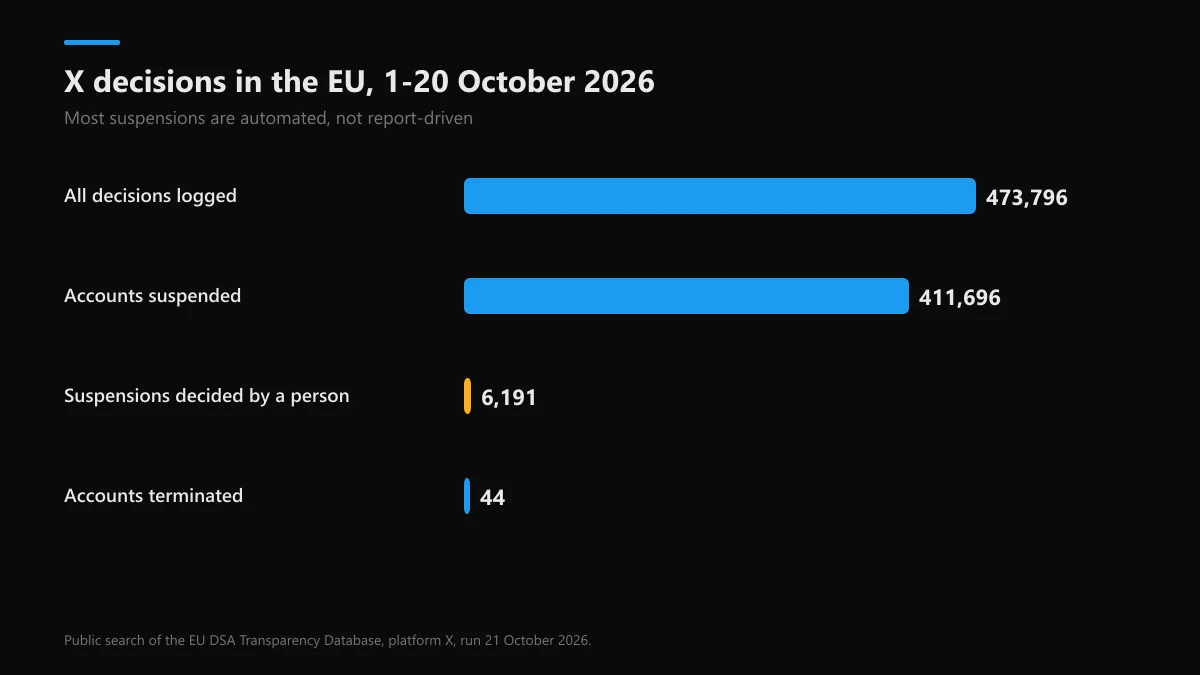
Rarely because of a report alone. We searched the EU DSA Transparency Database on 21 October 2026 for every decision X logged between 1 and 20 October:
| X, EU, 1–20 Oct 2026 | Decisions | Share |
|---|---|---|
| All statements of reasons | 473,796 | 100% |
| Account suspended | 411,696 | 86.9% |
| Account terminated | 44 | 0.01% |
| Made without automation (any type) | 15,250 | 3.2% |
| Suspensions made without automation | 6,191 | 1.5% of suspensions |
Almost every suspension in that window was automated, which fits what X's own report says. In April to June 2025 it suspended 27,834,297 accounts in the EU, and only 104,301 of those came from a user report. The same report shows 178,028 illegal-content notices, with 55% closed as no violation. A reported twitter account that hasn't broken a rule mostly just stays up.
What counts as a Twitter false report?
A twitter false report is one that points at content breaking no rule. Most are honest mistakes, and they cost the reported person nothing: the post stays up. Twitter false reports become a problem when they're organised. X's Authenticity policy lists filing false or duplicate reports "in large numbers", and coordinating others to do it, as platform manipulation. Good-faith reports are named as allowed.
The DSA adds a backstop. Article 23 lets a platform suspend people who often send manifestly unfounded notices, after a warning. X's 2025 report listed zero such actions, so in practice the protection is the review itself: a wave of reports against a clean account produces a wave of "no violation" outcomes. When we ran the October search, only 6,191 of X's 411,696 EU suspensions had been decided by a person, so a twitter reported flood with nothing real underneath has very little to land on.
Twitter report anonymous rules still hold for the people who file false ones: X won't tell you who they were, even when the reports are wrong. If you report someone on Twitter, is it anonymous when your report turns out to be mistaken? Yes, and if I report someone on Twitter, is it anonymous when the post stays up? Also yes; an honest mistake carries no penalty.
The "your account was reported" scam
A twitter false report scam doesn't come from X at all. A DM, a reply or an email says your account has been reported for copyright or impersonation and will be suspended in 24 hours unless you "verify" through a link. The link opens a fake appeal page that asks for your password, a login code or a crypto payment. Facebook pages get the same trick, which how to report a Facebook scammer walks through.
- Real X enforcement appears inside the app on your own account, not in a DM from a stranger.
- X doesn't ask for your password or one-time code in a message.
- Check by opening X yourself; if no notice is waiting, the message is the scam.
- Report the sender's account, and if it uses a brand's name, the steps in Twitter impersonation removal apply.
If you already typed your password into one of these pages, change it, turn on two-factor login and sign out other sessions. If you're already locked out, the Twitter account recovery routes cover each lost-access case.
How to respond after you've been reported on Twitter
Start with the notice, because it tells you the rule. If you agree the post broke it, delete it; the lock lifts and the case usually ends there. If you don't, appeal from the same screen and explain why the post fits the rules, in a sentence or two. For a full suspension, appeal while logged in to that account; suspended Twitter account recovery has the form and what to say.
Don't open a second account to keep posting. X treats that as ban evasion, and it can turn a temporary limit into a permanent one. Don't deactivate in protest either: a suspended account has to appeal before it can deactivate, and if you delete a healthy one, recovering a deleted Twitter account after 30 days explains why the clock matters.
What happens to your handle if the account goes?
A suspended handle isn't released to anyone else, which is why people searching for it see a name they can't take; why a Twitter username is unavailable explains each version of that message. Whether Twitter deletes inactive accounts is a separate question with its own rules. Anyone offering your old handle back for money is selling something X forbids, as the Twitter usernames for sale page shows, and the legitimate route is claiming a Twitter handle through X's own processes.
Reported on other apps at the same time?
Disputes rarely stay on one site. If the same person also reports you, or posts about you, elsewhere, each platform has its own review. YouTube has its channel report and Report history, a harassment policy set against X's and a separate form for a YouTube ad; you can also block someone on YouTube and on X. TikTok copyright cases follow the TikTok copyright form. On Snapchat, reporting a Snapchat account is the account-level route, and WhatsApp has its own steps for reporting a WhatsApp number. Facebook splits it further: abuse reports, impersonation reports, post and Page reports and, for whole accounts, taking down a Facebook account. If you're the one doing the reporting on X, our guide to reporting an X account covers that side.
FAQ
What happens if someone reports you on Twitter?
A reviewer or an automated system checks the reported post or account against the X Rules. If nothing breaks a rule, nothing happens and you are never told. If something does, you may see the post hidden behind a notice, a lock until you delete it, a read-only period or, for serious or repeated cases, a suspension.
Does Twitter tell you who reported you?
No. X's notices name the rule and the post, never the person who reported it, and X's UK help page says it does not disclose information about the person who submitted the complaint. A copyright notice is the main exception, because a copy of it with the claimant's details can reach you.
Can you find out who reported you on Twitter?
Not through X. There is no report log for the reported account, and a notice can arrive from X's own systems with no report behind it at all. Guessing from timing is unreliable, and going after the person you suspect can break the abuse rules yourself.
If you report someone on Twitter, do they know?
They can find out that something of theirs was actioned, but not that you were the one who reported it. You see the post you reported replaced with a note on your own screen. They don't get your name, your handle or a count of reports.
Are Twitter reports anonymous?
To the reported person, yes. X itself knows which account filed the report, and it can be required to hand data over through valid legal process. Inside the EU, the Digital Services Act only lets a platform name the person who sent a notice when that is strictly necessary, which mostly means intellectual property claims.
What happens with a Twitter false report?
A report that points at nothing against the rules leaves the post up. Filing false or duplicate reports in large numbers, or getting others to do it, is itself banned under X's Authenticity policy, and the EU rules let X suspend people who keep sending manifestly unfounded notices.
Is a 'your account has been reported' message from X real?
Usually not, if it arrives as a DM, a reply or an email with a link to an appeal form that asks for your password or a code. Real enforcement shows up inside the X app on your own account, and you check its status there by logging in directly, not through a link.